Home cooking: Week 5
Still following a home cooked diet. About 20% of the time anyway, as I still mix in a bit of Stella & Chewy’s or Primal freeze-dried food from time to time. I have bags of these foods bought a month ago, that would otherwise go to waste.
7 days of food… I store these in the freezer and thaw a new container each day.

Freshly cooked dinners.

It takes only about 1-2 hours per week and it is so much cheaper! 25lb active dog: 3lbs of ground meat, 2 lbs of veggies, and supplements. Under $30 a week. Amazing.
Is the food making a difference to Boogie’s skin condition? It’s really hard to tell. He is still itchy and has those flaky bits and blistery bumps. But I *think* his fur is growing back a bit more. And he LOVES this new diet.
I have a couple of questions about using a dehydrator to make meaty dog treats (like Bravo treats):
- If I want to dehydrate pieces of chicken, beef, or liver, do I have to cook the meat first before dehydrating?
- What if the meat is frozen? Does it need to be thawed out first? Or can it go straight into the dehydrator?
Pawalla mini box!
He’s a lucky Boogie. You may remember that about a year ago, Boogie was sent a Pawalla box for review. See the blog post here.
Pawalla now offers a mini box and it contains just a handful of doggie products… definitely less overwhelming 🙂 Again, these are products that are new to me; I have never heard of them before, and they all look and sound pretty cool. Here’s what we got:

- Wild Salmon treats <– Boogie loves these! Nice that they are grain-free.
- Grain-free Baked Duck treats made with potato and tapioca flours.
- Wigzi (treat-stuffing) ball
- Gerard Larriett “Balancing Rose” Aromatherapy Freshening and Shining Spray <– this is the only item we are not keen on. I would never spray Boogie with fragrance anyway, and he hates being sprayed. The only stuff I am applying on his sensitive dry skin are raw coconut oil and/or Virbac Resicort skin lotion (which unfortunately, has a fragrance).

“Another salmon treat, please”.
I checked out the website. It costs $12 per month to have a mini box of surprises shipped to you, and “Limited offer available only for the first 200 subscribers.”
Cooking for the Boogs
I am still reading Monica Segal’s K-9 Kitchen. Most of the information about understanding nutritional values of food items, calculating allowances by the dog’s weight, and preparing custom spreadsheets has gone way over my head. I will need to return to earlier chapters and figure out these nitty gritties. There is also a chapter on how to read a blood panel and what all the values mean but my brain cannot cope right now after having just spent the past two days on taxes & assorted spreadsheets…
I want to cook for Boogie again. I used to feed Boogie a mix of homecooked and The Honest Kitchen but it was a lot of work so I switched to 100% freeze dried/dehydrated raw and add fish oil, probiotic and kelp supplements. I want to see if an expert-formulated homecooked diet makes any difference to Boogie’s energy level and skin condition (which is still not good… his coat is thinning).
There is a chapter of raw, cooked and combo recipes in the K-9 Kitchen Book and tonight, I made a big pot of food for a 25lb active dog.

I may have made a mistake with the quantities. I later read that the ounces of veggies and meats in the recipe are for COOKED portions. I had weighed raw ingredients and cooked them all together. Oops. Next week we will do better. Boogie has not eaten grains in ages, but he used to do ok on oats (The Honest Kitchen: Keen) so we’ll see. The only complicated part was having to handle beef liver – which I had never touched before – and this was pretty gross. Slimy and bloody… worse than chicken liver, and it is stinky when cooked. I also hoped I used the correct amount of Calcium supplement… I stirred in some capsules as I don’t yet have the powdered version.
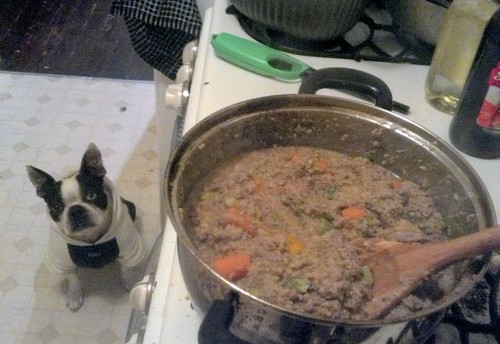
Look at Boogie. He wanted his big pot of dinner NOW. When the food was stored away in the fridge, he refused to leave the kitchen. In between games of fetch, Boogie kept running to the kitchen hoping that I would follow him and get the message. Each time I got up from my desk or couch, Boogie would dash to the kitchen and drop his ball at the door… “Please can I have some of that stinky meat sludge? Please?”
Classical Conditioning (notes from Clicker Expo)
There were some big lightbulb moments for me at the recent clicker expo, and these were related to the topic of Classical Conditioning.
Generally, the term “conditioning” can be a bit misleading because it tends to conjure up images (for me, anyway) from The Clockwork Orange or The Manchurian Candidate and suggests loss of free will, as if we are turning our dogs into robots. Technically speaking, the term “conditioning” simply means learning, and Classical and Operant Conditioning refer to the ways all living beings LEARN.
According to Dr. Susan Friedman, Classical & Operant Learning are always working together in real life. They always overlap. We artificially separate the concepts for teaching.
In Kathy Sdao‘s seminar on “Classical Counterconditioning for Agression” she draws out the differences between Operant and Classical Conditioning:
Operant Conditioning/Learning happens in the realm of observable behaviors that we can mark and reward. These behaviors are freely chosen by the animal in order to earn reinforcement or escape punishment. Clicker training is Operant Learning. Golden rule: Behavior is driven by Consequences.

I did this drawing after my last Clicker Expo
Classical Conditioning/Learning on the other hand, is in the realm of reflexive or respondent behaviors – all the hardwired emotional, subconscious stuff that an animal has no choice over. These reflexive behaviors (eg, Flight or Fight) are learned through repetitive association and tied up with survival in some way. You pair something neutral with something that elicits “excitement” often enough, and the neutral stimulus will trigger off excited feelings. You repeatedly pair something neutral with something scary and the neutral thing will trigger fearful emotions. Antecedents lead to Behavior.
“Classical Conditioning is a powerful foundation for Operant Conditioning. Classical Conditioning will not get new behavior. It will put existing behavior under different antecedents.” – Kathy Sdao.


At Clicker Expo, in different presentations, this memo came up several times: We can’t start clicker training an animal who is fearful or anxious.
Classical Counter Conditioning is the first thing that should happen in order to calm the limbic brain, before the animal is able to “behave”. In the case of triggers that elicit fear responses, we pair these with very good things. This memo came up in Julie Shaw’s and Debbie Martin’s “Behavior Modification Clinic” Lab and also in Sarah Owing’s presentation about helping “WallFlower Dogs”.

Note: This example is based on real life. Whenever Boogie hears a “ding!” bell, he runs to the window and barks. Even if the “ding” is coming from the kitchen, the TV or if I accidentally touch a glass with a spoon. Maybe in his previous home, this “ding!” sound was the doorbell.
Here’s a much more detailed illustration on Counter Conditioing that I did for the Ahimsa Dog Training Manual:

Kathy Sdao talked about the ways in which Counter Conditioning can be ineffective due to these common mistakes:
- Weak Unconditional Stimulus. (the toy or treat is not valuable enough; the love of this is not stronger than the fear of the trigger)
- Trainer’s hand is in the treat bag and the dog is too focused on this
- Rhythmic trials. The ” trigger + treat” event happens at regular intervals to become predictable.
- Inadvertant Avoidance Conditioning. eg, if we keep treating before the dog sees the trigger, we might accidentally condition the food to become a “warning signal”
- We present the treat without the trigger (eg, dog gets the high value treat anyway, when nothing happens) – treat loses value
- Contingency issue. If we forget to treat when trigger appears
- NOT following up with Operant Conditioning.
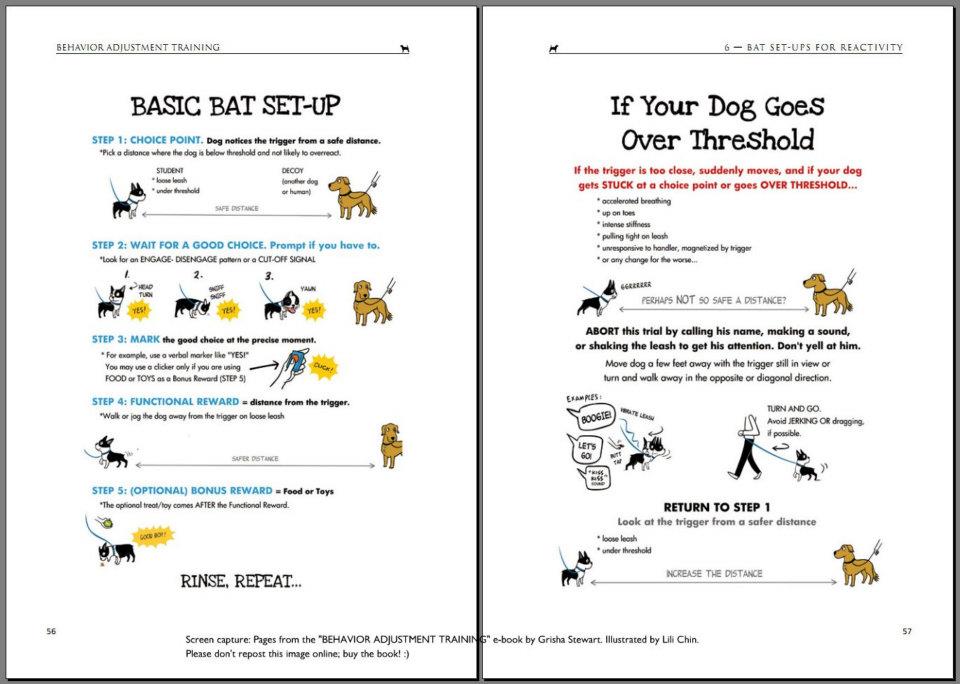
Classical Conditioning is also not considered practical in the real world or in the long term because it is too easy to not do it correctly 100% of the time for it to be effective. This is why we need to follow up with Operant Conditioning of replacement behaviors, which made me think instantly of BAT…
Another example of Classical Conditioning was in Ken Ramirez‘s Lab on creating value in “Non-Food Reinforcers”. He shared a story about a whale (or dolphin?) that wasn’t feeling well and wouldn’t eat and they needed him to take his antibiotics. As they were unable to reward with food, they used “reinforcement substitutes” like belly-tickling, clapping hands, praise etc. and these were just as reinforcing to the whale because they had been previously paired with food over a long time.
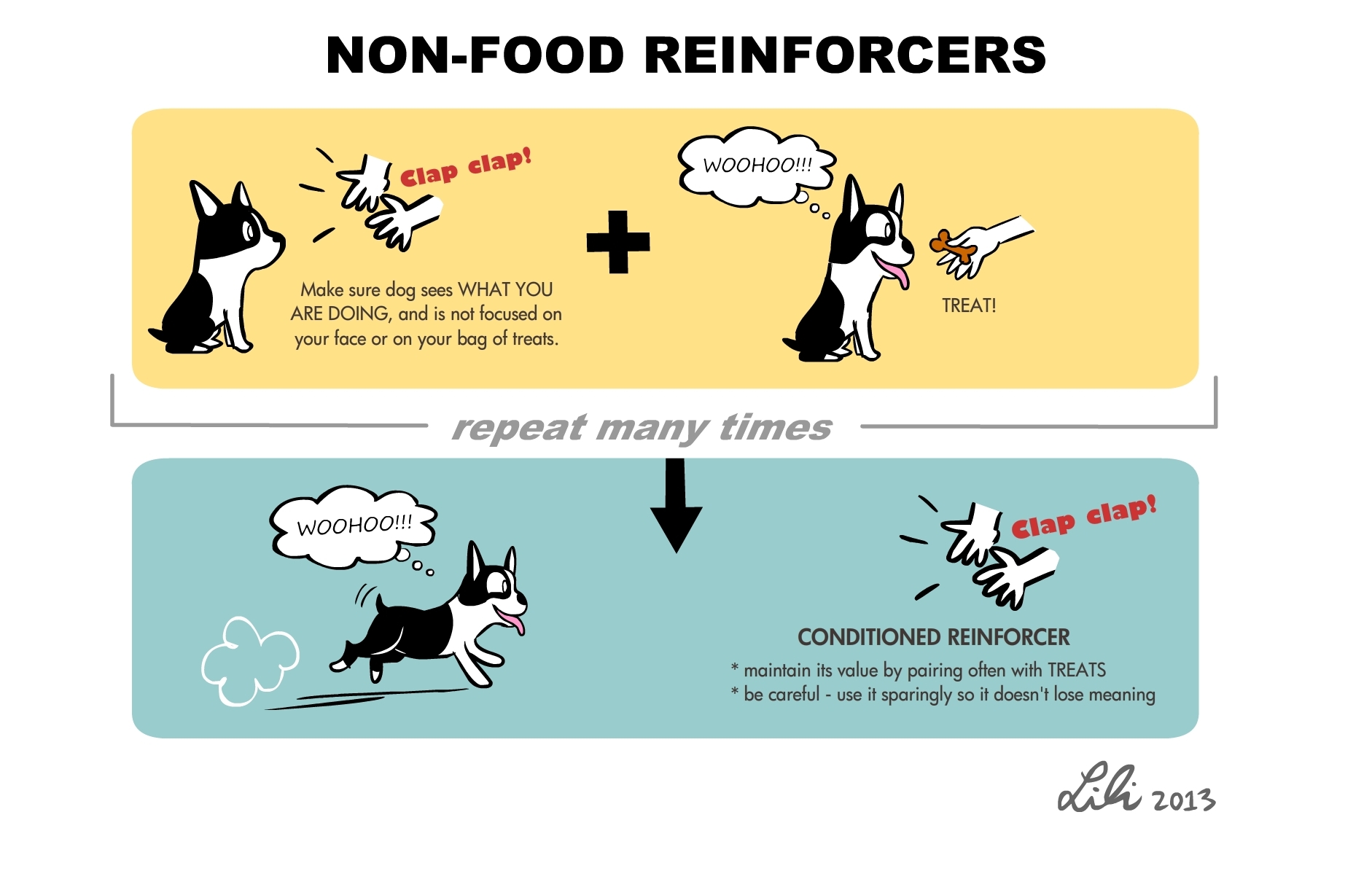
Similarly, we can train any novel stimulus – a toy or a human action (eg, clapping hands, thumbs up, “Good Boy!” etc) to be reinforcing if we pair this often enough with Primary Reinforcers (food, social interaction, play) during training. This pairing has to be maintained so that the non-food reinforcer stays emotionally meaningful to the animal.

“Charging a clicker” . Click = treat (anticipation, joy)
Some Ken Ramirez quotes:
“Yes, this is exactly like charging a clicker”
“A toy is not intrinsically reinforcing. It is reinforcing because it is paired with the Primary Reinforcer of PLAY”.
He also talked about learning how exactly your dog likes to play with a toy. Every dog is different. Example with tennis balls: Some dogs prefer chasing and fetching; some like to chew, or roll the ball around; some dogs like to peel the skin off. (Boogie is all of the above) Similarly with “touch” as a reinforcer. Each individual animal likes to be touched a certain way and only by certain people that he/she already has a relationship with.
“Value disappears from a conditioned reinforcer if you don’t know how to maintain it”
Susan Friedman in her closing speech at Clicker Expo also brought up the classical conditioning aspect of clicker training. A clicker is also a conditioned reinforcer… we infuse it with emotional value and meaning because it gets paired with food. The click not only marks behavior, it also elicits respondent behavior/happy emotions (“woohoo! I got it right!”) Not only do we have to be precise with our clicking, we also have to ALWAYS back up every click with a treat to ensure that this powerful training technology is effective.
She showed video examples of trainers not using a clicker correctly… eg, trainers who click several times before giving a treat OR trainers with animals who are responding to other signals and are not getting what the click means and are focusing on the food instead… and as a result, the animals don’t perform as requested or they get frustrated and walk away, or get cranky.
Susan Friedman: “If you click, dammit, TREAT!”
If you were at Clicker Expo and if I have misinterpreted any of the information in this blog post, please feel free to let me know! 🙂
Next blog post: When animals make mistakes – dealing with these in the least intrusive way.
Home from Clicker Expo
After three full days of Clicker Expo, a total of 14 seminars, half a notebook full of notes and scribbles, my brain is so full I don’t even know how to start writing about this experience. I may need a couple of weeks to process and streamline everything!
I attended my first Clicker Expo 2 years ago (you can read about it here and here) and this time I went all out and registered for the full event. I wanted to learn new things, be inspired, meet up with my clients, make new contacts, listen to expert trainers like Ken Ramirez and Kathy Sdao, meet Dr. Susan Friedman in person (she ordered multiple copies of my poster!) and sit in on Sarah‘s and Irith‘s shorts presentations, which were really great. I must say that even though I was in the 2% of attendees who don’t work professionally with animals – I didn’t at all feel overwhelmed or lost.
Clicker Expo was everything I hoped for, including the joy of seeing doggy “down-stay” butts every time I visited the hotel’s ladies’ restroom.

photo by Cindy Bennet Martin
I could write a day-by-day review and this would turn into an epic 3 or 4 part blog post but for now, let me direct you to this Flickr Set where I have posted some photos and quick notes.
Some topics that I want to think/write more about and do illustrations for….
- Anthropomorphism & Mechanomorphism (Karen Pryor)
- Classical Conditioning in relation to Clicker Training (Kathy Sdao, Susan Friedman)
- Dealing with Unwanted Behavior in the Least Intrusive Way (Ken Ramirez)
- TAGTeach – Clicker Training for human beings (Theresa McKeon, Irith Bloom)
I enjoyed every single talk and Learning Lab at Clicker Expo but the highlight for me personally was Kay Laurence’s “Targeting” Lab on the final day, which was amazing to watch. I am so in awe of Kay Laurence’s skills, her sensitivity to the dog, and her way of articulating reasons for every little training choice that she makes. There’s something about seeing a LIVE training session that can’t be beat by watching a YouTube video or DVD.
And after those three intense days of learning and meeting people, it was so good to be back home with Boogie, who is a refreshing change from all the “well-behaved” dogs at Clicker Expo…

Boogie in his new tiny teacup doggie bed.

Boogie unstuffs his new bed.
In other news, I have started reading Monica Segal’s K9 Kitchen: Your Dog’s Diet. The Truth Behind The Hype. It is a fascinating read but I am now even more aware of how much conflicting info there is about dog nutrition floating around… for instance, the “grain-free, potato-free” diet that is said to prevent yeast infections. See this earlier blog post.
According to Monica Segal, cutting carbs out of a dog’s diet won’t make any difference to yeast growth.
“A very popular myth circulating on the Internet claims that yeast feeds on carbohydrates…. There isn’t a direct link between carbohydrates or sweet vegetables and yeast. The focus should be on eliminating the food culprit whatever it may be” (usually proteins or grains or supplements)
She also adds that grains can be a GOOD THING for some dogs (better coat)… so long as they are thoroughly cooked to be digestible. I am particularly interested in the chapter on recipes and on how to prepare a home cooked diet that has the correct balance of nutrients…
More later…
National Train Your Dog Month – My dog book reading List
Will I ever get through this list?
1. The Science of Consequences by Susan M. Schneider. I am about 30% of the way through this book and enjoying it so far. It’s like seeing the world with new eyes through the filter of Behavioral Science (Operant Conditioning) and how this philosophical approach applies to genetics, evolution, behavior modification in humans and all animals large and small, etc. I am very chuffed that Susan Schneider wrote a blog post about my Animal Training poster.
2. The Misunderstood Dog by Jordan Rothman (my illustrations are in this book!) There’s a sale going on this month! So far I have skimmed through the first few chapters and can’t wait to read through it properly. I promise I will post a blog review. The Misunderstood Dog is like an easier-to-read, friendlier, jargon-free version of Jean Donaldson’s “The Culture Clash”, and it is written for dog owners rather than dog training professionals.
3. 25 Dog and Puppy Training Tips e-book by Emily Larlham. I am a big Emily Larlham/Kikopup fan. I can’t wait to read this. *Does anyone know of a good program that can convert PDFs to Kindle Format without messing up all the photos? The e-book is a large PDF file with lots of photos that got lost when I emailed it to my Kindle.
4. Decoys and Aggression by Stephen Mackenzie. This book was recommended to me on a dog training forum. I believe this is a book on teaching police dogs to PERFORM AGGRESSIVE BEHAVIORS (in a humane way) and therefore has some very insightful offerings on how to read and shape dog body language . Also liking this video by Steve White, another police dog trainer whose DVDs I would love to watch but cannot afford.
5. K9 Kitchen: The Truth Behind The Hype by Monica Segal. Not a training-related book but one about nutrition. I think I will start cooking for Boogie again soon. *Does anyone have good tips on using a Dehydrator to make pet treats? eg. do you cook the meat first before dehydrating it?
6. Understanding Cat Behavior by Roger Tabor. Not a dog book. I ordered this because I need a cat book for drawing reference, one with lots of photos showing various body language poses and expressions. Unfortunately, some of this information might be very outdated. Just take a look at this little blurb on dog training –
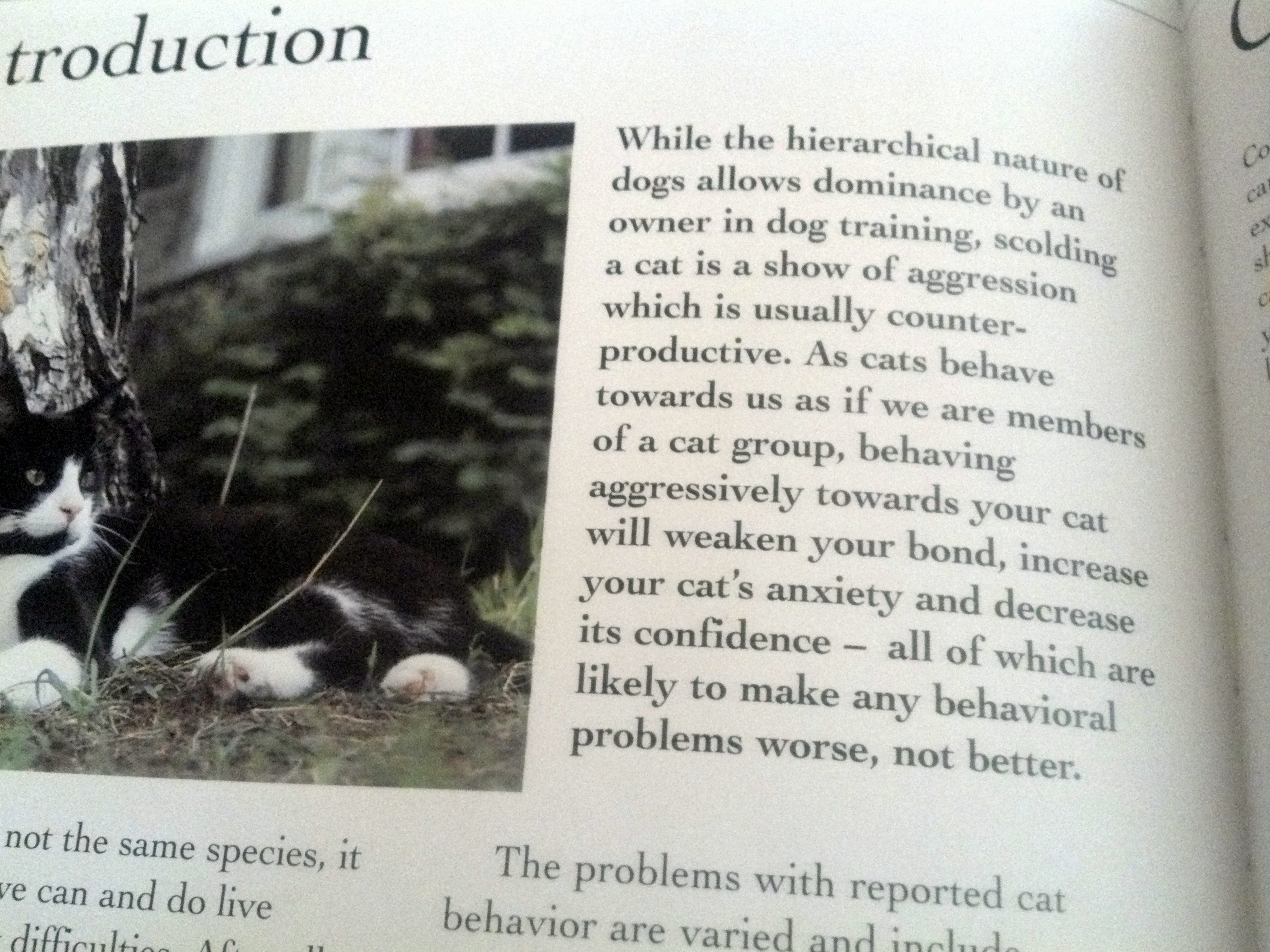
So it’s not OK to boss around and scold a cat because it will damage your bond and mess up your cat, but it’s OK to do this with dogs? While it’s great that nowadays many dog-lovers are promoting and teaching the world about modern force-free HUMANE dog training methods, I wonder if this info is also getting through to the non dog people…. And btw, are there any CURRENT books on Cat body language/behavior/training?
Seeing that it’s National Dog Training Month, I am learning to use a MannersMinder!
To be honest, it looked a little intimidating until I watched the instructional DVD which goes into a lot of detail about training games, the correct order in which the games should be taught, and how to work the machine settings. It’s quite loud too. When you press the remote control (to dispense the treat), there is a loud BEEP followed by a loud whirring sound before the treat plops out.

Ah… my scaredy Boogie dog. As soon as I put the MannersMinder down on the floor, I could tell that Boogie was scared of it. It wasn’t even turned on! I put a treat in the bowl; Boogie looked at it and backed off. He would not go near the machine. He went to his bed, instead. After some coaxing, Boogie ate the treat out of the bowl and then everything was fine after that. He learned very quickly how to make the “BEEP and TREAT” happen. So far I have been training “Eye contact”. Tomorrow we do “targeting”. Now I need to find some treats that are of consistent size so that they don’t get stuck…
This is going to be an adventure! 🙂
Happy Holidays!

Apologies for the long silences between posts and thank you to everyone who has left comments (advice, tips, personal stories etc) on this blog, particularly with regards to Boogie’s skin issues. I have been out-of-town; now I am happy to be back home and snuggling with the Boogs again. He is less itchy now that the weather has cooled down. His coat is still very thin with the same bald patches, and his poor skin has been dry, flaky, and dandruffy.
I am trying a few new things:
- No chicken in his diet at all. He has been eating lamb and/or fish-based meals. It has only been 1 week… I can’t tell if there is any difference.
- Adding Pet Kelp to his food. 3 weeks, now. Can’t tell if this is making any difference with his skin, but his poop is looking very good!
- Virgin Coconut Oil massage, every other day <– THIS is making a difference! Skin is noticeably less dry.
- New Year Resolution: Make pet treats with the new dehydrator (which is still in its box)
I am determined to do anything to avoid more vet visits & antibiotics! In fact, I took advantage of Monica Segal‘s recent Black Friday Sale and ordered a dietary consultation for Boogie in the new year. I need help figuring out what foods (if any) that Boogie’s system may not be tolerant of.
Meanwhile…
 Check out Jordan Rothman’s new book The Misunderstood Dog, with my illustrations. I would describe it as a simpler, easier-to-read version of “The Culture Clash”, written for dog owners. The Boston on the cover is the author’s dog. Here is the Amazon.com page.

Order a snazzy little name tag that I designed for blanketID. A percentage of sales goes to Boston Buddies rescue. I think this would make an awesome Xmas gift. They come in red or blue, and small or large sizes. The photos that I have of Boogie wearing this blanketID tag on his collar are kinda blurry…. Will try again later. ORDER HERE
Who is going to Clicker Expo in San Francisco next month? I would love to meet up! I know names but not faces, so if you recognize me, please say hi! I will be there for the full three days. First time that I am staying for the whole expo and very excited!
HAPPY HOLIDAYS! – Lili & Boogie x
What Is My Dog’s Poo Telling Me?
I swear I am not obsessed with dog poo. This is the first time in my life that I have drawn dog poo and I am doing it because I would rather not be seen taking photos of Boogie’s poo to illustrate this blog post. It’s bad enough to have this drawing (below) on my computer screen when the landlord and workmen showed up in my apartment today. Yep, giant drawings of dog poo on my monitor when I wasn’t even here. Totally embarrassing.

Yes, Boogie really did THREE poos on our walk this morning.
So Boogie eats exactly the same food everyday (not including the scraps that he steals off the sidewalk) so I don’t understand why there is so much variety in his poo. His first poo of the day is always the “healthiest” looking, and as the day progresses, it gets softer, weirder… and just now at 12pm, he did a totally drippy poo. I am starting to see instances of black poo (= blood) which freaks me and makes me wonder if I should rush him to the vet, but then his poo would switch back to normal a few hours later, so… what does this all mean? Should I be worried?
There is a book titled “What’s Your Poo Telling You”?” I think someone, preferably a veterinarian or dog nutritionist, should produce a similar but serious book about dog poo analysis. Seriously.
Please feel free to discuss your dog’s poo and share your thoughts on dog poo in the comments!
EDIT/UPDATE:
Check out this Fecal Scoring Chart ! (Thanks, Patricia Tirrell!)
Boogie’s first poo of the day would be a #2 or #3. Then for the rest of the day, it varies. Sometimes #1 (really hard and pebbly, especially if I feed only Stella & Chewy’s with nothing else mixed in), or #5 (like toothpaste consistency) or #6 (drips out). #5 and #6 are happening more frequently than I am comfortable with. Poor Boogie.
I think I will consult the vet again, ask about possibilities of infection or colitis, and also look for a pet nutritionist. I am starting to wonder if Boogie’s GI issues and skin issues (which are not getting better) are RELATED and I really want to believe I can ‘fix’ this problem on a nutrition/lifestyle level rather than have to continually rely on antibiotics and steroid meds and high vet bills which I hate so much.
Catching up. Notes about Behavior/Training.
It has been a crazy month – major computer issues, health issues, catching up on a huge backlog of work – and poor Boogie’s Blog has been neglected. I don’t have time to go into too many details, so this blog post is a quick summary of stuff that I have found interesting.
1. Two great books!

First of all, I am plugging Grisha Stewart’s Ahimsa Dog Training Manual – I am doing new illustrations for the next edition! 🙂
Paul Chance’s First Course in Applied Behavior Analysis is about modifying behavior in people, not dogs, but the philosophical premise and methods are the same as what are used in modern dog training methods, and I enjoyed learning about the same concepts in “human contexts”. Some quotes:
ABA is concerned with using environmental events to change behavior in desirable ways.
Much of the time, a behavior problem means either that a behavior occurs too often or that it does not occur often enough. The task of the parent, teacher, manager or therapist is to increase or decrease the frequency of the behavior.The chief difference between the people who live inside mental hospitals and those who live outside of them is not that we never behave as they do but that we behave as they do less often than they do.
One of the great things about ABA is that is focuses on what people can do rather than on a label or on some mysterious, unseen psychological disorder.
Please note that reinforcement strengthens BEHAVIOR, not PEOPLE. Everyone slips up now and then and speaks of reinforcing a person, as in, “John was studying very hard so I reinforced him”. You don’t increase the strength of people with reinforcement; you increase the strength of their behavior.
Some people think that people with Ph.D’s go around thinking up new terms for everyday words just so what they say will sound more sophisticated. There may be some truth to that, but the word reinforcer is not just a synonym for reward. Here’s the essential difference: Rewards are defined by consensus; reinforcers are defined by results. If an event strengthens or maintains the behavior it follows, it’s a reinforcer; if it doesn’t it isn’t a reinforcer. There is no other defining characteristic of a reinforcer.
This is an important point; one students often miss. People often get the impression that a behaviorist is someone who carries a bag of reinforcers about and whenever behavior needs strengthening, he reaches into the bag and hands out reinforcers. The essence of behavior analysis is not handing out reinforcers but analyzing the effects of antecedents and consequences on behavior. That includes identifying consequences that are reinforcing.

2. The DogRead Yahoo Group
I am subscribed to the DogRead group by email. Every month a new book/author is featured readers can interact directly with authors, ask questions etc. This week, the amazing Kathy Sdao is on DogRead. Kathy Sdao used to train dolphins for the Navy, and I almost included this example in my poster. I love Kathy Sdao’s response to this reader question:“is it always possible to use only positive, gentle reinforcing training methods with dogs?”
My experience has taught me that we tend to presume a false correlation between reliable behavior & the use of aversives. IOW, it seems to make intuitive sense that if the animal “must” do something really important (e.g., locate a bomb, track down a criminal, guide a blind person), we have to use some sort of force to teach the animal he doesn’t have a choice.
Yet, I believe we revert to coercion and force when our skills at implementing structured, clever, careful reinforcement procedures run out. The dolphins I trained for the US Navy reliably located deep-moored mines (as much as 600 feet down), reported the mine’s presence to their trainer on a small boat, then carried a heavy packet of explosives back down to the mine, attached this in a quite specific location on the mooring cable, then swam back to the small boat and leapt onboard for the long ride back to their pier-side pens. This behavior chain was long, cognitively and physically challenging, performed in the presence of huge distractions (including live food-fish swimming all around the work site), and ended with each dolphin choosing to go back to captivity.
It is beyond the scope of this discussion of my book (Plenty in Life is Free) to further discuss details of this training, except for the critical fact that we did not use “corrections.” We obtained accurate reliable real-world performance through the use of careful design of the training environments and tons of R+ over the course of many months of training. Punishment was not part of the program.
When folks say “yeah, but those were dolphins and they’re really smart,” I respond that dogs are every bit as smart. It’s just that their trainers are more often seduced into believing that punishment is necessary to teach “the important stuff.”
My affiliation (as an occasional consultant) with Guide Dogs for the Blind (GDB) over the past few years has allowed me to see how amazingly effective positive-reinforcement training can be when done by skilled and creative trainers. Their implementation of clicker-training over the past ~five years has been amazing to watch. Their results have been so impressive that guide-dog organizations all over the world are seeking GDB’s advice on how to modify their own programs.
Hanging by my desk is this quote, from one of my all-time favorite books, Dr. Murray Sidman’s Coercion & Its Fallout (2001):
“An overworked and incorrect bit of folk wisdom pronounces the carrot to be of no avail unless backed up by the stick. But the carrot can do the job all by itself.”
… which is the point of this poster illustration –
[click on pic for more info]

Still trying to break the cycle
Boogie is now officially seeing a new vet. I feel that we deserve a second opinion, and The Village Vet is so much closer to home, way easier to get an appointment here, it’s clean, modern and uncrowded. As much as I like our previous vet, Dr. R , the place was just way too small and crowded. Boogie is now also on pet insurance.
The hair loss, the bald itchy patches on his skin… Sigh.

“Please… can we go home now?”
Boogie is eating grain-free meals. I bathe him once a week with medicated shampoos. I spray or rinse him a couple times per day with a chlorhexidine solution. He has also been on fish oil, an immune system supplement and probiotics. Dr. F said that in spite of everything that I am doing – which is good, Boogie still needs to be on antibiotics or steroids to keep the whatever-it-is under control. Dr. Fuller has prescribed a different kind of antibiotic: Simplicef – 14 days. She also suggested bathing Boogie more often and gave us a ResiCort lotion/leave-on conditioner.
Tomorrow, we get the results for Boogie’s “Geriatric Blood Panel”. He’s growing old, this little Boogie.

“Would really like to leave now. Please”.
Dr. F suggests allergy testing – which is also something that Dr. R brought up. Sigh. I keep putting this off because I can’t afford it, and I don’t think the insurance will cover it. Boogie’s skin troubles are a pre-existing condition. 😦


 Boogie's blog