Posts filed under ‘Social stuff’
How NOT to greet a dog
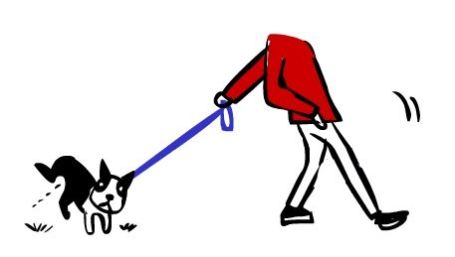
We had an incident today at a local pet store…which is what inspired this illustration below.
The crazy thing is that most people don’t believe me when I tell them that my dog is very sensitive and that he could react if you lean too close over him.
One lady at the pet store actually said to me: “Sometimes you just have to let dogs do their own thing. He is fine. Look! He is so well-behaved. You don’t have to worry.” I know she meant well but it was almost as if she thought I was being a control freak!
When Boogie snapped, the first thing she said was “Oh, you’re right. He’s a rescue dog with issues”. WTF. It wasn’t Boogie’s fault.

DVD: The Language of Dogs
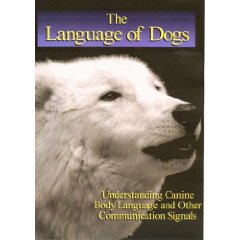
I got around to watching this 2-disc DVD today and it was very interesting.
Sarah Kalnajs is a behaviorist who does temperament testing on shelter dogs to figure out what the dog’s “behavior problem” is (assuming that this is why the dog was surrendered) so that the shelter can decide on whether the dog is adoptable, and by whom.
To be honest, it was quite stressful to watch because there is a lot of footage of dogs displaying anxious behavior.
The first part of this documentary is about dog communication and body language and there are many examples displayed by a variety of breeds. The signals are divided into the following categories:
- Signals of Stress
- Calming Signals or Appeasement/Non-Aggressive Signals
- Distance Increasing Signals (which could lead to aggression)
- Distance Decreasing Signals (inviting interaction, friendly)
- Displacement Behaviors – some behaviors that dogs do when they are unsure what they should be doing
- Ritualized patterns of behavior that are odd… eg, if the dog has been trained this way, or socially inept, or abused, or has OCD…
Sarah K makes it clear that we have to look at these signals in context rather than in isolation… We should look at the whole body and what else is happening.
Stress signals aren’t necessarily a bad thing or a cause for alarm. But it is important that we notice them because they are usually triggered by something that we (or the environment) are doing to the dog that may be invasive.
Some notes:
– Slow movement or lack of behavior IS a behavior. A dog may not move much; he may not appear scary or stiff, but if he doesn’t offer any behaviors, and shows little or no movement or interest in food or whatever we are doing, this can be interpreted as a stress signal.
– A wagging tail, contrary to what we have been taught as kids, DOES NOT mean that the dog is friendly and wants to be petted. If the tail is high up and wagging fast, this signals “arousal” and could in fact lead to aggression.The only time that it is safe to pet a dog is if his tail swishes around in slow big circles like a “windmill”. Not that this applies to Boogie, who doesn’t even have a tail.
– Distance Increasing signals (eg, hard eyes, ears forward, heightened posture, tail up, excessive barking etc.) = “Back off”.
– Distance Decreasing signals (eg, playbow, easy windmill tail, tongue flicking, relaxed posture, submissive grin, soft eyes, rollover etc.) – we should NEVER punish these signals or the dog might stop offering them. Sarah Kalnajs also says that we should also never punish a “growl” because the dog will then skip the growl and go straight for the bite. (We think that in a previous life, Boogie used to be punished for growling/barking, which is why he is a “silent biter”)
– When a dog lies down and shows his belly, this does not always mean = “Pet me” (or friendliness)
She distinguishes between the “Rollover” and the “Tap Out”. The former is when a dog’s whole body is relaxed and/or wiggly and he wants a belly rub. But if a dog lies down and shows other signs of stress, and then gets back up again after you retreat, this is a submissive “tap out”. He does not want to be touched.
The later part of the DVD shows behavior sequences when shelter dogs are being assessed. In most cases, Sarah K performs certain actions to elicit the problem behaviors (eg, touching the dog’s body or food with a fake arm-on-a-stick)… and offers explanations of what is going on. Some dogs appear totally friendly, then turn suddenly and bite!!! (HELLO, Boogie!) Sometimes the warning signals are really subtle; sometimes they only come out when food is present or when a person does something to freak the dog out, eg, touch his tail.
It is sad to know that some of these dogs will be euthanized if they don’t pass the temperament test… like one puppy that showed subtle signs of aggressive behavior that she believed would get worse in adulthood. I don’t understand why this puppy was considered untrainable.
There are also heartwarming examples of dogs who improve after spending time in a foster home with TLC (away from the stress of the shelter) and become place-able in forever homes, which reaffirms for me why rescue and fostering is so important.
Video: Ian Dunbar
This is awesome.
P.S. I love the bit about how our dogs believe they have trained us to give them everything they want! Yes, Boogie SITS for everything! The “sit” is his command to me when he wants attention, a treat, to go outside, to play, to make me go to the bedroom, to make me do everything! And I am the one who ends up offering a variety of behaviors to figure out what he wants me to do! 🙂
More Ian Dunbar videos HERE ( Three Basic Skills to Effectively Train a Dog )
Are SQUIRRELS positively-reinforcing?
Boogie and I had a longer-than-usual walk this morning. We saw two squirrels on Los Feliz Blvd and of course, Boogie dashed after them, totally ignoring me and the scary stinky homeless old person seated on the sidewalk whom he would have normally lunged or growled at.
Boogie is a strange dog… sometimes I can’t work him out. In this video below, is he offering CALMING SIGNALS (head turns, lip licks) to the squirrel? Or to me? He has been known to SIT for squirrels.
[Youtube=http://www.youtube.com/watch?v=5eOk9ot-fGo]
When the homeless man started yelling: “I am going to kill you!!!” and looked like he was headed our way, it was time to get out of there.
Later on we ran into a really cute boston puppy whose name is POTATO! This is the second time that we have met Potato and I was so glad I had my camera on me.
Apologies for the terrible camerawork. It was hard to take video, deliver treats, manage tangled leashes and keep my eye on Boogie’s body language at the same time. I think he was less interested in Potato and owner (lots of calming signals… grass sniffing, turning away etc) than in hunting for squirrels on Squirrel Street. He kept looking past everybody, scanning the trees, pulling me away…
(All the nitty gritty details in Boogie’s Daily Walk/Training Log)
Turid Rugaas DVD
 I have just watched this DVD by Turid Rugaas the dog expert & author of the book by the same title, and I am totally baffled that this information is not more publicly available.
I am also amazed that a show like The Dog Whisperer which carries on and on about “calm submission” does not have anything to say about Calming Signals and how dogs use these to communicate their need for calmness and conflict resolution.
I learned so much from this DVD and it’s only 48 minutes long. In fact it answered several questions about Boogie’s behaviors that have been festering in my brain.
Here are some things I learned:
– Dogs are born with these calming signals. They are part of a dog’s natural makeup and heritage. Puppies know this stuff and as they mature they get better at it, if they are allowed to socialize frequently with other puppies and people.
– Dogs live in packs so *conflict resolution* is a highly important part of their natural behavior repertoire. Conflict resolution is more important that obedience. An example: If your dog is at the dog park surrounded by dogs and you call him to you and he doesn’t come straight away, acknowledge that he has to *peace-out* with the other dogs before he comes to you. This is polite social behavior.
– When a dog is wagging his tail, this doesn’t necessarily mean he is happy. A wagging tail = arousal and excitement.
– There are two types of Playbow. There is the playbow when the dog wants to play and he will jump from side to side in this position. Then there is the playbow when a dog jumps backwards and wanders off like he is not really interested in playing. In this case, he is doing the Playbow as a calming signal to the other dogs to let them know that he is friendly. Boogie does this all the time!!! Check out my earlier blog post and video.
– When dogs mark, there are several reasons –
1. He could be marking his territory
2. He could be stressed about something
3. He could be using this as a calming signal to another dog/person.
4. If two or more dogs are marking something together, this is “being social” together.
Did you all know this stuff about marking? I certainly didn’t. I always wondered why sometimes when Boogie sees another (friendly) dog the first thing he does is go mark a tree. He seems to mark more often when there are more dogs around. I always wondered if he was being “dominant” and showing the other dog who’s boss, but now it’s good to know that this could be a response to stress or a conflict-resolution behavior.
Turid also says that if we are walking our dog and if a stranger approaches and our dog goes off to one side to sniff or mark, we should let him do it. (According to BAT, this is a “functional reward”. I let Boogie do this anyway, and I also praise him because it is a friendly alternative to lunging)
– Because dogs don’t like conflict, sometimes when two dogs play too rough or get too close, a third dog will run in and split them apart. According to Turid, the dog who is splitting up the action is not “jealous” or trying to be party-pooper. He is doing his part to prevent potential conflict. He will barge in from either the side or the back, not front on. The splitting-up behavior is a calming signal to the other dogs.
– Another calming signal is to walk in a curve around another dog/person. This is a social skill that we can help our dogs develop by leading them (on-leash) in a wide curve around the other dog/person. The more stressed or agitated our dog, the wider the arc and the further the distance, and as he shows signs of being more comfortable we can make the distance smaller, but still in a curve, because in the dog world this is polite behavior and we want to reinforce it.
– Turid points out that most people greet dogs the wrong way and this is so true. Most people lean over a dog and pet him on the head or stick their hand in front of his face. To dogs, this is stressful stuff and the dog may then turn his back on you, lick his lips, turn his head away or walk away past you (as calming signals). Or in the case of Boogie, he will cower or bite you. The correct way to greet a dog is to give him your BACK or your SIDE and pet him on the side of his face or body. This communicates to the dog that you are no threat.
– As we learn to read a dog’s signals we can change our behavior. If we see that a dog is stressed, we can make the choice to change our position, turn our heads or turn our bodies around to make the dog more comfortable.
This information is so valuable! Thank you to Sarah for lending me this DVD.
P.S. The DVD is much better than the book because you get to see dogs moving and interacting. Just try to ignore the cheezy muzak soundtrack 🙂
Related link: Turid Rugaas website
How do you interpret this behavior?
This video was taken just over 1 year ago, at Lake Hollywood dog park. This was before Boogie started growling, lunging and snapping at other dogs (on our walks), when it was still relatively safe to take him to an off-leash dog park.
See in the video how he greets the other dogs, stiffens, and then jumps away from them? The other dogs are kinda relaxed, but Boogie is all skittish and jerky all over the place.
I am interested to know what this means. I interpreted this behavior as “dominant” posturing at the time but I really don’t know what it’s all about.
This week, Boogie met a few new dogs and didn’t react too badly. These were cute puppies his size or smaller – (He still freezes and barks when he sees big dogs) and I could sense that he wasn’t so threatened by them that it was safe to let him go sniff.
Boogie seemed to be a lot better – no aggressive snapping, thank goodness. But I noticed that he still does that weird thing of sniffing the other dog, then jumping back really fast – like in the video – sort of like he wants to play, but not quite, because his body is mostly upright – not a full playbow.
What do you make of this?
UPDATE: Sarah, our new behaviorist/trainer comments on this video
Boogie- Day by Day
I have started a “Daily (Walk) Log” for Boogie to keep track of his behavior on our outdoor walks, with improvements or otherwise. It’s easy to forget the details and I want to record and remember everything… especially Boogie’s responses to different situations – what he likes/dislikes, what freaks him out, how he handles himself etc. including too what *I* do and say- what works and what doesn’t
This log is hosted on a separate blog – http://boogietoday.tumblr.com/
On the right sidebar, there is a Widget of this blog’s RSS feed – Look under “Boogie Today” – I will be posting something everyday.
Comments are welcome!
Boogie shakes hands

to add to my doggie booklist…

I havent read ALL of these, btw.
Clicking With Your Dog is like a beginners level book with lots of pictures which makes it super easy to follow.
Example page –

As fun as clicker-training is it’s sometimes hard. For me it’s having to problem-solve laterally ie, figuring out other ways to get Boogie to do something without physically touching/manipulating him and instead, creating a situation where he does the behavior on his own so that I can reinforce it. Check out this amazing article about people testing out their clicker training skills <- THIS is what I mean by lateral-thinking.
So our Boogie monster here doesn’t know any tricks. I tried to teach him to shake hands by repeatedly lifting his paw and saying “shake hands”, then giving him a treat and he NEVER EVER got it. I had taught Rocky (my blind ex-foster dog) to shake hands this way and he got it in 5 minutes. Not Boogie.
So recently I decided to try again this time using a clicker. I read that the way to get your dog to lift his own paw is to hold a treat in your hand and move it around in front of him until he paws at it at which point you “click”. This method didn’t work with Boogie who has the amazing ability to sit and stare at you for 30 minutes without moving until you give in.
So I took Boogie’s paw, and lifted it off the ground. CLICK-AND-TREAT.
I think I understand why they say don’t physically manipulate your dog to do something. When I lifted Boogie’s paw (click and treat), his body fell off-balance to one side. A moment later when I said “Shake Hands”, Boogie tried to sit LEANING to one side and almost collapsed! Uh-oh.
Eventually he got it because he’s a smarter cookie than I am. After a few more practices doing this with the clicker (I was careful that he wasn’t leaning to one side or in an uncomfortable position) Boogie learned the cue!
Here is video evidence! (no clicker involved at this stage)
p.s. Usually the tennis ball gets him running but this time he wanted a food treat
So far, I still think THE BEST THING we have accomplished with a clicker is hand-targetting. Now when some random person sticks their hand out in front of his face, Boogie no longer shrinks away (or uses his teeth). He goes forward and sniffs their hand 🙂
Progress report!
Boogie has been so great on our walks this week.
No, he isn’t perfect but we are both learning and I can feel the difference. With each morning, things get a little better, a little easier, a little less drama. And this is with a pouch full of treats, loose leash, and I am proud to say – NO CORRECTIONS.
About a week ago I was still walking Boogie with the Sprenger collar on (no corrections) as I started practicing some clicker-training techniques. These past few days – no Sprenger collar at all and things have been good!
So here is how I have been practicing the HEEL cue, with tips from the Click To Calm book, and Emily’s awesome video tutorial.
If Boogie pulls forward on the leash I stop till the leash goes tight, call him to me (like in Emily’s video) and when he turns and approaches me, YES!-and-treat. (easier to say “YES” than to carry a clicker at the same time) When Boogie comes towards me he usually sits because it’s his default ready-for-a-treat position. Which is not really what this exercise is about. I want him to HEEL, not sit.
So here’s something I figured out by accident and it has been working really well. It’s easier to keep Boogie in heel position if when he comes to me , I turn my body to the right and walk him in a circle.
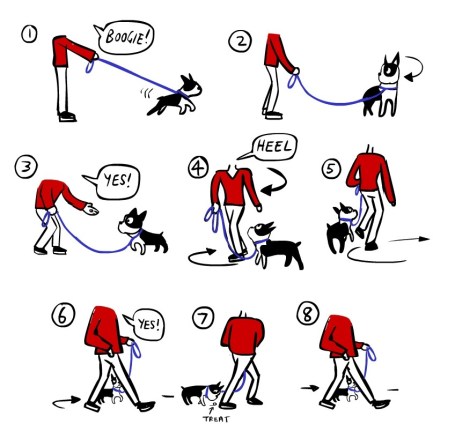
Before he has a chance to sit, I take the leash, say HEEL and walk him on my left, turning clockwise so that we are headed back in the original direction and he is by my side again. Walking in a circle slows us both down, and it means that Boogie can’t charge forward after he receives his treat. Yes, he does this. He is rascal 🙂
And voila – Boogie heels. He gets a treat, and he continues to heel for a longer stretch of time. Wide-eyed and perky, looking up at me. He is SO CUTE.
Compared to a week ago, Boogie now rarely pulls forward (he keeps looking up at me every few minutes.. and when he does charge ahead he turns back to check ..)
BUT – one problem is that now more so than ever, he pulls behind me, and he doesn’t come when called. It’s like he has figured out that he can still have control of the walk if he pulls backwards and to the side, instead of forwards. I haven’t yet figured out how to deal with this problem. Even when I hold out a treat he ignores me, takes his sweet time sniffing and peeing on bushes. This is infinitely more exciting to him than cheese or sausage.
Yes, Boogie still reacts to specific people and dogs. He still stiffens and turns his head and pulls away from me when he sees them walk by, but when I call his name, he turns back towards me and heels. Which is such a big improvement!!! 🙂 I cannot tell you how many “scary people” we encounter every day and how many times this sort of thing happens and it’s so great to see Boogie coming to me for a treat instead of lunging at someone.
This morning an eccentric old Asian lady in our ‘hood stopped to say hello to him. Everytime she sees Boogie she talks to him “Oh you are such an adorable baby, blah blah blah” and Boogie growls.
I have no idea what it is about this lady that sets him off… Even if she is way across the other side of the street his hackles go up when he sees her. (He has a thing about old Asian people) So this morning I thought to myself Oh no, not again when she stopped to chat. I told her: “He gets scared of people that he doesn’t know so please don’t come close”. The lady stood there several feet away but wouldn’t stop chatting to him. “Oh you are so adorable, you are such a beautiful dog, you are so lucky to have each other, blah blah blah”.
There I was shoving cheese into his mouth while his whole body was tense. He almost wouldn’t eat the cheese.
When the old lady walked off, Boogie pulled after her, I called him, and he came towards me again. YES!-and-treat. Good boy, Boogie! Two weeks ago he would have been uncontrollable with this lady around.
Of course, it’s not easy. I am feeding Boogie a ton of treats every morning and it’s a lot of hard work to remain attentive to our surroundings (on the lookout for scary people and other dogs approaching) My fingers also stink of cheese or meat. I hope that I can phase out all these treats over the next few weeks. I want to make sure that Boogie heels for a longer stretch of time before he gets a treat. I also want him to heel CASUALLY, without staring up at me every 2 seconds (where’s my treat, mom? where’s my treat?)
At the vet today, they said that Boogie has gained TWO POUNDS! He is now a whopping 26.5 pounds! YIKES.
Must feed less during mealtimes or take up hiking again!
On Thyroid-related behavior issues
This is something I learned only recently and today Boogie had his blood taken for a Thyroid test. We will get the results on Saturday. Fingers tightly crossed.
*UPDATE: The vet hasn’t received all the results yet. Still waiting….
It has been said that aggression issues (especially “aberrant aggression”, fear of strangers etc.) can be linked to thyroid issues and that medication can help in addition to behavior modification. Sometimes, medication eliminates all the symptoms and a fearful/anxious/aggressive dog becomes friendly again. (wow. Sounds too good to be true?)
Some links:
The number of animals showing various types of aberrant behavior in these three classical modes (aggression, extreme shyness or seizure-like activity) has been increasing in frequency over the last decade. Consequently, we began to examine these animals by using the stepwise diagnostic approach outlined above [ Complete history; clinical examination; neurological work-up; routine laboratory testing of CBC, blood chemistry and thyroid profiles, urinalysis, fecal exam and x-ray; additional specific laboratory tests as indicated; examination of cerebral spinal fluid; more specialized neurological examinations). We were surprised to find that in many cases studied, significant abnormalities were found in the thyroid profile.
Boogie doesn’t show any of the usual symptoms of thyroid disease like ADD, lethargy and weight gain, but we know he has aggression issues and Dr. R said that he has recurring skin problems and ear infections… and while allergies may be the primary cause of these infections, we can’t rule out low thyroid levels.
We’ll wait and see…


 Boogie's blog