Posts filed under ‘Reads’
The Behavioral Revolution
This is fascinating. Excerpts from the Patient Like The Chipmunks DVD which I am tempted to order, but I think this video clip already offers plenty of amazing footage.
After watching this clip, I now fully understand why Operant Conditioning or Clicker Training is sometimes criticized as being too cold, too mechanical or emotionless. As in the YouTube video above by Bob Bailey, he shows how the Brelands (Animal Behavior Enterprises) successfully trained thousands of animals of different species using Behavioral Science (vs. old school aversive methods) such that they could have their animal shows travel around the country, and be coin-operated and fully-automated like Skinner boxes. There is proof here that direct human contact or interaction is unnecessary and … I don’t know… there’s something a little depressing about the way these animals perform like little robots – repeating the same behaviors over and over again – even if they are all well-paid and treated humanely.
On the other hand, it is exciting to know that anyone can learn these training skills, that there are logical explanations for the whys and hows, and that the methods are always evolving in a more intelligent and humane direction. The nerd in me would love to attend one of Bob Bailey’s chicken training camps and I love this Bob Bailey quote from Sophia Yin’s article “Bells & Whistles” in the current issue of The Bark magazine…
Crafts generally develop over thousands of years and tend to preserve what’s old and what has been done before. Information is passed down in secret from master to apprentice, and the apprentice must never question the master. As a result, when errors are introduced, they tend to be preserved. Another characteristic of a craft is that a change is designed only to solve an immediate problem . Rarely do they look for general principles.
Science on the other hand, is a systematic way of asking questions, a process that eventually weeds out mistakes. It’s guided by principles and data, and researcher’s approaches change and are revised as new information comes to light. As a result, science advances quickly compared to craft.
… which is interesting when considering Why Dominance Won’t Die. (…interesting choice of photo)
Related links/good reads:
Keller and Marian Breland Create the Field of Applied Animal Psychology by Sophia Yin
Dog Whisperer, Horse Whisperer. What is all the Whispering About? by Cindy Ludwig
The Pursuit of Happiness – Is There Room For Emotion in Dog Training? by Jane Killion
Emotionless Training by Sara Reusche, whom I collaborated with on this illustrated guid to Playing With Your Dog:

(click to see it larger/download options)
Speaking of learned behaviors, yesterday Boogie was on his bed next to the heater. His body was awkwardly twisted around because he was trying to lick himself. He accidentally hit the heater with his leg – CLANG! – freaked out, ran to the window and barked. You know, UNFAMILIAR NOISE –> BARK AT WINDOW. Even if he caused the noise himself.
Another classic example is the time when Boogie ran around the room chasing his ball. In his klutzy excitement, he bumped into my leg and jumped back with a huge yelp like I had kicked him. I threw his ball and all was forgotten.
Never a dull moment around here with my sensitive Boogie! 🙂

Interviewed!
A few weeks ago, Marshall from Coffee With A Canine invited me to participate in an email interview.
Here we are! –> Lili Chin and Boogie

From Suzanne Clothier’s book…

I just finished reading Bones Would Rain from the Sky: Deepening Our Relationships with Dogs by Suzanne Clothier.
Well, truth be told, I skipped over several chapters and sections in this book (that I found too repetitive or too sad) and read only the parts that had Suzanne Clothier interacting with her dogs or dealing with the problem behaviors of her clients’ dogs. These chapters were wonderfully enlightening, and I loved the way Suzanne Clothier retells scenarios from the dog’s perspective with such amazingly heartwrenching detail. It is also so refreshing to read a book about “human-dog communication” that isn’t full of scientific/training jargon.
Sharing a few clippings from my Kindle copy:
“Training is a mechanical skill.” The problem arises when we mistake the skill of training for the relationship itself.
A good deal of dog training is rather Procrustean. Procrustes was a mythological fellow who had a special bed that he guaranteed would fit all who tried it. And amazingly, it did—because he would stretch anyone too short for the bed and cut off any parts that were too long and hung over the bed. Perfect fit, every time! And we do this to dogs, stretching them unnaturally to suit our training demands and lopping off the parts we don’t like or the parts that don’t neatly fit within our paradigm.
It’s okay to guess what your dog is trying to communicate as long as you’re willing to accept that you might be wrong, correct your misunderstanding and try again. It is not okay to guess what an animal is thinking or feeling if you are unwilling to accept nothing less than absolute compliance with your wishes.
…every interaction with a dog is one that the dog takes seriously. He has no other way of interpreting his world. The dog’s world does not contain careless interactions. In every interaction with another dog or person, a dog says what he means.
All of the simplistic never advice contains the implied but unspoken phrase of dire warning “or your dog will become alpha.” This is as silly as saying if you let children run and play, you will never have control over them. The truth is that if you don’t have control over the children in the first place, then when they do run and play and get terribly excited, you won’t be able to control them in that situation. If you can’t tell your dog to get off the furniture or out of your bed, it’s not because a comfortable couch has eroded the dog’s respect for you. Particular actions in and of themselves are not usually the problem when it comes to leadership issues. The lack of respect we have earned from our dogs is the problem.
The dog does not need to be “deranked” so much as the people need to learn to act like people worth listening to.
…the loophole in the canine possession law—if you voluntarily turn your attention away from an object and another dog swoops in and takes it, that’s fair.
We want to believe in the Lassie myth, to focus only on the dog’s gentle, forgiving, loving nature. Of all the rocks on which we may stub our emotional toes, this is a big one. We do not want to think that the dog lying at our feet is a predator and a powerful one at that. It may be that we’d prefer that the people and animals we love most dearly have no dark, ugly side; we idealize them with this simple “Oh, he’d never do that!” or “She’s just not that kind of person.” In any relationship, such sanitized, idealized views of another being does not lead to deeper understanding or a more intense connection but to the inevitable disappointment that occurs when we are unable to embrace both the potential for both light and the dark contained in all of us. This is not to say that all dogs will sooner or later act in aggressive ways, no more than all humans will eventually harm another person. The dark potential that lurks within each of us needs to be recognized, and our relationships shaped to encourage the joyful lightness of being, not trigger the ugly possibilities.
In the United States, roughly two thousand children die every year at the hands of their own parents, but less than a dozen are killed by dogs. And yet people don’t look at children and whisper, “Be careful. Parents can turn on you.”
If I am mature enough to understand that not all behavior directed at me is about me, I am then in an even better place to carefully search for the real message behind the behavior.
My experience is that very often, an animal needs an acknowledgment of the motivation behind his resistance more than he needs us to simply withdraw our request. Though it sounds terribly simple, I am endlessly amazed by what happens when I assure an animal that I do understand why he finds something unpleasant or scary, and I believe that like all people I know, animals also need to be heard.
Doggy links and stuff
This blog post has absolutely nothing to do with Boogie.
I suppose by now, most people have seen the Food On My Dog tumblr blog? Tiger the Staffy-Bulldog gets photographed with food on her head. And according to the FAQ, this lucky girl gets to eat most of the food on her head 🙂

Today I found Maddie On Things. Maggie, the coonhound is photographed standing or sitting on fences, rocks, furniture, scooters… I am so impressed. Of course, I can make Boogie pose on ANYTHING, but not in real life 🙂

And then, I had to order this mug.
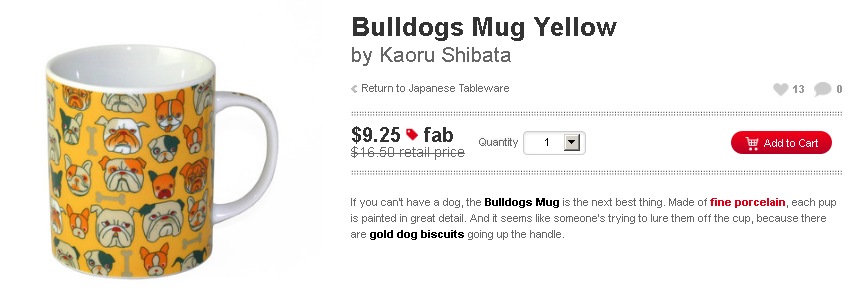
Sale ends in only 1 day, at http://www.fab.com –http://fab.com/sale/4094/
Boogie Says PLEASE…

[Look, it comes with a BAT book bookmark!]
A couple of nights ago, I read Kathy Sdao’s new book : Plenty In Life Is Free. (I saw Kathy Sdao speak at last year’s Clicker Expo and she was an amazing, feisty and inspiring speaker.) It is partly a memoir, but mostly a critical look at the NILIF “Nothing In Life Is Free” sacred cow of dog training, also known as “Learn To Earn” or “Say Please”.
 NILIF is something that almost all dog owners already know about. It is sort of a “relationship philosophy” for humans and dogs that is often said to prevent and/or fix behavioral issues. With NILIF, the dog has to earn his food, attention, permission to get on the couch, anything… by first performing a specified polite behavior, usually sitting. Coincidentally, I recently finished doing some illustrations for Sophia Yin’s “Learn To Earn” program so the NILIF regimen is still fresh in my mind even though, thankfully Boogie is already mostly a calm, polite and patient dog so I don’t feel any need to micromanage his behaviors.
According to Kathy Sdao, NILIF puts a lot of emphasis on withholding attention/love/food (aka Negative Punishment) and making the dog earn these things. Even though she herself has advocated this philosophy for years, she now questions if NILIF is in fact a not so benign, “passive-aggressive” way of communicating that doesn’t foster trust and intimacy in any relationship. In some extreme (and unethical) examples of NILIF in action, trainers even starve their animals in order to get more compliance out of them during training.
NILIF also often contradicts some behavior modification protocols. One problem that I can really relate to is when Boogie sees a trigger on the street that he might lunge or growl at. I have learned through many experiences that the WORST thing I can do is to ask him to “Sit” (regardless of whether I give him a treat or not). The sitting only makes Boogie more intensely magnetized to the trigger and there is a higher chance of reactivity or aggression. As I have learned through BAT, the best thing I can do for Boogie is to reinforce voluntary polite signals with MOVEMENT.
There is one page in the book that I found really fascinating and interesting… it’s about Chained behaviors , and also related to asking a dog to SIT for what he wants. I think Sarah has mentioned this before. When Boogie jumps up and I ask him to SIT, then reward him for sitting, I am accidentally reinforcing both behaviors – “JUMP UP + SIT”.

My brain went off on a tangent and I started thinking about how Boogie often sits and stares at me whenever he wants something. He never barks at me, he never pounces on me. He just sits quietly and waits, and he can do this for a very long time. To most people this might be the sign of a well-behaved dog, but I’ll admit that it sometimes drives me nuts. Yes, Boogie, you are very polite by sitting and saying Please, but WHAT THE HECK DO YOU WANT???
I also don’t always notice him sitting there because he is so quiet.

And then there have been times when I wake up in the middle of the night to see Boogie sitting at the foot of my bed, staring at me, hypnotizing me to wake up because he needs to go outside and eat grass, do a poo, or whatever. I feel so bad because I don’t know how long he has been sitting there quietly and desperately waiting. Any other dog would probably bark and paw me awake. What if I had taken a benadryl and slept like a log?
Afer four years, even though I have learned to read most of Boogie’s sits (eg, when he needs to go outside, he sits with front legs held really close together and his ears go back) a lot of the time I am still presented with a multiple choice quiz. I have to look at the clock or get up from my chair to find out if Boogie will lead me to the kitchen, couch, front door, or bedroom.
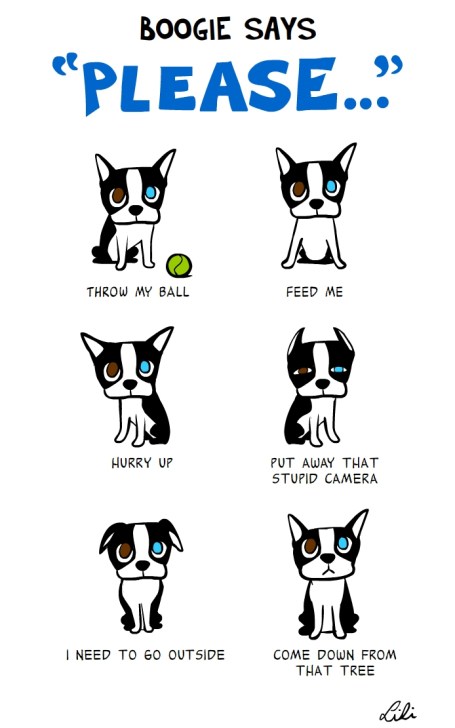
Disclaimer: These drawings are exaggerations.

In the book, Kathy Sdao advocates a protocol of “fifty rewards a day” and also SMART, acronym for SEE, MARK and REWARD TRAINING. In place of NILIF, we could be devloping better training skills, the main ones being:
1. Seeing/Noticing when our dog voluntarily does good behaviors
2. Marking/Pointing out to the dog when he does these good behaviors (click or “yes”)
3. Rewarding the dog so that we increase the strength and frequency of these good behaviors.
“Seeing, Marking and Rewarding voluntary behaviors violates versions of NILIF that require trainers to ask their dog to respond to a command (or to a trainer-produced cue) before the dog recieves any rewards. SMART frees us to reward dogs anytime they aren’t worrying or annoying us. The more we do this, the more our dogs will behave in ways that please us and the less risk we’ll have of accidentally reinforcing them for pushiness.”
Good reads – dog behavior-related
The Paws Abilities blog. I have only just found this excellent blog.
Denver Dog Behavior blog by Michael Curran.
- Part 1: Anatomy of a Typical Dog Bite – re: Denver Dog Bite analysis
- Part 2: Stress and Fear
- There will be a Part 3.
A very interesting article about dog’s eyes and how different breeds see differently. (via Dr Sophia Yin’s facebook)
Meanwhile, I am recovering from a cat attack. Yep, an extremely fearful aggressive CAT that lunged at Boogie and me. I will spare everyone the most recent photo of my leg which is covered in huge swollen bruises. I am also on antibiotics and still very very relieved that Boogie was not seriously harmed.
I love this photo of Boogie, taken a few days ago.

The Denver dog bite incident and BAD DOGS
There has been a LOT of internet discussion on this topic already. Everyone should read this article: A Perfect Storm. Also Sophia Yin: When A Kiss Can Get You Bitten (with my illustrations!)
The whole incident brings up some horrible memories for me, being the owner of a dog that has bitten people (even before I adopted him), and we’re talking Level 1,2,3, and 4 bites . I can personally relate to how traumatic it must be for everyone – the person who gets bitten, the dog, and the owners of the dog. The first time that this happens is especially traumatic.
I was fortunate that the person that Boogie had bitten with a Level 4 bite was a dog-lover and did not sue me, and that Boogie does not look like a pit bull.

But I did spend $$$$ as a result of that incident and I remember the emotional trauma I went through dealing with the authorities who wanted to take Boogie away from me and dump him back in a shelter. I fought really really hard to keep him, claiming as much responsibility as they would let me. Last thing I wanted was for Boogie to be back at a shelter or rescue. This was a life-changing incident as you can imagine and one that has led to me learning everything I could about dog behavior, and sharing all these illustrations.
The news reports are upsetting because the implication is very clear that the “aggressive dog” is to blame. Max the biter was quarantined for 10 days not for rabies testing as they say (this is not technically possible) but because he had bitten someone and was therefore considered a dangerous criminal. His “crime” was worse because it was to the FACE (as opposed to a foot or hand, I suppose). Never mind that the news anchor was the one who stuck HER face in his face by kissing him on the nose and freaking him out. No doubt her intentions were loving. Most people don’t know how to correctly greet a dog and/or don’t know how to read signs of discomfort in dogs until something bad happens.
What remains so disturbing is that after the storm, there has been no apology from the Denver News crew – nobody is taking any responsibility here for human errors and so Max still looks like a good dog gone bad…
“Max has no history of aggression. Max is a gentle, loving, family dog. Max is well-mannered and obedient, and he hardly barks. This incident truly is unfortunate and does not reflect Max’s disposition towards people.” (statement from Max’s owner)
And I suppose things don’t bode well for the breed –
Argentine mastiffs, also known as the Argentine Dogo, are known as big-game hunters and historically have gone after wild boars and pumas. While they are now used as pets, they were bred from a rather violent group of dogs. Because of the dogs’ violent nature, several areas have banned the breed, including Aurora, Colorado. Aurora is the neighbouring city to Denver, where the broadcast took place. The animal is also banned in New York City public housing, and laws in the UK allow police to take the dogs away from their owners and prosecute them.
And so poor Max has become a dog “with a history of aggression”. Branded a bad dog.
————————————————————————————————–
As I was writing this blog post, there was a loud knock on my door, Boogie rushed to the window (the one that isn’t covered) and growled his head off. The mailman was outside with a package that I had to sign for. I put Boogie in his crate (where he was howling and crying) and stepped outside. Our conversation went something like this:
ME: Sorry for the wait, I was putting my dog in the crate.
MAILMAN: You said that three years ago.
ME: What?
MAILMAN: You really love that dog don’t you?
ME:Yes I do.
MAILMAN: That dog bit me, you know?
Several years ago, the mailman reached out to pet Boogie and Boogie snapped at him. No skin broken. I started looking for a trainer around this time.
ME: I know, and I am really sorry. He hasn’t bitten anyone since I started training him.
MAILMAN: Yeah, three years ago you said you were training him. Three years ago. Why is he still barking at me?
ME: He has not bitten anyone since. As for barking, this isn’t personal. You have to understand – you are the mailman, you are someone who comes and goes… you are not part of the family. And a lot of dogs have a problem with mailmen. There is really nothing personal in this and it’s something I am trying very hard to control. In fact I can’t control everything that my dog does. It’s not easy.
MAILMAN: That dog is a problem.
ME: I know he isn’t the perfect dog and this is why I keep working with him. Did you see I put frosting on the windows?
MAILMAN: It has been three years. I don’t know how you could love a dog like that.
In light of reading about the Denver incident, my own memories being dredged up, the drafting of this blog post, the last thing I needed today was to have someone try to make me feel guilty (in a passive aggressive way) for keeping and loving a “bad dog”, and for putting me on the spot to explain Boogie’s behavior. This mailman has had Boogie’s barking explained to him so MANY TIMES before by myself and by dog trainers. (barking is reinforced by mailman leaving etc etc ) He clearly does not want to understand dog behavior, accepts no explanations, hates my dog, and I really don’t know what else to say.
When the mailman left, I burst into tears. Even though I personally don’t believe Boogie is a bad dog, and why should I care what other people think, it is still upsetting. I can’t help feeling immense empathy right now for “bad dogs” and the owners of these “bad dogs” everywhere…especially those of us who are trying so hard to educate ourselves and others.
______________________________________________________________
*Edit to add* This comment from a pet dog behavior specialist (on this FB post about the Denver incident):
One aspect of the video overlooked in most commentaries is the owner’s behavior. The owner held the collar tight,but the dog was on leash. The owner may not be a great reader of canine body language, but he knew his dog was uncomfortable. The owner held the collar tight because he felt his dog had the potential to act out in the situation. Why couldn’t he express this feeling? Because it would require a tacit admission that his dog might act “aggressively.” Dog aggression is taboo, especially from a Dogo Argentino. So the owner pretended his dog was fine, while tightening up on the collar. Now, after the bite, the owner is forced into a defensive position regarding his pet’s behavior, with no lesson learned. Dog owners need to feel more empowered to tell people when their dog is uncomfortable.
So true.
Some video links
I have been SO busy. I had started drafting up a post about The Culture Clash, with some illustrations in mind, but have been swamped with work and deadlines.
Sharing here some YouTube videos I found recently:
From Zak George – a very interesting point about rewarding with PLAY vs rewarding with FOOD, when teaching something very physical. I remember the times I have tried to teach Boogie cues (involving a toy) and he became more interested in running off with the toy or playing tug with it than in receiving food treats.
I have also noticed that when Boogie is barking at somebody outside (that was before I applied the Window Film – see previous blog post), I could more easily redirect his attention with the tennis ball than with food because he was so hyped up.
Article by Casey Lomonaco: When Food Is the Wrong Answer
I like the idea of using play as reinforcement but… still haven’t successfully trained “Drop it” or “Let go” …
And THIS! 🙂
We won an award! And ‘window film’…
First of all, Boogie’s blog won an Inspiration Award! Thank you so much to Pamela of Something Waggin This Way Comes. I feel humbled by this award because I don’t consider myself a “good blogger”. I post infrequently, and I don’t follow many blogs (except the training/behavior ones because I’m such a nerd) so I always feel a bit out of the doggie blogosphere loop.
Several weeks ago, I said I was going to cover my windows with ‘privacy film’ to manage Boogie’s reactivity at the window. Well, the roll of film arrived this week and this morning I started sticking the pieces to my window panels. In the photo below, the film has just been freshly applied to the glass with soapy water, hence the splotchiness and air bubbles. I still need to work that squeegy.


They say on the instruction sheet that it takes a few days for the film to dry completely, after which it should look smooth and clean like the photo on this page. I hope so!
The film lets light in, but you can’t see a thing out of it.

And here is what it looks like from the outside (with Boogie at the window).

So…Does it work? As I am typing up this blog post, I can hear the mailman outside…
Boogie barked once, and ran to the window, then stopped and let out a whimper. He is now back in his bed.
Next blog post: Notes from The Culture Clash byJean Donaldson. I can’t believe it has taken me so long to read this book!
Doggie Language, and a very funny book
Have I posted this before?

I have drawn several “dog body language” illustrations, but my Boogie Doggie Language version is the largest one, and available for FREE download! This has also been translated to Japanese, Chinese, Spanish and Thai, … more languages coming soon.
***EDIT TO ADD: http://www.thebalancedcanine.com/canine-language/ – reading body language in context!
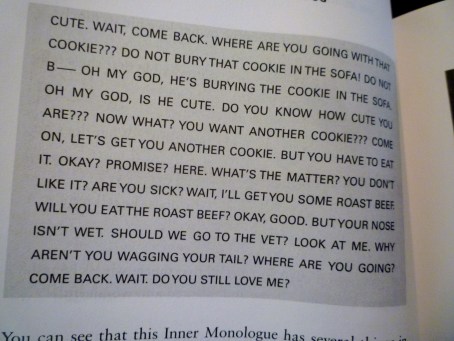
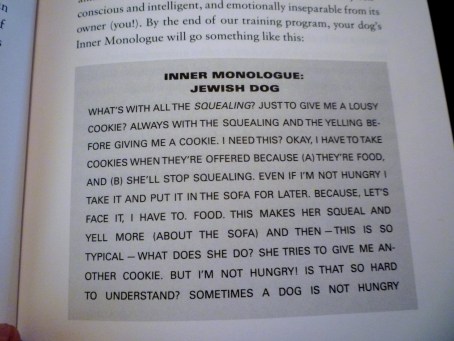
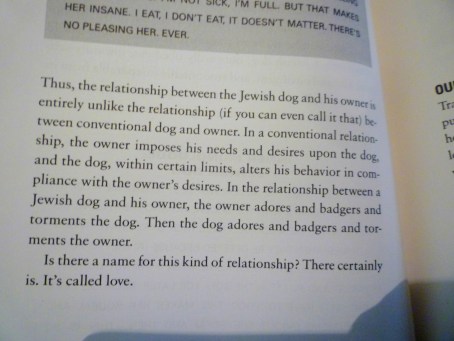
Recently I started reading How To Raise A Jewish Dog.
This is not a dog training book, it’s supposed to be filed in the HUMOR category and OMG, it’s hilarious.

This book is a parody of the Monks of New Skete book (haven’t read, no interest in reading) and the authors say you don’t have to be Jewish or want to be Jewish to follow this program, which is not about training or rewards or punishments, but about “solving problems together”. Techniques include Praising Dog to Other People, Guilting (in private), Situational Matyrdom, Pampering, and Use of Subtext. Ha.
Pages for your amusement:
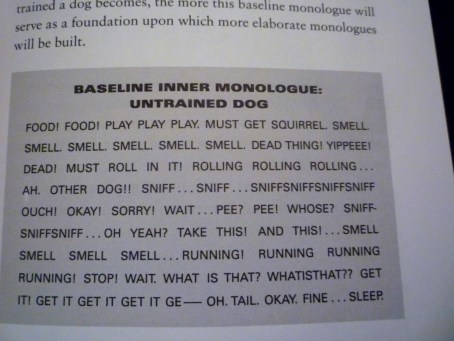
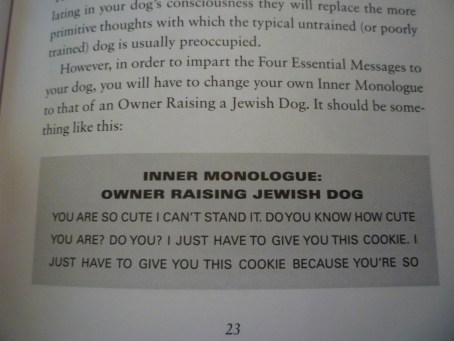

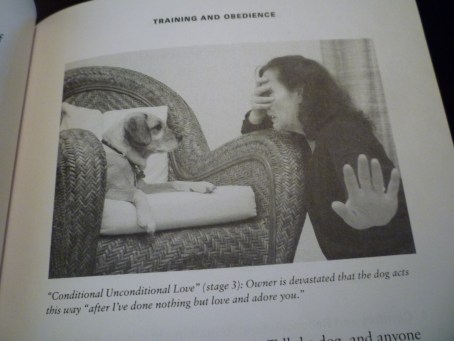
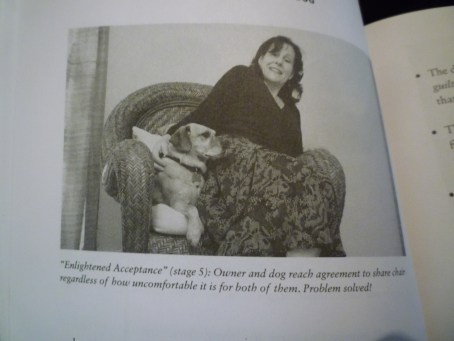
“Enlightened Acceptance” happens too frequently in this household 🙂


 Boogie's blog