Playing with Boogie: Nina Ottoson Dog Fighter Game
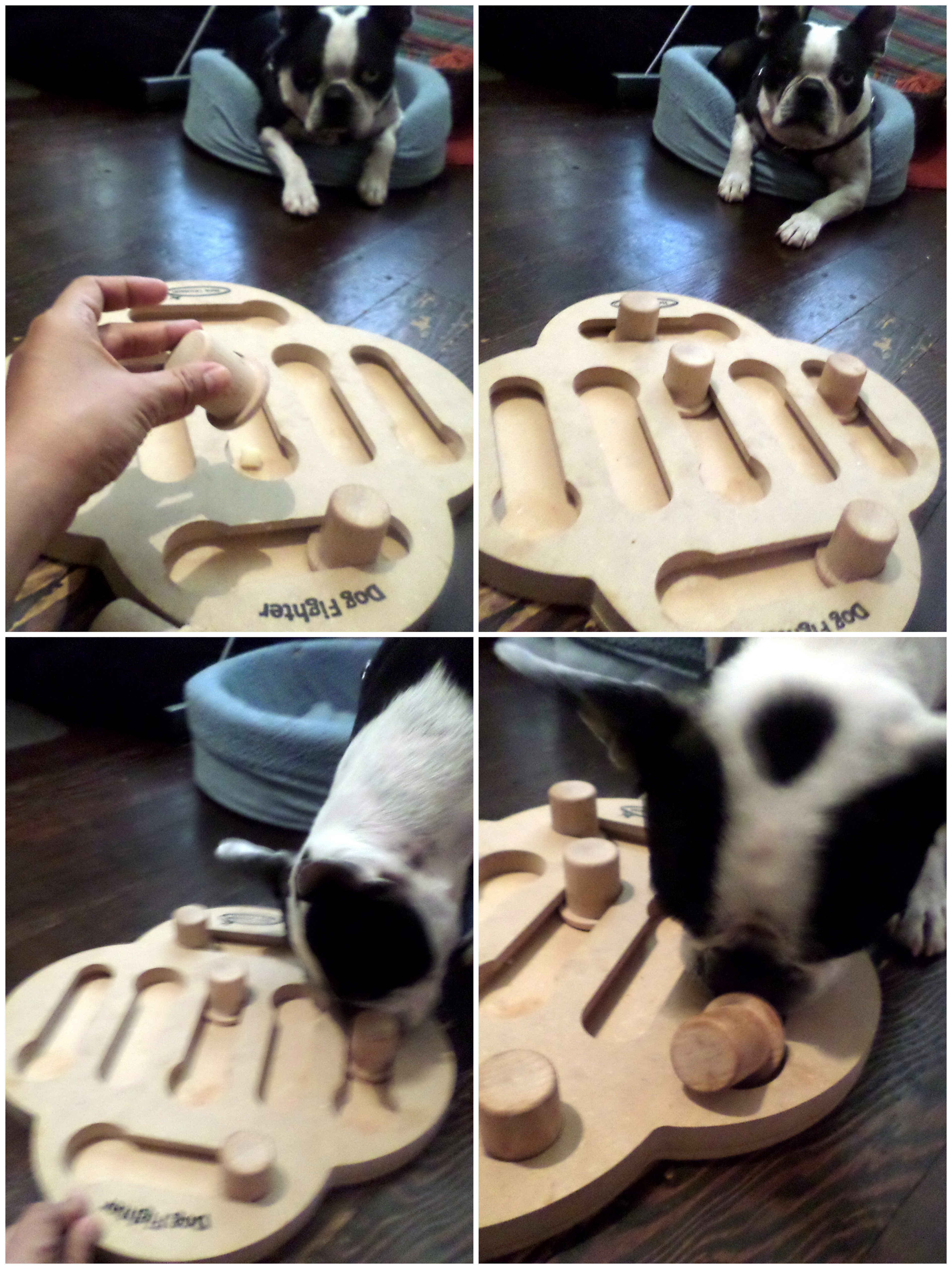
To be honest, I am not sure how to teach Boogie to play this Nina Ottoson game.
I put pieces of CHEESE underneath the cups. Then I called Boogie over to get the cheese. Boogie hasn’t quite figured out the mechanics of this game yet. If I don’t remind him to slide the cup thing (by demonstrating the sliding action to him), he sniffs and nudges and paws at the cup, and doesn’t know what else to do. Sometimes he slides the cup and retrieves the cheese and I assume that he gets it; but sometimes he doesn’t, and he continues to nudge the cup with his nose. When the cup stays put, he gets confused, backs away to his little bed, lies down and looks at me: “Please can YOU get the cheese?”
I was hoping Boogie would know to LIFT or PICK UP the cup from the base. My sorry attempt to demonstrate “lifting the cup” and holding it in front of Boogie’s mouth, ended up with him running off with the cup as if it were a new cheese-scented chew toy…
Trying out Darwin’s Pet food – eating “rare”
We were at the vet again last week. Boogie is now on Cephalexin (antibiotics) and Temaril-P (steroids). 30 days of Cephalexin.
The itchiness has stopped but Boogie’s skin is still splotchy. Hopefully it won’t take too long to heal. One side effect of Temaril-P is increased hunger, so the poor little dog is constantly starving. Walks are frustrating. He has become obsessed with scavenging off the sidewalks (“Leave it” only works 50% of the time) and at home he often sits looking up at me, pleading for treats. He won’t even play fetch or tug. He would rather eat.
The upside is that Boogie is paying no attention to his usual triggers on the street. He is ignoring other dogs and scary humans and concerned ONLY with finding food scraps on the ground.
I told Dr. F that I cook for Boogie, and she mentioned that she orders her dog’s meat from Darwin’s Pet . Knowing that Boogie does not eat raw meat – he has either walked away from it, or eaten it and vomited later – I at first figured that this wouldn’t be something worth trying out. But when Dr. F told me that she cooks the meat and that it is ok to do so, I placed a trial order…

The prices seem really good. I spend about the same amount of money each week at the local market anyway; and the meat from Darwin’s Pet is organic, antibiotic-free and already mixed with organ meats, bone meal, veggies, apple cider vinegar and supplements. In the photo above – our first shipment of 10lbs of food – $15. When the box arrived, my first thought was – there is NO WAY THIS IS GOING TO FIT IN MY FREEZER – but then I realized the contents were mostly dry ice. The meals comes sealed in 1/2 lb packets. They include a fed ex slip for you to send the box back to be recycled.

Left: empty container; Right: that’s 4 x 1/2 lb packets of food (Beef)
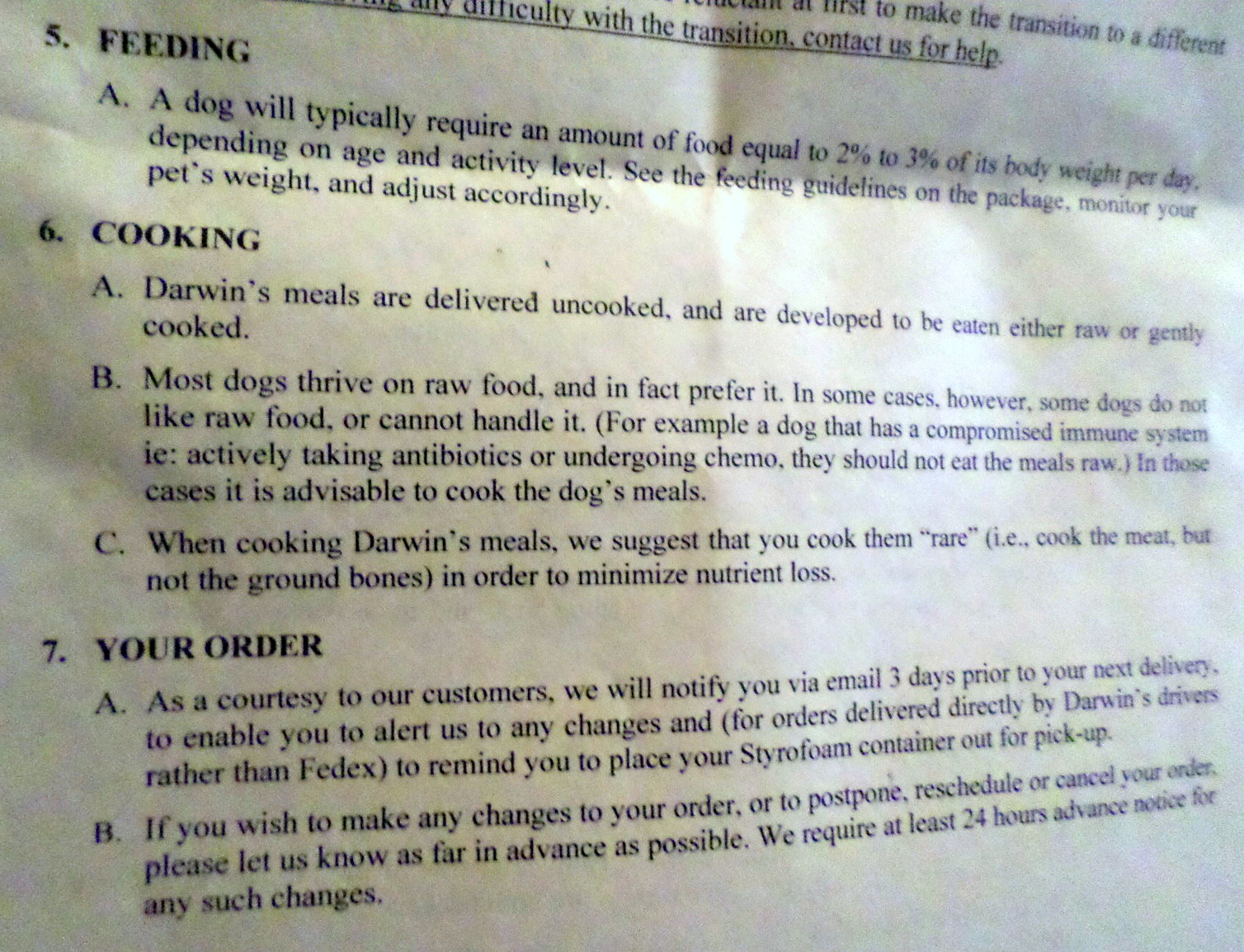
Interestingly – the instruction sheet says that if the dog has a compromised immune system, he should not eat raw and it is advisable to cook the meals…
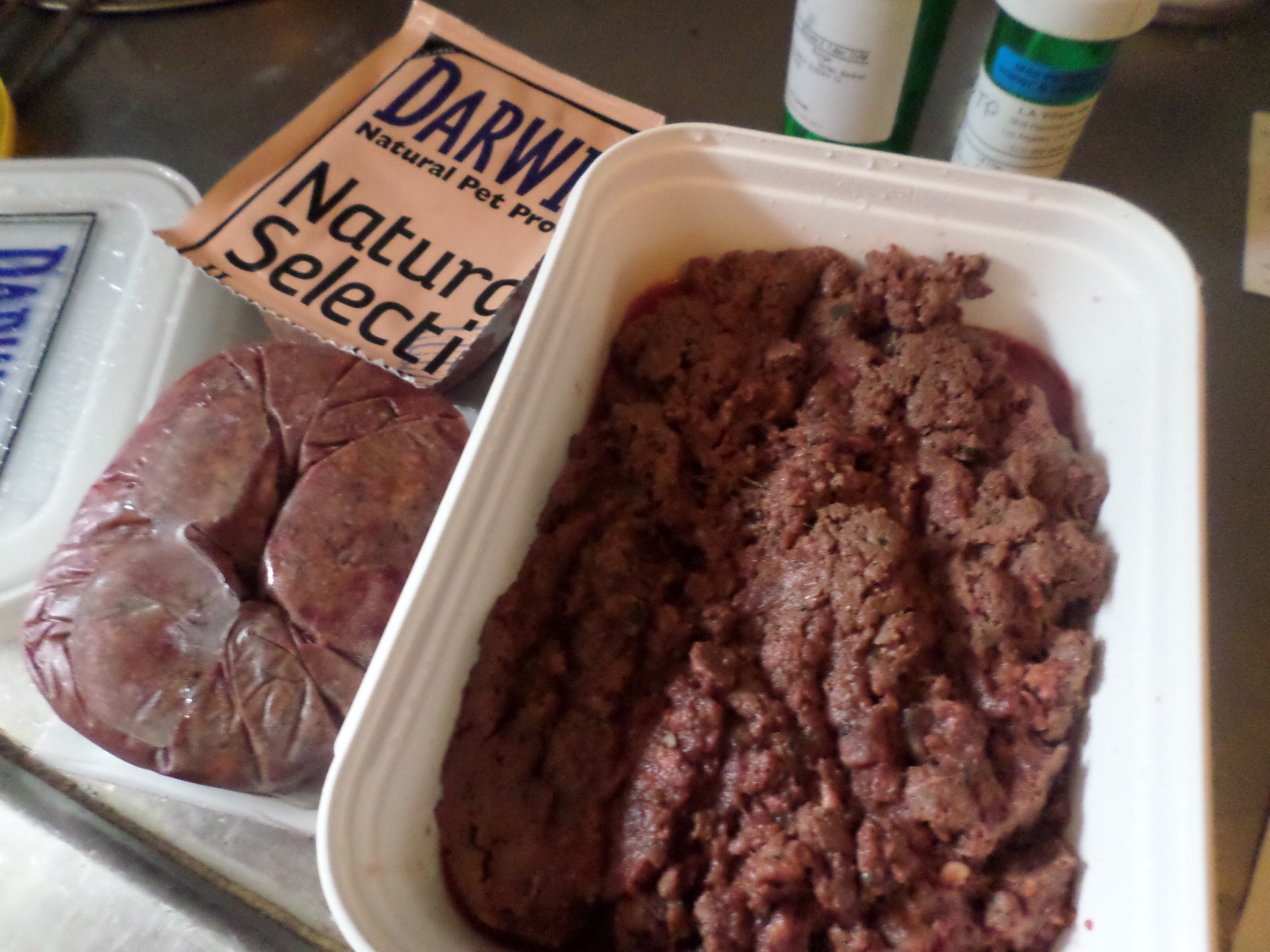
Left: raw, sealed food Right: Cooked RARE
This evening I started transitioning Boogie over to Darwin’s Pet food… I sauteed 1lb of food – as you can see in the photo the meat is still red in color – definitely rare – and added 2oz of this to his usual fully-cooked mix of meat and veggies.
I have a question – does “rare” meat keep longer than “raw” in the fridge? This is a transition period so I won’t be feeding all of this rare meat too quickly but I don’t want it to go bad sitting in the fridge for too long… How many days is safe? I suppose I could cook it some more…
Dognition games!
I can’t remember where I first heard about Dognition.com – I think it might have been via my Twitter feed. From what I can see, Dognition.com is a website that offers a series of structured games (or exercises) for dog owners to do with their dogs, and through these games, owners can gain new insights into their dog’s personality and cognitive style. I guess they are like doggie personality tests with no right or wrong answers, just an evaluation of how smart your dog is. The games are organized into these categories: Empathy, Cunning, Communication, Memory and Reasoning.
This week, I saw that Dognition were offering some games for FREE and I couldn’t resist. I signed Boogie up and had Nathan help out.These are short 10-minute games and I love that they are very clearly explained with video demos and step-by-step instructions; but you do need a human assistant to do them. One person has to follow the online instructions and log the scores while the other person interacts with the doggie. It’s hard to do everything at the same time with only one person, unless if your dog is well-trained to obey commands like sit and stay and um… Boogie isn’t very reliable. Well at least not right now, while he is suffering on Temaril-P (steroid meds) and might starve to death if he doesn’t grab the treat ASAP.
In the Dognition Empathy category, Boogie proved himself to be “bonded” to me.
Nathan: “He’s a boston terrier, after all!”
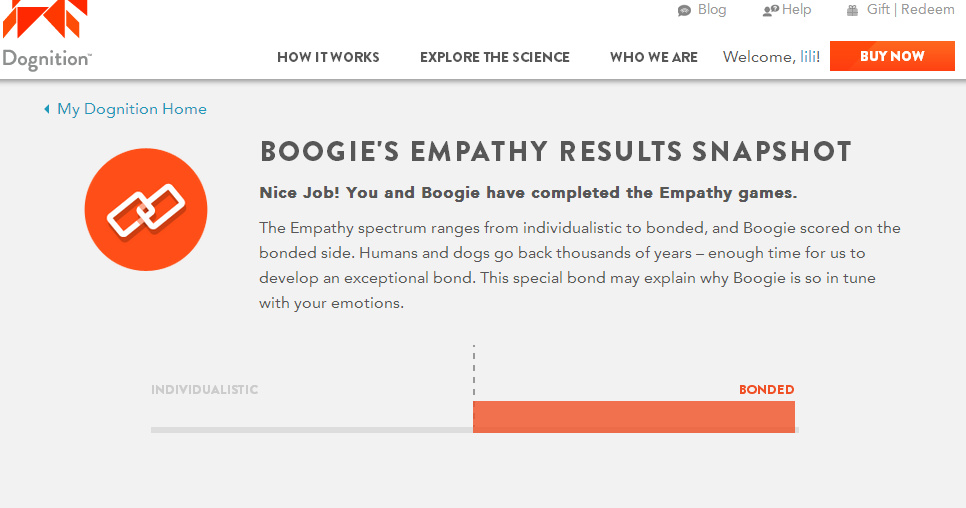
I did a series of yawns and Boogie yawned too. During the eye contact exercise, Boogie did not break eye contact at all even while he experimented with changing poses, from sitting to standing to lying down, to stepping back, to sitting down, to lying down again etc. Boogie . did. not. break .eye .contact. Except once or twice when he experimented with a quick head turn to see if these would earn him the treat. Yes, he has always been an eye contact champion. He can stare at me forever while I offer various behaviors trying to guess what he wants….

The Communication games revealed some fascinating results. I placed two treats on the floor in front of me at the same time, one on each side. I had to look at and point (first with my arm, later with my foot) towards one of these treats, alternating between left side and right side. This was a test to see if Boogie responded to where I was looking and pointing, or if he was more likely to make his own decisions.
Interestingly, almost every single time, Boogie moved towards the OPPOSITE treat – the one that I wasn’t pointing at.
The Dognition verdict?
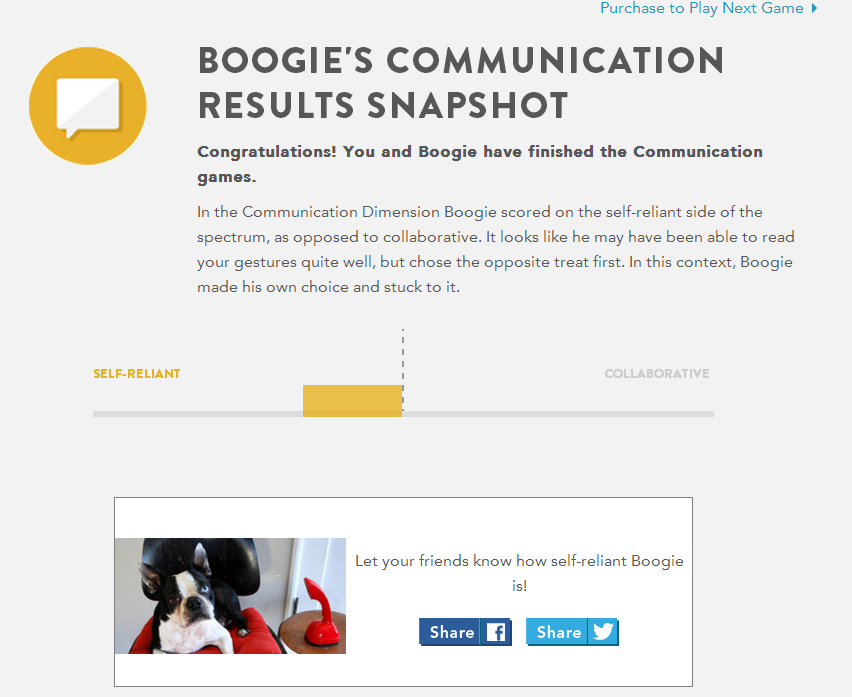
*I forgot to add: Boogie is sort of nervous around hands or feet … (he will rarely take treat that is placed next to a foot) I wonder if this had anything to do with his decision?
And so we completed the freebie games. To continue, I would have to pay for membership… not something I can really afford to do right now.

I am curious – has anyone signed up for full membership and done all the games? Your thoughts?
Products and supplements for skin issues and seasonal allergies
I have been receiving LOTS of tips and product/supplement recommendations from Boogie’s Blog readers. Thank you!!! I am going to list some of these items here for people whose dogs are suffering the same problems. I can’t tell you if all of these work because I have only just started using some of them, and keep in mind that Boogie’s skin problems are REALLY BAD.

it’s 100 degrees here in LA…
1. Apple Cider Vinegar.
I have been spraying a diluted mix of this on Boogie’s coat after his last two baths. I can’t tell if this is making a difference. I have been told by several friends that adding ACV to a dog’s food makes a big difference and eliminates the skin itchies so I started doing this today. We’ll see if this works. From this Whole Dog Journal article: “recommended dose usually 1 teaspoon to 1 tablespoon per 50 pounds of body weight.” According to our vet, diluted ACV also makes a good ear cleaner. I have ordered some ACV pills because I can’t stand the odor.
2. Witch Hazel.
I have been dabbing or spraying diluted witch hazel (the ALCOHOL-FREE version) on Boogie’s skin, and on mine too when I get insect bites. It is also good for cleaning “raw red areas” on his face from scratching, as well as his ears. I actually add a couple of drops of Lavender Essential Oil when using as an insect repellent. This helps ME (I am super attractive and allergic to fleas) so I am assuming it is helping Boogie too. I don’t know how it compares with the ACV in terms of effectiveness but it doesn’t smell as bad as the ACV.
Astringents work their magic by quickly tightening skin and subcutaneous tissue, and thereby reducing inflammation and redness. A classic example of such an astringent is witch hazel extract, which can be purchased in a clear liquid, distilled form at any drugstore. A dab or two of witch hazel applied by cotton ball can bring instant relief to angry flea or mosquito bites. (Whole Dog Journal)
3. Brewer’s Yeast and Garlic.
I bought a big tub of this stuff and have been adding a teaspoon daily to Boogie’s food for the past week. This is supposed to protect him against fleas. I can’t see any significant difference (yet)
Fleas particularly dislike the flavor of garlic and yeast (nutritional or brewer’s yeast). Mixing garlic and yeast with your pet’s food can render their blood unpalatable to fleas. However due to risks associated with garlic which affect cats and some breeds of dogs, it is generally recommend that you avoid feeding your pets concentrated amounts of garlic. (Eartheasy.com)
4. Fish Oil.
I have been adding Salmon Oil to Boogie’s food for years. It has made no difference whatsoever.
5. Coconut Oil vs Virbac Resicort Lotion
I was massaging Boogie with Extra Virgin Coconut Oil after every bath. The dryness disappeared and his skin was no long flaky. I found the coconut oil to be way more effective than the Virbac Resicort lotion that our vet recommended. Boogie likes to lick himself so I feel better applying something that is safely edible. And then I was alternating between the two “moisturizers”. I no longer use either of these because I am trying out the Apple Cider Vinegar spray and I can’t imagine that it’s healthy to overload his coat with too much stuff. p.s. The Resicort lotion has a very strong fragrance.
6. Pramoxine Spray
This spray is supposed to soothe itchy inflamed skin, but I couldn’t tell if it worked. It also has an overpowering fragrance (poor Boogie nose) so I would rather stick with Witch Hazel or something less intrusive.
7. Virbac Cortisoothe Shampoo… and other options?
Our vet gave us this shampoo and I bathe Boogie once a week. We have been using this shampoo for months…I think it might be a bit drying (hence the Coconut Oil/Resicort lotion), but I am open to trying other options. So far, people have recommended to me this Dermacton Skin Conditioning Shampoo Bar and also a Pine Tar or Coal Tar Shampoo. I haven’t tried these yet. Any thoughts?
8. PetzLife Complete Care spray
This natural pesticide-free insect repellent was recommended by Dr. Fox (SPARCS conference) so I have ordered some. I hope it’s fragrance-free…
9. Colostrum and Quercetin supplements
From what I have read, these are supposed to support the GI-tract and immune system, and quercetin would help with the itchies.
Quercetin is a bioflavonoid with anti-inflammatory and antioxidant properties. I call it ‘nature’s Benadryl’ because it does a great job suppressing histamine release from mast cells and basophiles. Histamine is what causes much of the inflammation, redness and irritation characteristic of an allergic response. By turning off histamine production with a quercetin supplement, we can suppress or at least moderate the effects of inflammation. (healthypets.mercola.com)
I may consider getting some if the Apple Cider Vinegar doesn’t work.
*edit to add:
10. Chlorhexidine (antibacterial) soak and spray
I still do this occasionally. I fill the bathtub with some water and solution and let Boogie soak his feet (if he is licking them excessively). I also spray him with this Duoxo Chlorhexidine spray. Interestingly, my dentist sent me home with a prescription for the SAME Chlorhexidine solution to use on my gums so I now have more than a gallon of this stuff at home.
11. Triamcinolone cream
From Dr. R (our previous vet). This is an anti-inflammatory cream that I use only on Boogie’s face when he has scratched it red and bloody.
Genius ideas
1. Home-stuffed Holey Ball! – I got this idea from 38 Brilliant Hacks for Dog Owners (Also see #30!!!!)
8. For a dog who loves to tear apart stuffed animals, make a durable activity ball with a Hol-ee rubber ball, scraps of fabric, and treats.
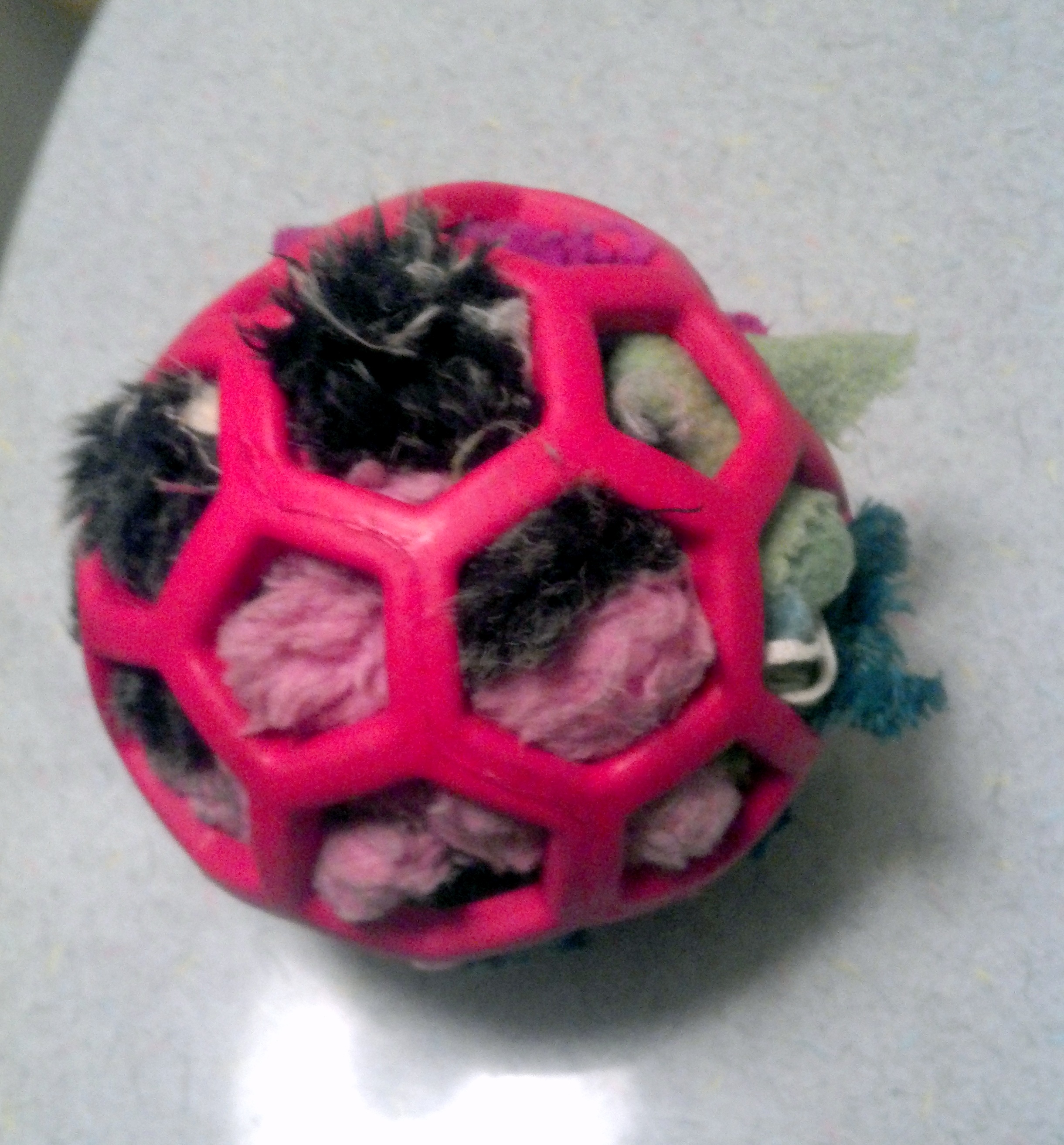
I may never need to buy plush/stuffed toys ever again. I stuffed this holey ball with scrappy fabric from old dismembered plush toys. It took Boogie 20-30 seconds to unstuff it. But oh it was so much fun! And we can do this over and over again!
Just received a handy tip from Melita on Facebook: “Maybe knot some of the scraps onto the ball?”
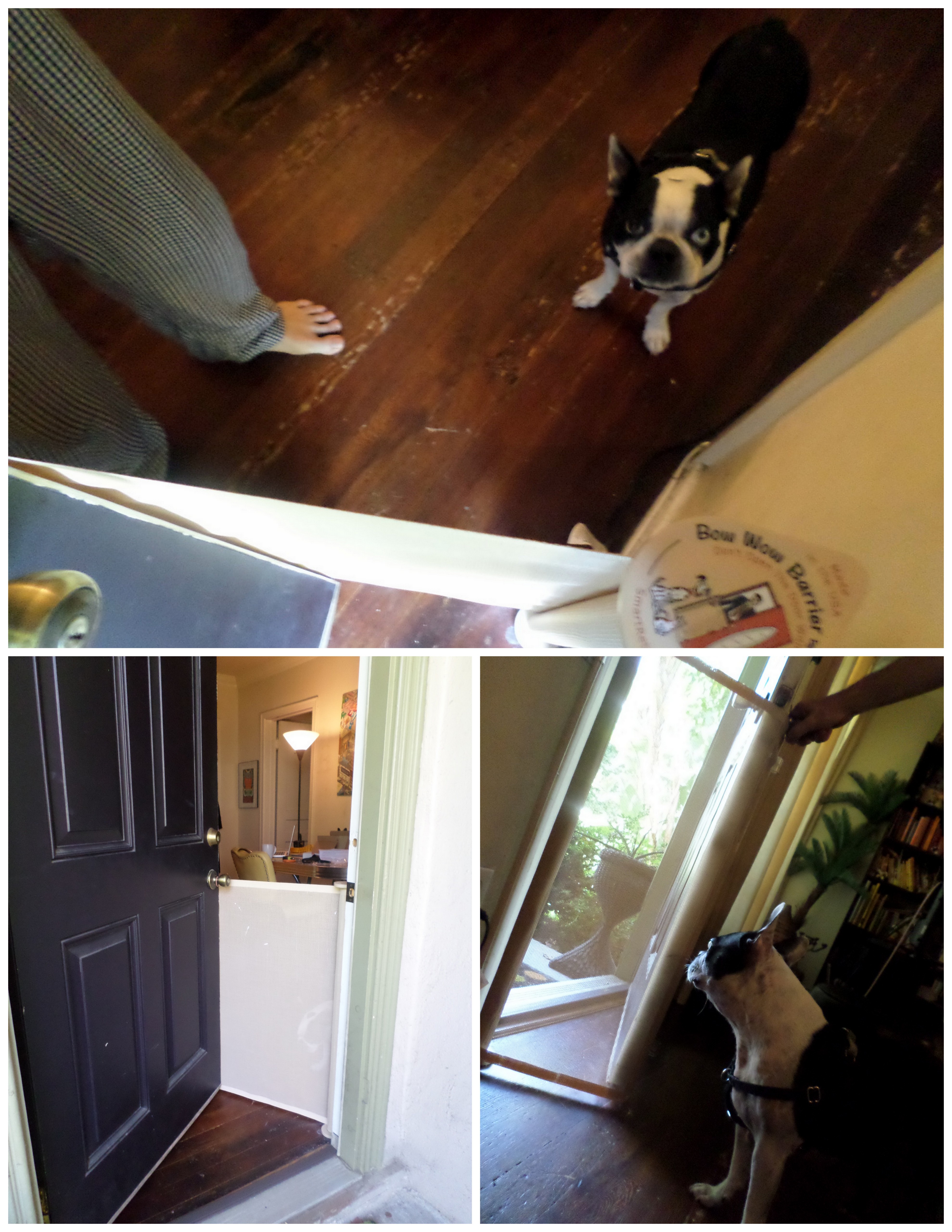
2. “Bow Wow Barrier” Retractable gate. A big thank you to the lady whose name I don’t remember (at Grisha’s L.A. BAT seminar) who told me about this local company. There is also a UK company that makes a similar product but international shipping costs more than the gate itself. Last week I ordered the Bow Wow Barrier gate and today, Nathan helped install it. If you LIKE Retract-A-Gate on Facebook you get a discount coupon. This is a genius concept and is way less cumbersome and aesthetically-intrusive than a regular baby gate. The tough mesh fabric is see-through from the inside (good for Boogie) and unrolls when you open the door. The “gate” can also be unclipped from the door whenever you want. Will be VERY USEFUL when mail delivery people bring packages that I have to sign for, and when visitors arrive! *Boogie isn’t the kind of dog to run away, but he does always rush to the door to greet.
Sigh.
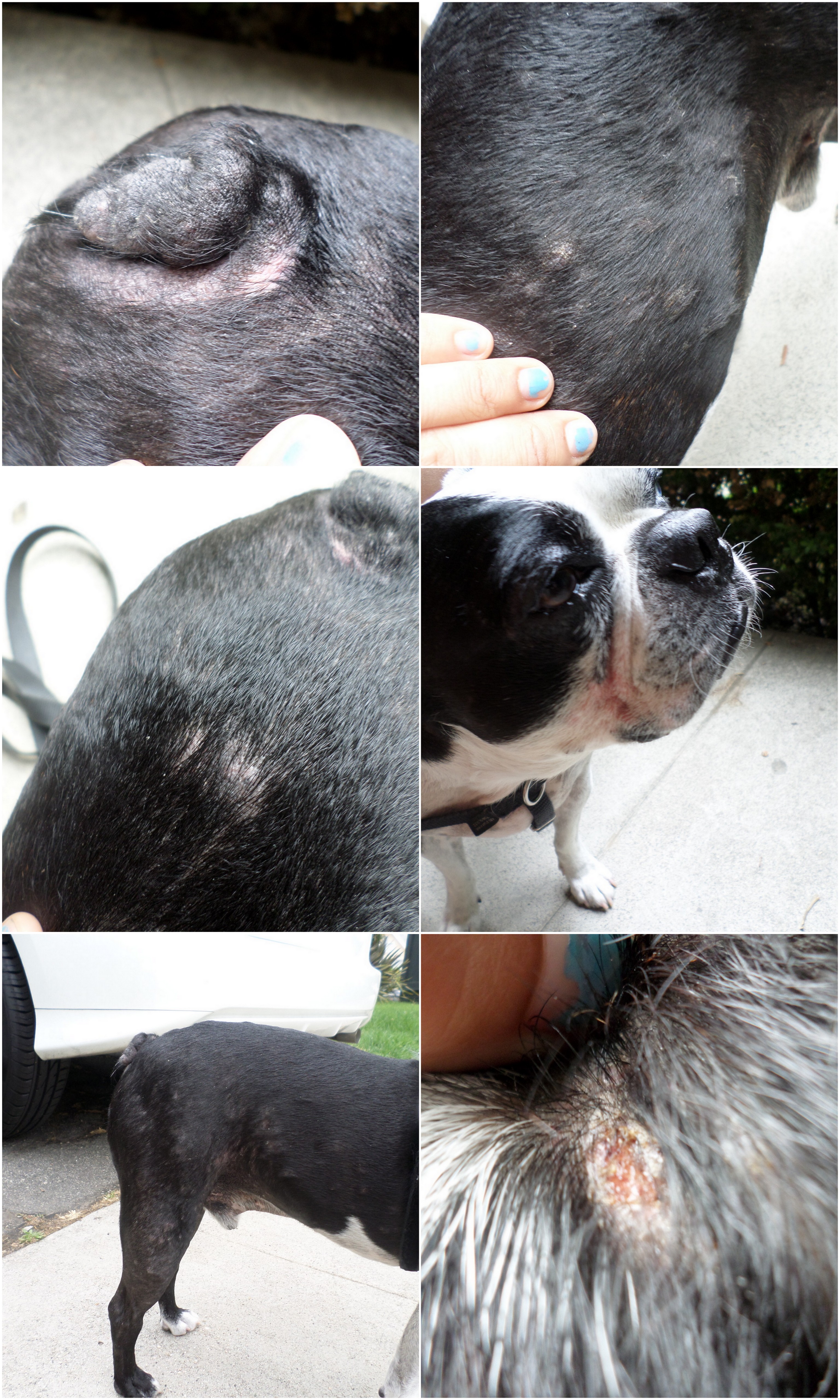
Poor Boogie
It breaks my heart to see him like this. He is so itchy and miserable. The allergic reaction has flared up really badly in the last week (combination of grass pollens and 1 or 2 flea bites) and in spite of the baths, witch hazel, coconut oil etc. it looks like Boogie’s skin issues have progressed to some sort of secondary bacterial infection because he has been chewing, rubbing and scratching himself raw and bloody, and the bald patches have spread. 😦
I read a recent article in THE BARK magazine that if the dog’s GI tract is healthy, this would be the BEST protection against allergic reactions, compared to antihistamine or steroid-type medications. Well, I thought Boogie’s GI tract was health-ier! Now I don’t know, anymore.
We have a vet appointment tomorrow morning.
And as skin issues are a “pre-existing condition”, we are not covered by Healthy Paws…. Sigh.
UPDATE: Since these photos were taken, Boogie’s skin got much worse. The sides of his body are full of bald patches. There are red bloody sores on his neck. Dr. F (Boogie’s vet) has prescribed Simplicef antibiotics and Prednisone. I hope the meds will help him feel better, not so itchy.
Beware the grass.
The most popular posts on Boogie’s blog are about skin issues. It astounds me that so many dogs have been experiencing the same problems with dry, crusty, flaky skin patches… (diagnosed as some sort of staph infection that started as an allergic reaction) and like me, their parents have tried almost everything including long courses of antibiotics. I got very tired of putting Boogie on Cephalexin every summer. You should see my impressive collection of Virbac shampoos and conditioners. The first year I adopted Boogie, he was on antibiotics for 1 week. Then it became 2 weeks… 3 weeks… 1 month… 2 months… and the antibiotics worked but the symptoms always came back more frequently, and our vet even suggested feeding Boogie a low dose of antibiotics every day for the rest of his life.
Well, last year I changed vets. Not only was his skin in a really horrible dry condition, he was losing his hair. His coat was so thin, the white parts were no longer white. You could see raw pink skin and grey freckles everywhere. Poor Boogie was going bald.
Four months ago, I changed Boogie’s diet and switched to 100% homecooked food using a balanced recipe from K9 Kitchen. I also gave him coconut oil massages for his skin – which did a lot more for him than Virbac lotions ever did. Boogie’s poop also looked excellent and very slowly, I could see that his hair was growing back.
The weather here in SoCal has been warming up again and in Summer, one thing Boogie loves to do more than anything is to roll around and crawl around in grass.
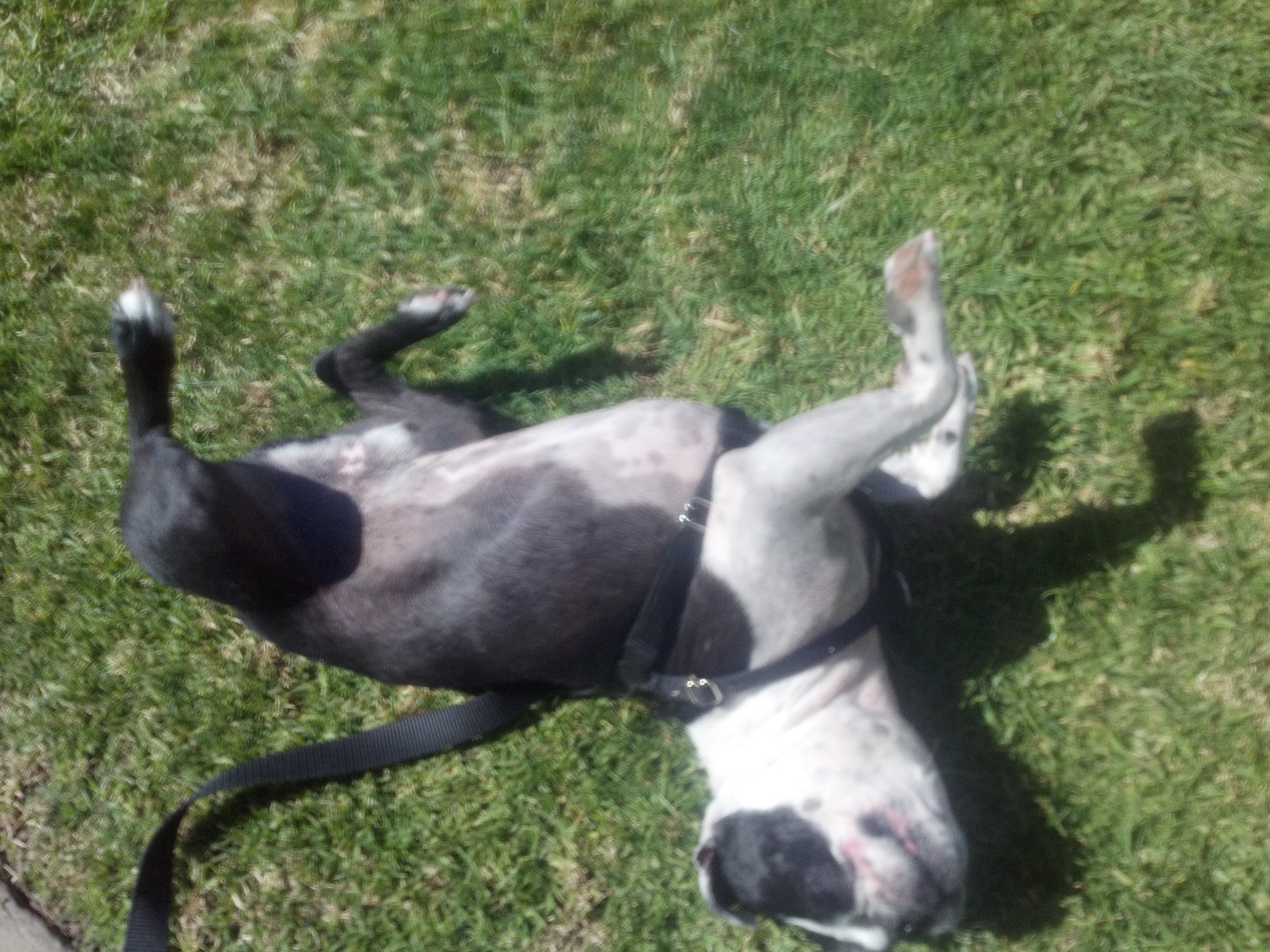
My mistake is that I have not been very vigilant about bathing him or washing him after these frequent grass-rolling sessions. Lord knows what they put in the grass around here.
The skin problems have come back 😦 The white, dry, flaky patches. The dandruffy coat. Boogie is scratching himself; and his hair is falling out. I am bathing him once a week, giving him chlorhexidine soaks and more coconut oil massages but the problem is not getting better.
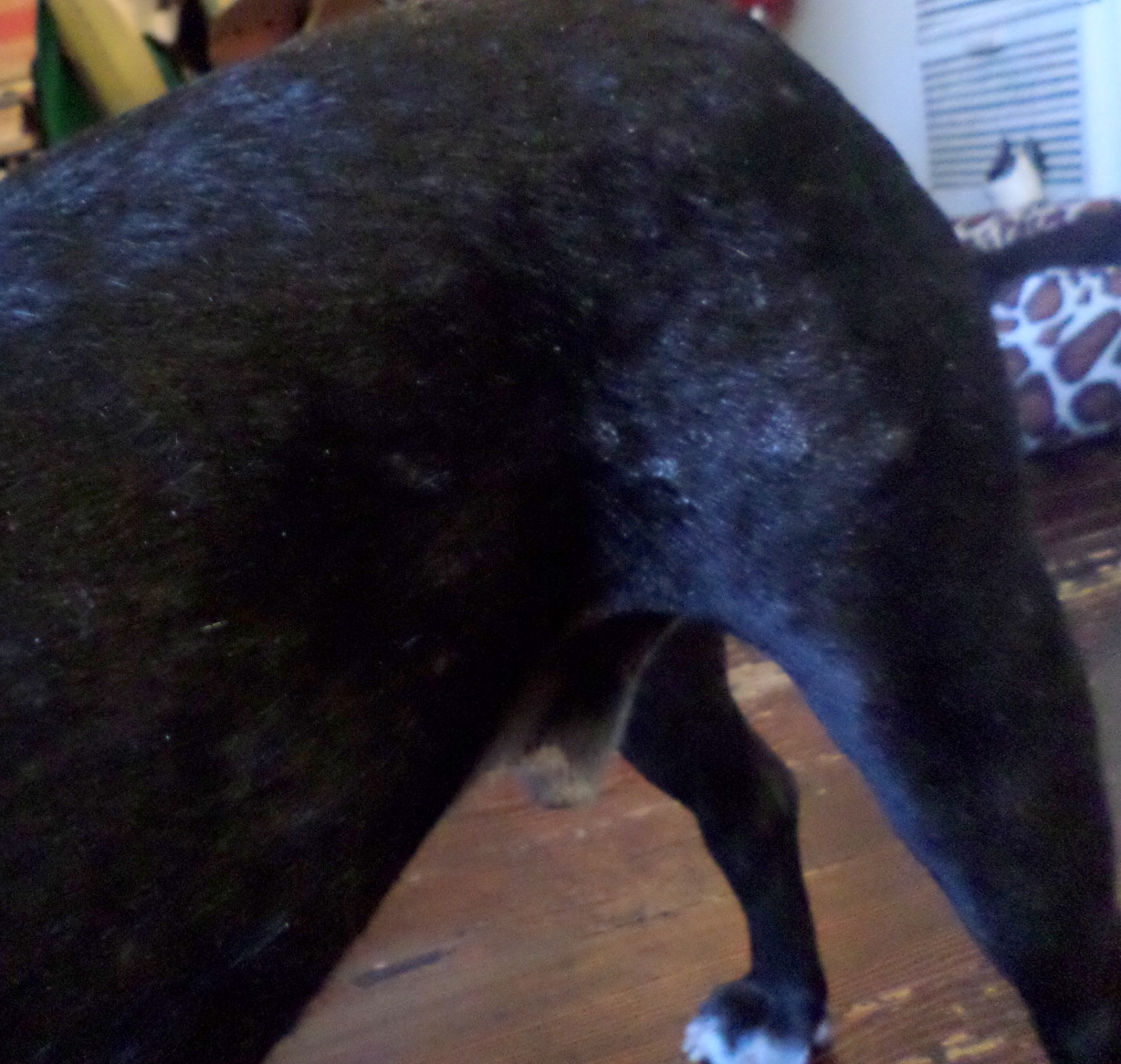
I need to figure out what to do, but here’s one thing that I am now 100% positively sure about. There is nothing wrong with Boogie’s diet. This is a seasonal and environmental problem. He is going to hate it so much that from now on, NO MORE ROLLING IN THE GRASS. 😦
PROCESSING… more thoughts about Boogie and BAT.

This is a follow-on from my previous blog post.
I want to write down and share a few events from yesterday simply because GOOD EXPERIENCES are worth remembering and sometimes I get emails from blog readers who are struggling with reactive dogs who ask me if Boogie has changed with the training that I have been doing. If he is a different dog or if he is better than before?
My short answer is that Boogie will still BITE if he feels threatened. He has done it too many times already (up to Level 4) and I don’t think I can ever eliminate this possibility. Boogie is a very sensitive dog, and he still gets startled and freaks out. BUT…. the biggest lessons I have learned are that I CAN help him relax and/or bounce back so he doesn’t freak out so easily. I CAN reduce the likelihood of him feeling triggered out on the streets, and I think he is doing really well in the context of my insanely busy neighborhood. Yes, he IS a different dog from 2 years ago. He is a much more communicative dog than he ever used to be. And whether it’s only because I am better at listening to him, or whether he has actually expanded or clarified his “body language” repertoire… I am not sure. Training works both ways, right?
Here are some more detailed examples of what I see as “progress”. Yesterday….
SCENARIO 1: GIANT MASTIFF
Boogie and I were out walking and he stopped to pee and sniff the ground. He didn’t see that a person and their giant mastiff had appeared on the other side of the street. Knowing Boogie’s tendency to be triggered by “sudden environmental contrasts” (SECs) — ie, he is ok with a group of people walking towards him, but may be triggered by 1 person appearing on a quiet street — I thought it better to point out the mastiff to him so he wouldn’t get startled when he finished sniffing the ground. (Raise head, strange dog WTF! , freak out)
I said “Boogie, Look at that!” (cue to look at something, then look back at me)
Boogie raised his head, turned around, looked at the mastiff.
Me: “Yes!” (mark the “look”)
I was quite surprised that Boogie didn’t want a treat. He turned away from the treat in my hand. Instead he took a few steps back to sniff the ground behind us. (calming signal, self-soothing behavior)
I waited. The mastiff had walked past by now.
Boogie looked up at me: “Ready for that treat, mom!”
I said “Good Boy!” and gave him a treat.
Did Boogie really just direct that entire BAT sequence himself with bonus reward? 🙂
SCENARIO 2: EXCITED CORGI
We were taken by surprise when we turned a street corner. Right there – a few steps away- was a man and his barking corgi – just standing there. I am not sure what they were doing but that corgi was pulling on the leash barking his/her little head off at Boogie. Not in an aggressive way, but super excited all puppy-like.
Boogie did not take his eyes off the barking corgi. This was not a good time to go anywhere even though my natural impulse was “Gotta get away”.
I waited. My thought bubble: “Relax the leash relax the leash, just breathe” Puppy still barking at my dog.
Then Boogie turned to look at me, and asked to walk in the opposite direction. We turned away together and left the barking puppy far behind.
NO REACTIVITY.
SCENARIO 3: ANGRY FRENCHIE
A man and his Frenchie were passing in front of us. The Frenchie stopped and stared at Boogie face-on. I recognized this Frenchie – he is left outside in his yard all day to run around barking at passing dogs. Boogie froze. I waited for the the Frenchie to keep walking but instead he was really stuck, just stood there (not sure what owner was doing) staring at Boogie before suddenly exploding in a fit of barks.
Boogie exploded back, pulling, lunging, barking. To me it didn’t sound like his usual “I am going to kill you, asshole!!!” bark, more like a “shut up, you idiot” bark.
Frenchie moved away. Boogie did a whiplash head-turn to look at me. He looked so proud of himself like he wanted a treat.
I gave him a treat for checking back with me and tried to console myself that THE OTHER DOG STARTED THE DRAMA FIRST even if I did not manage the incident very well.
SCENARIO 4: POLITE PUPPY BEHIND A FENCE
Yes, really. These 4 incidents happened all on ONE walk that lasted about 40 minutes. Welcome to my world.
There is a really adorable black puppy who hangs out in his yard, and he is the sweetest, most polite, most mellow-friendly puppy ever… to both dogs and humans. The first time we met this puppy (weeks ago), when Boogie looked at him through the fence just a few inches away, the puppy sat down, averted his eyes, turned his head away, went all “soft and curvy”, basically offered every polite signal in the Doggie Language book until Boogie relaxed. Everything was cool. Both dogs got to greet nose to nose.
We passed this yard again and this time the puppy (slightly larger than before) was lying down on the porch far away from the fence.
Boogie stopped at the fence and looked at the puppy. He would not move. Puppy stayed on the porch.
And I didn’t move Boogie because I felt that things would be OK with the fence there, and I knew that the puppy was super friendly and polite.
Boogie waited. I couldn’t see the puppy from where I was… but in a little while, the puppy was at the fence, wiggling AWAY from Boogie. Totally non-confrontational. Sitting and looking at me sweetly. Boogie turned his head away from the puppy and then I let both dogs sniff nose-to-nose through the fence. Puppy sat again, ears soft, body soft, all curvy and wiggly. Boogie’s body relaxed. I could see him soften then turn away. I gave both dogs a treat. Boogie looked at me as if to say “Puppy is cool. Let’s go”.
And on that peaceful note, we went home. 4 dog incidents. 3 good, 1 bad. Actually it should be 4/4 because the frenchie started it. 🙂 That’s a good score, ok?
MY THOUGHTS:
I was sort of struggling with the idea in BAT that “distance from the trigger” is reinforcing because it was often hard for me to tell if the retreat is really about “getting away from the trigger” (negative reinforcement) or simply “getting to move towards better things” (positive reinforcement). Most of the time I feel that Boogie wants to move away because he wants to move, not because he is trying to escape from the dog/person. And if there is no -R, then is Boogie really learning to cope with triggers? Or is he just doing what he wants to do anyway? How exactly am I marking and rewarding? Also, if there is no food, then how do we know what exactly is reinforcing to the dog and is it enough?
My experiences from yesterday remind me of a Dr Susan Friedman quote:
Control (over one’s environment ) is a primary reinforcer. To deprive an animal of control is akin to depriving them of water, food.
To the greatest extent possible all animals should be empowered to exercise personal control over significant environmental events.
I am starting to wonder if the Functional Reward in BAT has more to do with “control” or “agency” rather than “distance” per se. I am speaking about Boogie of course. I don’t know about other dogs.
Just this morning, we checked out a strange dog (sniffing around in bushes, on leash, next to his owner) from about 10 feet away. I noted that the other dog was calm and polite so I knew everything was safe. When Boogie was done looking at the dog – yes, I waited until he was totally done getting his information – we both very undramatically walked past that dog in a wide arc (as we usually do with dogs) and kept on moving. There were no reactivity or over-threshold signs whatsoever. Only genuine curiosity and disengagement. It was kinda wonderful.
ONE FINAL SCENARIO: HUMANS IN OUR TERRITORY
Later yesterday, Boogie and I stepped out of my apartment and there were two people in the front yard. Thanks to having done BAT set-ups in this location, Boogie would usually Stop, Look, then Turn to look at me and we would jog back towards the apartment, I give him a treat, before moving out again. (I stopped using a verbal marker when Boogie started being able to disengage and move away by himself)
Yesterday however, he Stopped, Looked at the two people in the front yard, looked at me, and turned 180 degrees away towards the back exit. He didn’t care about a treat. He wanted to leave via the back way instead. Of course I can’t read Boogie’s mind but my guess was that he was saying to me “Let’s not do the back and forth thing this time, Mom. Let’s just go THIS WAY. Path is clear”.
“Thank you, Boogie!” and I gave him a treat.
So I think what I personally take away from these experiences and the BAT seminar are what Susan Friedman said about Control as a primary reinforcer, and I see that when a reactive dog feels he has control over his environment and can move where he wants to move, this can be a powerful reinforcer for non-reactive behaviors. Classical Counter Conditioning is happening at the same time too, right?
I have always felt that Boogie is cool if he has time and space to process things. Grisha has reminded me a couple of times that when Boogie is done looking at the trigger, and does not want to go back and look at the trigger again, I shouldn’t ask him to (not even if I ask him really nicely). The whole experience should remain the DOG’S CHOICE and be completely non-aversive.
On a final note, to people reading this blog, I don’t want to give the impression that we should phase food rewards out of training. I know some people are concerned about this no-food thing, with regards to the fate of “Positive Reinforcement Dog Training” in the broader public context, where old-fashioned punishment-based food-hating trainers still dominate the media. What I am learning now is how to use food rewards with more awareness and sensitivity towards what Boogie is feeling and not rushing things.
Related links:
EileenandDogs: http://eileenanddogs.com/2012/10/31/thank-you-susan-friedman/
Patricia McConnell: https://www.patriciamcconnell.com/theotherendoftheleash/tag/bat
Click here for some Susan Friedman quotes I collected via Twitter
NEXT: I still have notes from January’s Clicker Expo that I need to share. Coming soon!
L.A. BAT Seminar, Boogie’s session with Grisha Stewart
*slightly edited – May 18th*
Two weekends ago, I attended Grisha Stewart’s first ever BAT seminar in Los Angeles.
As you know, I have read Grisha’s book which I illustrated (see link on right side of this webpage), watched most of the DVDs, I have been occasionally following the functional rewards yahoo group, and done mostly “stealth BAT” on the streets with dogs behind fences. However, in terms of formal BAT set-ups, I am not that experienced – having done only about 4 set-ups in the past few years – mostly with people triggers – and only up to BAT Stage 2.

Grass is good!
Backtracking a couple of months ago, Boogie volunteered himself as a BAT student dog at Balboa Park in Encino. Thank you to CBATI instructors, Ellen Gerdes-Naumann and Kristin Burke for setting this up! I found it all to be a bit chaotic because Boogie was very distracted by everything around him, and it was really hot. At first I had little luck convincing Boogie that the decoy border collie was more interesting than the tennis balls flying about in the courts, the squirrels and rolling in the grass. There was so much happening around us. (Boogie, pleeeease look at the dog…. we are all counting on you to make this a successful BAT session)
We eventually we closed the gap between Boogie and the collie and there was a brief greeting. I got a bit nervous about Boogie’s intensity and jerky movements (which is what usually happens during Boogie-dog greetings) the raised hackles, and his slapping his paw on the collie’s back, trying to hump her and all that. The instructors reminded me to keep my leash loose and Ellen offered this useful tip: “When in doubt, look at the other dog. If she is not worried, don’t worry. Everything is fine.”
And then last week after the seminar, I was very privileged to have Grisha Stewart – the founder of BAT – and her dog Peanut over here to do a dog-dog BAT session with Boogie and me. Peanut and Boogie did a Parallel Walking session and Irith and Sarah took video and helped me organize myself, reminding me to mark, relax my leash hand, also notifying me whenever a stranger or mail carrier approached. And then after the session, we all viewed the video footage and analysed Boogie’s movements and my (crappy) leash handling skills in slow-motion.
Here are some notes from the weekend’s BAT seminar including general thoughts:
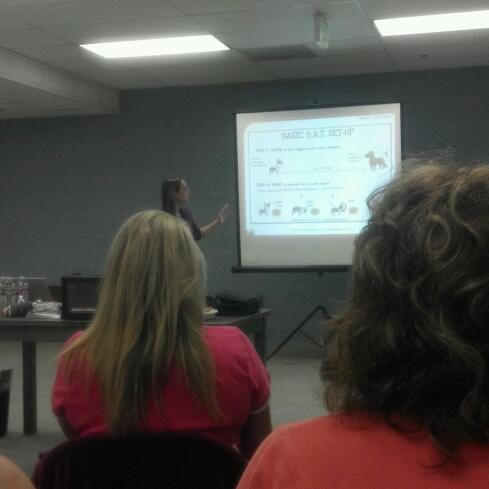
It’s Boogie on the screen!
1. BAT IS ABOUT THE DOG’S CHOICE.
I don’t think I really fully understood this before. In addition to marking and rewarding polite behaviors and/or cut-off signals, a key feature of BAT as a training protocol is letting the dog choose. In other words, asking and listening to the dog. The dog chooses if he wants to get information from the trigger. The dog chooses when he is done and ready to move away. The dog chooses the direction that he wants to move away to…(Not necessarily a straight line back and forth) The dog chooses the non-food reinforcer (functional reward)… which may be sniffing or moving forward. Unlike in other training protocols, the BAT handler isn’t supposed to be controlling the dog’s movements, only paying attention and helping the dog stay below threshold. There should be minimal verbal communication and leash pressure at all times.
“The Five Second Rule” came up as a great example of letting the dog choose.
Grisha: “Socialization should be on the dog’s terms, not ours”.
If the dog comes to you and leans into you, then pet the part of his body that is closest to you. After 5 seconds, stop and wait. If the dog wants more petting, he will let you know by leaning in some more. If he is done, then we should respect that he is done and honor his need for space. This respect for affection boundaries should work both ways. When we are done giving affection to a dog who wants more affection – we should give him an “all done” signal. This is a great YouTube video about asking the dog if he wants to be petted.
2. NEW LEASH SKILLS.
In the seminar, we did leash-handling exercises and took turns to be the “dog”. One person held one end of the leash in their hand, the other person did the handling. It was quite a revelation to be able to feel the tiniest softest amount of pressure on the leash. The point of this exercise was to show that dogs can feel the lightest movements of the leash. We don’t need to pull them.
“The dog should always feel like he is OFF LEASH except when you stop him to prevent him from going over threshold”
Grisha and Sarah both suggest that I learn the Silky Leash Technique... (Me: “Yes I illustrated this for the book but I have never tried it”) Watching the video playback, I notice that I tighten the leash way more often than I think I do, and I do this unconsciously a lot of the time…and whenever the leash tightens, Boogie’s body leans the opposite way.

Two leash techniques covered in the seminar:
The Slow Stop: “Use when your dog starts to be magnetized towards the trigger, or just whenever you want to stop.” The idea is to give your dog warning that you want him to stop without yanking the leash. It’s like slowly braking a car vs. slamming on the brakes. Stopping too abruptly can lead to the dog exploding. I really like this Slow Stop technique. I have been doing this every day since the seminar and it makes a big difference! I can see Boogie in front of me … his body axis goes from forward-leaning to more centered as he stops. I am using it also as soon Boogie pulls on the leash. When he stops, I wait for both of us to rebalance before we continue walking.

Mime Pulling or How to Change Direction: Get into your dog’s peripheral vision (270 degrees) and “Mime Pull” = slide left and right hands along the leash – without actually shortening the leash. Call your dog (or make kissy noise), bend knees, turn your body towards where you want to go, so your dog follows. We are giving the dog information (leash flutter) that we are changing direction, without physically pulling him to move. Unfortunately, mime pulling doesn’t work on Boogie when he has his mind set on where he wants to go and will even lie down on the pavement to make his point. But maybe it will work if I could master the Silky Leash Technique….

3.WAITING FOR DISENGAGEMENT. UNDERSTANDING “Cut-off Signals”
In BAT when the dog is looking at the trigger or decoy, the dog is using all his senses to get this information: “Is it safe for me to turn my back? Do I need to fight?”
The idea is to wait for the disengagement to happen naturally, however long it takes, without prompting or calling the dog. We prompt or call only when the dog is stuck and likely to go over threshold. A big revelation for me this week is that while a dog may look like he has turned away – and may give the impression that he has disengaged – he may not actually be fully done. The nostrils may still be twitching, the body may still be leaning forward slightly, ears flicking, and if/when you mark “Yes!” he may not want to move because he is not ready. In which case, we should keep the leash loose, rebalance, exhale, wait…
This step is not always easy because it takes knowing how to read subtle signals really well in the context of what is happening – and this is why it has been super helpful to have a professional set of eyes around to interpret what is going on, and also to have video footage to review, to see missed signals.
There was a demo dog at the seminar- Kiku, an Akita – who, to my less-experienced eyes, looked pretty relaxed facing the trigger 60 feet away. Before this BAT seminar, I would have marked the smaller signals, which I now know, did not indicate that the dog has truly disengaged.
Video of BAT demo session from the seminar:
Several times during Boogie’s BAT walk, when I marked “Yes!” Boogie did not want to move. When we replayed the video from our session later, (with Grisha doing Boogie’s voice-over: “Let me see how many ways I can turn my head”) it was clearer that Boogie disengaged only when he was able to turn his whole body away. He was still engaged on the other dog even when he was turning his head and looking at me.
Video of Boogie turn-away:
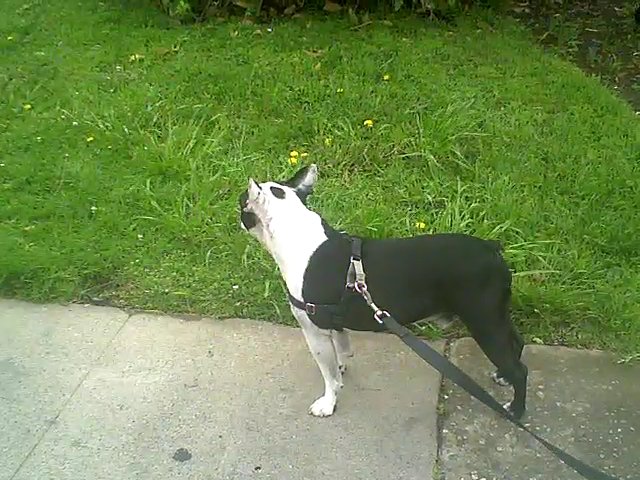
waiting for Boogie to disengage
Maybe it’s because I have reinforced so many Boogie head turns in the past (assuming he was fully done when he may not have been) that for Boogie, head turns = good things = we get to move!
I had thought that the whole point of marking and rewarding polite behaviors was so that these behaviors are more likely to happen… and that this is a good thing and this was the whole point of BAT. However, now I am seeing that there is a distinction between trained behaviors and the dog being ready to move away or move forward, and in BAT we are supposed to honor the “cut-off” moment, more than the smaller behaviors…
Sarah: “This is not like Clicker Training where you click for a high rate of reinforcement. We are waiting for the dog to make a choice.”
Grisha: “The more it is the dog’s decision to turn away, the more that he will learn”.

From the BAT book
Sarah offered a useful tip: Think of the verbal marker as a question, like a “Ready?” or a “Done?” (vs “Yes!” which feels more like a cue/command to move) This choice of verbal marker doesn’t make any difference to the dog , but it helps us get into the right frame of mind. I really like “Ready?” or “Done?” because I need a different cue anyway, for BAT Stage 3. Whenever I say “Yes!” Boogie looks at me like there is going to be food. I also don’t want to poison the “Yes” that I am already using in non-BAT contexts if I don’t follow up the “Yes!” with food as primary reinforcer.
So change and progress are relative… I remember during our very first BAT set-up years ago, the best cut-off signal we could hope for back then, would have been a single eye-blink to break the eternity of Boogie’s staring and stillness. And then he started offering more eye-blinks, softened ears and head turns. These days, Boogie is a much more relaxed dog than he used to be and generally less stiff and stuck on things. But of course, now for me to be sure that Boogie is really done, I have to wait for bigger signals; bigger changes in his body language.
Yesterday, I was thrilled when Boogie looked at a large dog who was staring at him, and on his own (with no prompting from me) chose to turn away and sniff the ground. This morning, a hyper little dog appeared on my front lawn. Boogie turned his head to look at me the first time. Yes and walk away. The second time he looked at the little dog and did a big shake off. I love it when this happens.
Video: full body disengagement “Yes, I am done here.”
Seminar note: The approach and retreat can be in a zig-zag or curved direction. It doesn’t have to be in a straight line.
During the seminar, Grisha made another interesting point about disengagement and why we don’t call the dog; why we wait:
“Be careful. Dogs with a huge amount of obedience training may not have really disengaged from the trigger just because they walk away with you when you call them.”
Alas, I don’t have the problem of an “over-obedient dog”.
4. THE “FUNCTIONAL REWARD” may not be what you think it is.
“It is always the dog who decides what the Functional Reward is.”
In the seminar, Grisha brought up a cool “Functional Reward” example: The case of a dog’s reactivity towards a cat. First we have to figure out what is really happening. If the dog’s reactivity is predatory (the desire to grab something), then the functional reward can be a game of tug. If the reactivity is fear-based, then the functional reward should be distance away from the cat. Each time the dog engages and disengages, we would mark and reward by letting the dog move away from the cat. At the same time, we can also reward the cat for being calm. The cat’s reward = getting petted, & dog moves away. This way, we are honoring both animals’ need for space; and both dog and cat are BAT-ting at the same time.
In BAT, distance or space is the major primary reinforcer and I learned this weekend that this doesn’t always have to be literally moving backwards. Moving forward or sideways, may be more reinforcing than moving backwards. Sometimes moving in itself is reinforcing. Or moving backwards only a few steps (Boogie: “Why are we walking so far away?“).
Boogie would rather move forward in the direction that he wants to go in, than retreat. In which case, a diagonal movement forward may be best so that he doesn’t get too close to the decoy. Or as Grisha suggested for future BAT set ups: the decoy dog could be walking behind the student dog so that the functional reward for the student dog is moving forward (away from decoy). Several times, Grisha also had Peanut retreat as the functional reward.
Irith suggested that the “Monster In The Middle” set-up would be a good one for Boogie, because he gets to keep moving, provided that the decoy dog is super mellow and has no issues being circled by another dog.
During our BAT walk, when Boogie stopped wanting to retreat and made it quite clear he wanted to walk forward in the direction of the decoy, we assumed that he wanted to get closer to Peanut. Grisha moved Peanut off the path to one side and when I led Boogie forward, Boogie walked past Peanut without even looking at him. It seemed that the true functional reward in this trial was WALKING FORWARD south on Lyman towards Hollywood Blvd where we always walk, every single day. The familiar route that may lead to stinky stuff in the bushes outside the Goodwill parking lot….
Grisha: “Boogie has the neighborhood mapped out and he knows exactly where he wants to go”.
So I am still a little confused here about the Functional Reward and if it matters whether or not this is a Negative Reinforcer = moving to get increased distance from Peanut, or a Positive Reinforcer = moving to get ahead to good stuff on Hollywood Blvd. Is this distinction relevant? Are we supposed to set things up so that the movement away from the decoy is still about the decoy?
I want to be sure that Boogie is learning the right stuff and if I am reading the situation correctly. If the decoy is becoming invisible after the initial engage-disengage, I am still (without a professional set of eyes present to help me out) not sure how to tell if this is a case of Boogie thinking “I am feeling safe enough now. Let’s go” or if it’s an elephant-in-the-room scenario of “I really can’t handle that dog at all. Let’s pretend he doesn’t exist”.
Grisha said that if Boogie is completely ignoring Peanut (elephant in the room), this is a sign that we are working too close, we should not push, we should make things easier for Boogie. We either increase the distance between the dogs, or switch to Stage 2 with clicks and bonus food rewards. Which is what we did… a combo of Stage 2 and Stage 3.
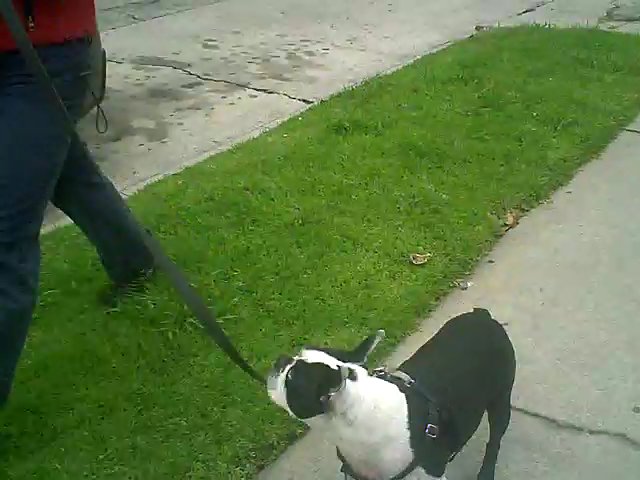
Click, move away, treat
5. On not using FOOD. (BAT Stage 3)
At the seminar, Grisha had made some thought-provoking comparisons between BAT and other training protocols … and in most cases food was a big issue. Ideally, BAT should be done without food rewards if we want the dog to really learn. Some examples:
BAT & “OPEN BAR” COUNTER-CONDITIONING.
With BAT, getting information (“looking” at trigger) = safety. The dog has a choice to be pro-active. The dog also has a choice to move away. With Counter-conditioning (overfeeding), the dog is so motivated by food they are not learning to process what is really happening in their environment. CC is not an active process for the dog. The trigger appears and disappears. Food appears and disappears.
I still use counter conditioning with PEOPLE on the street because people come and go so quickly, AND because I can’t faithfully predict which people are triggers and which ones are safe for Boogie, it’s easier to do CC with every single person. This protocol has worked really well for us. Now Boogie turns to look at me on his own, when he spies a trigger. “Weird guy approaching. Where’s my treat?” Otherwise, he just moves off to sniff and ignores the person.
BAT & CONTROL UNLEASHED®
In CU, triggers are cues for the dog to focus on the handler. According to Grisha, many highly structured click-and-treat “focus-on-the-handler” games are great for management and survival but don’t really teach the dog how to cope with triggers. Reactivity/aggression/frustration issues are not so much issues between the dog and the handler, but between the dog and his environment. In BAT, we honor the dog’s need to process his environment (“is it safe for me to turn my back?“) instead of having the dog stare at the handler all the time. In BAT, when marking and rewarding the dog’s “look away” from the trigger, this doesn’t necessarily have to be on the handler.
I haven’t done CU exercises except for “Look At That” so I am not qualified to comment. I still ask Boogie to look at me when people appear on the street as part of CC. However, whenever Boogie turns away from a trigger and looks somewhere else or does something else (eg. ground sniffs) instead of giving me eye contact, this always feels so much more rewarding for ME. Then I know that he really isn’t turning away from the trigger just to get a treat (as he does with CC) and that he is able to handle things peacefully on his own.
Grisha: When we don’t use food rewards, we get a more honest answer from the dog… we get a more real baseline of what the dog is feeling. Food also makes a dog conflicted – even though he would really prefer to move away, he will eat. The other problem is when people punish or correct their dog – this teaches the dog to hold it all in; the dog “lies” to us, we don’t see what he is really feeling.
My visual summary:

#3 is BAT
*Edit to add: I don’t want to give the wrong impression with my illustration above (which I may revise) to suggest that BAT should replace other techniques or that it is better than other techniques. I wanted to mainly show where the dog’s brain is at, in each example, based on my seminar notes. I am copying and pasting this from Grisha’s comment :
Dogs need to really get information about the trigger and if you can use open bar / closed bar classical counterconditioning (CC) or clicker training focus to get close enough to experience the trigger and figure out that it’s safe, rehab is likely to happen. You can even combine tools to allow the dog free choice throughout, but sometimes have food. However, if the dog spends all of her time doing the windshield-washer thing (see man -> get treat, see man -> get treat) then the dog doesn’t have a chance to process the information.
Doing punishment-based ‘obedience’ near the trigger is a common technique with potential for even worse fallout, because the dog is distracted AND the dog can make a negative association with the trigger. At least with food, the dog is having a good time.
6. CLOSE-UP GREETINGS.
BAT is really big on honoring the dog’s need for space. I think Grisha may have said that BAT is a “flight-based” training protocol – we reinforce the dog’s choice to walk away from a scary situation. ( example of a “fight-based” training protocol would be where the student dog might bark his head off at a trigger and the trigger only leaves when he stops barking. It has more of an anti-social goal )
Close-up greetings is a scenario that I feel the least confident about because I have done so few dog-dog BAT sessions or close-up greetings with new dogs. Boogie has his friends, but I generally err on the side of caution and avoid unfamiliar (or barky) dogs. Notes from the seminar:
- Prompt more than you would with dogs that don’t know each other. eg. Sniff, call away, treat.
- If one dog gives a cut-off signal, call the other dog away (if he/she doesn’t respond)

“Do you want to say hi?”

Boogie sniffs.
Above, photos of the final interaction between Boogie and Peanut. Grisha had Peanut’s butt facing Boogie for as much as possible during our walk up to the end of the session. (to quote Grisha: “The blunt end, not the pointy end”)
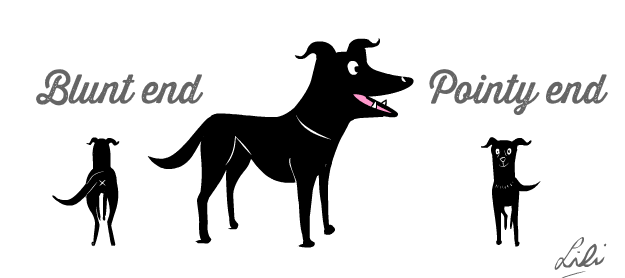
After about an hour of parallel walking, Boogie sniffed Peanut on the butt and I clicked. (BAT Greetings Stage 1) Boogie didn’t register the click the first time. He was so intensely sniffing. Second sniff, Boogie got even more intense and pulled forward to sniff Peanut’s crotch. After a short break from each other, I asked Boogie if he wanted to say hi again but he showed no interest in moving closer to Peanut and instead starting digging and eating dirt (sign of social anxiety, conflicted emotions).
Grisha: “He already has all the information he needed”.
We ended the walk with the two dogs standing pretty close to each other. I think they were both quite relieved that they didn’t have to do any more Parallel Walking. I live in an insanely busy neighborhood and both dogs were quite stressed. Grisha pointed out that more walks would have helped to lessen the intensity/stress of the greeting.
7. MY CHALLENGES
Sarah: “Listen to Boogie. Your job is to stay sensitive to what is actually reinforcing to him in that moment–while still helping him maintain a successful threshold distance in case he starts getting magnetized.”
Thanks to the BAT seminar and our BAT walk with Boogie and Peanut, I feel I have a ton of new information to process especially with learning how to handle the leash, remembering to relax and rebalance myself in order to help Boogie rebalance. I have learned now that BAT as a training protocol is actually a lot more fluid or organic than what I thought it was, and that in the past, I may have made things a bit aversive for Boogie by trying to stick to particular patterns that didn’t need to be stuck to, or not paying enough attention to Boogie’s thresholds & choices in relation to the general environment (not just between Boogie and an obvious trigger).
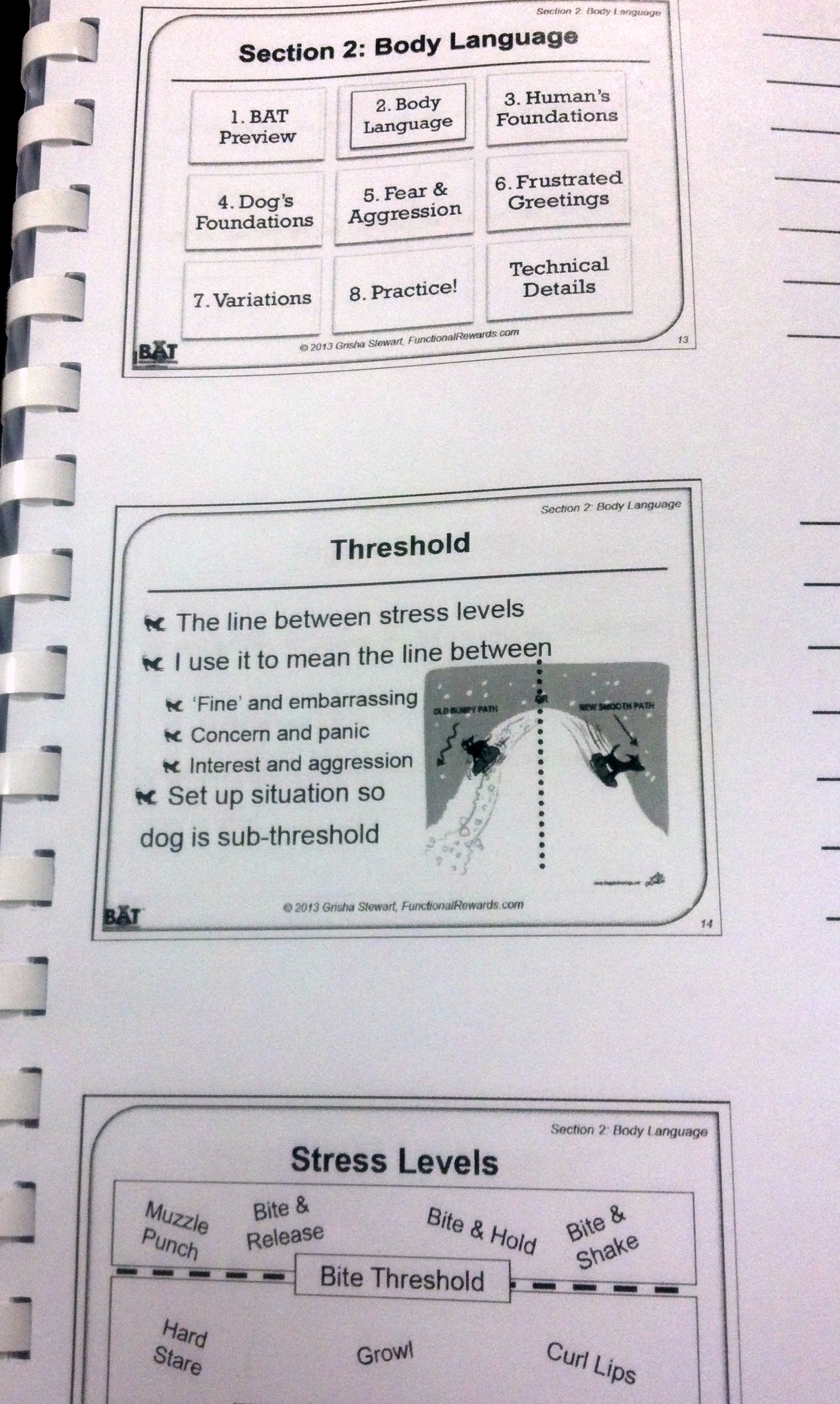
In the BAT seminar handout there was a diagram explaining the term Threshold = “the line between stress levels”. I think this has always been difficult for me. To identify where this Threshold is, exactly. I don’t want to have to let Boogie go into staring mode to gauge where his engagement zone is. (Quote Suzanne Clothier: “The Think and Learn Zone” = dog is able to split his attention between trigger and on handler) At the same time, I don’t want the opposite… I want to be sure he is engaging with the trigger, not purposely ignoring it because there are more interesting distractions around.
There is also the issue of Boogie not wanting to do BAT for long… almost as if he is bored, or it’s too much work. “Do I really have to go and look at that dog again? I already told you I am done. TWICE.”
After one or two trials, Boogie often seems ready to move on and away (“ok, I know this ol’ game”), unlike the dogs I see in Grisha’s seminar videos – who seem to happily walk back and forth, engage and disengage over and over again without other cares in the world. Would I be adding stress by having him continue BAT-ting? Or should we move on, and what exactly has been learned here? Would the fact that Boogie only wants to deal with the trigger for a very short period indicate that
1. He feels safe now ?
OR
2. Too much too soon – gotta get away from it all?
Miki sent me this Suzanne Clothier’s article on Thresholds: It’s More Than Under Or Over which I think it super helpful. ( Made me think of the Good-Cheap-Fast diagram… it’s a balancing act!)

Miki, Sarah, Grisha all brought up the same point: My environment is stressful. Boogie’s “Think and Learn Zone” is very tiny and narrow when we go on walks because there is so much stuff happening that I cannot control.
And so to summarize, I think the biggest challenges for me are still what they always have been:
- the fact that I live in a busy neighborhood with lots of people, dogs, traffic, etc. coming and going all over the place. There are so many factors outside my control. It’s as if we take 3 steps forward and 2 steps backward each day. And I don’t have a fenced private yard. Grisha suggested driving to a quieter neighborhood and practicing there.
- I can only do so much as one person. It’s hard to be vigilant about my environment (watch for triggers), practice better leash skills, and pay 100% attention to Boogie’s body language all at the same time. I need professional assistance for BAT and it would help to have video feedback. (A posse of people around with every BAT session?)
- I am not going to see significant progress until I do more BAT sessions in the right environment with nobody else around to distract Boogie or to distract me. It will be easier to read Boogie’s signals , understand his thresholds and functional rewards when we are in the right environment. Thanks to the BAT seminar, I may have connected with a few new people who have mellow decoy dogs we can practice with 🙂
Thank you again to Grisha, Peanut, Sarah, and Irith!!! – Lili & Boogie.
Disclaimer: Please note that this blog post is totally personal – these are my own observations, thoughts, and visual interpretations of the stuff I read and think about, and do not officially represent BAT. I want to mention this because I noticed that Boogie’s Blog is listed on the BAT Seminar handout 🙂
Protected: A bunch of Boogie PLAY videos. PW: boogs
March 18, 2013 at 1:21 am Enter your password to view comments.


 Boogie's blog