Posts filed under ‘Training’
The window film… Extinction burst?
About two weeks ago, I applied window privacy film to the windows in my living room. The plan was to manage Boogie’s running to the window and barking/growling his head off at whoever is outside in the shared yard of my apartment building. Following on from the theory that the barking is reinforced each time a dog sees the trigger LEAVING, if Boogie can’t see outside, then he would not have any reason to continue barking.
For the first week, I saw a big improvement. Boogie would run to the window, bark once or twice, not be able to see, whimper, then go back to his bed. Overall, he was quieter.
But then something else started happening a few days ago. Boogie would suddenly growl, jump up from his bed, run to the window, not be able to see, then continue barking, and start to restlessly pace around the living room, then going from room to room, moaning and crying and barking some more. The barking was no longer the aggressive “If you don’t F-off, I will kill you!” type of barking directed at people outside the window, but a “Help! I can’t see! I can’t see! There is something happening outside and I don’t know what it is! I don’t what to do!” panic-stricken type of barking.
I kept asking myself… is this an Extinction Burst?
Definition of Extinction Burst: If someone’s gained some reward every time for a particular behavior, the behavior will persist. If suddnely the reward stops coming, it’s likely that the person or animal will not immediately give up the behavior. Instead, they’ll try it again and again, harder, faster, more emphatically.It’s a burst of activity. If the reward still doesn’t come, eventually the behavior will extinguish, or become extinct. So, the burst of behavior before extinction of the behavior is called an “extinction burst”. (via this site)
Clearly, Boogie is so used to chasing people away from the yard, is he stressing out because he no longer has this sense of control? Or… is he feeling more insecure from not being able to SEE what the trigger is?
I almost feel bad for covering the windows. What bothers me too is that he has been extra trigger-sensitive on the streets. 😦 We need more distance from strange dogs…
So, I am working on a solution to this problem.

Fortunately, I did not cover ALL my window panels with the frosted film. I only covered the window panels that Boogie usually looks out/barks out of. If you look at the quick and rough doodle above, the reactive-barking window is WINDOW #1 and the greyed-out panels have the film on them. These windows face the neighbors.
Not too far away, WINDOW #2 remains uncovered by window film.. this is the window closest to my desk that Boogie rarely visits. I usually leave this window open to let fresh air into my apartment. These windows face the street.
Boogie knows he can look out of Window #2 but by force of habit, he is still running to and reacting at Window #1 whenever he is triggered by a sound. Even though he can’t see a thing out of Window #1. And if he is too over-threshold, he will continue to stay at Window #1 or at the door, barking and crying, forgetting that there’s that second window….
Backtrack several months. I taught Boogie the cue “Who’s there?” He would run to the Window #1, look outside, turn back to me and get clicked and treated. We did many repetitions to the point where I could effectively 90% of the time have Boogie GO LOOK OUTSIDE then voluntarily TURN AWAY from the window. Treat or tennis ball to follow. Basically, the Look At That game.
It occurred to me recently that I need to re-teach “Who’s There?” at the less-familiar and forgotten Window #2, and so I have started doing LAT games with Boogie at Window #2. I want Boogie to know that he is not trapped in a room without a view… he can still see outside, but in a structured way, without going over-theshold.
I am also going to play more music to drown out triggering noises. (Tip from the BAT book)
Tip from Sarah: Because Boogie is such a visual dog (he needs to SEE to feel in control) I could use “looking outside” as the functional reward. She suggested that I may want to tether Boogie to me so that as soon as he is triggered and before he goes over threshold, I can call him to me and then reinforce his recall by taking him to the window/door to look outside. See? Nothing. Nobody. All done.
Never a dull moment with dog training 🙂
We won an award! And ‘window film’…
First of all, Boogie’s blog won an Inspiration Award! Thank you so much to Pamela of Something Waggin This Way Comes. I feel humbled by this award because I don’t consider myself a “good blogger”. I post infrequently, and I don’t follow many blogs (except the training/behavior ones because I’m such a nerd) so I always feel a bit out of the doggie blogosphere loop.
Several weeks ago, I said I was going to cover my windows with ‘privacy film’ to manage Boogie’s reactivity at the window. Well, the roll of film arrived this week and this morning I started sticking the pieces to my window panels. In the photo below, the film has just been freshly applied to the glass with soapy water, hence the splotchiness and air bubbles. I still need to work that squeegy.


They say on the instruction sheet that it takes a few days for the film to dry completely, after which it should look smooth and clean like the photo on this page. I hope so!
The film lets light in, but you can’t see a thing out of it.

And here is what it looks like from the outside (with Boogie at the window).

So…Does it work? As I am typing up this blog post, I can hear the mailman outside…
Boogie barked once, and ran to the window, then stopped and let out a whimper. He is now back in his bed.
Next blog post: Notes from The Culture Clash byJean Donaldson. I can’t believe it has taken me so long to read this book!
National Train Your Dog Month: training resolutions
January is “National Train Your Dog Month” and off the top of my head, I have two training resolutions for the new year. Well, the first one is more of a management issue than a training one.
Problem #1: Barking at people outside my apartment
I have a bunch of new neighbors and Boogie has been barking at all of them, in addition to the regular trespassers (workmen, mailmen etc.) When I call Boogie, he comes away from the window. I usually throw a ball and his attention is diverted for a few seconds. Then he’s back there in a flash, growling, whining, and barking.
I have been telling myself that I can live with this problem … I mean, it’s annoying but it only lasts for less than a minute, he doesn’t carry on for too long .
The problem is that the barking is happening more frequently. It seems to be getting worse. Dog behavior fact: this noisy behavior keeps getting reinforced by the people leaving, so he will continue to do it, and it WILL get worse…

Solution #1: Cover the windows
I have just ordered free samples of “privacy film” for my living room windows. Perhaps I’ll stick these on the lower half of the glass windows and Boogie will not be able to see out of them to react. (Thank you, Rewarding Behaviors blog) I hope my windows won’t look too unattractive… We’ll see.
Solution #2: Counter-Conditioning? Today I heard the mailman arrive and saw that Boogie was curled up in his bed (not yet aware of the mailman). I got down to the bed-level and gave Boogie a massage… lots of petting, stroking, belly rubs and more belly rubs. He rolled on his back looking all blissed-out. In the background we could both hear the clanging of mailboxes and jingling jangling of keys. I was half-expecting Boogie to spring out of bed, run to the window and go crazy. Well, he didn’t do that. He remained on the bed, relaxed, letting me rub his belly. I stopped when the mailman had moved away from my building.
I wonder – If I gave Boogie a massage every day at the same time as the mailman’s arrival … would he learn to chill out?
Or did his calmness today have absolutely nothing to do with the mailman?
Very interesting and useful video from Emily Larlham about making sure you have the right “predictor”:
Problem #2: The place is a mess! There are toys everywhere. Every day, Boogie goes to his toy basket, pulls all the toys out of it to get the toy that he wants and by evening, I am stepping over toys to move around the room. Of course, I pick them up, put them back, and before long, Boogie pulls them all out again. I suppose the easiest solution is for me to not let Boogie have 24/7 access to those toys and keep them out of sight until it’s play time.
OR… Could I teach Boogie to put away his toys?
So far, whenever I offer Boogie a toy to DROP into the toy basket, he does this a few times, then runs off with the toy to chew on it elsewhere. Or somehow, the training session turns into a game of Tug. It’s as if the ultra exciting combo of clicker + food + TOY gets him way too hyped to stay focused on what we’re doing… Clearly, I need to work on the “Hold” behavior first…
Question: Would I have to do this with every single toy? Will Boogie be able to easily generalize this “cleaning up” process to his gecko, rubber monkey, 2 steaks, 3 corn cobs, 4 tennis balls, little orange ball, red cuz, half-chewed plush animal limbs, blue octopus, pizza frisbee, dumbbell, two bones and plastic chicken?

Boogie is a DINOS (“Dogs In Need of Space”)
I read an awesome and much needed blog article today! –> “My Dog Is Friendly!” A Public Service Announcement
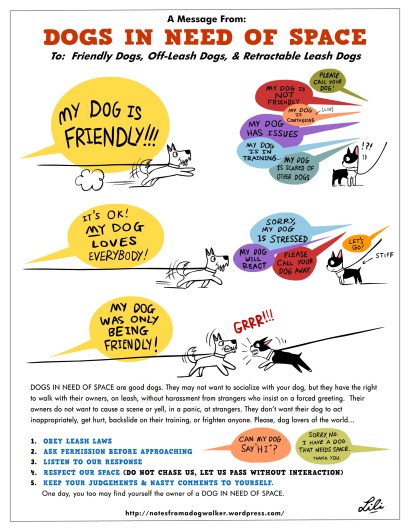
*Update: DINOS/DOGS IN NEED OF SPACE is trademarked. Please refer to the new version of the poster > “SPACE ETIQUETTE FOR DOGS” if you wish to download and share.
I cannot tell you how many times Boogie and I have been approached (or even CHASED) by dogs whose super enthusiastic owners call out: “My dog is friendly!” Or have MIDFs roll their eyes at me when they insist that their dog is friendly.
Take for example, yesterday at the vet’s office when a lady and her large-sized dog walked in. “My dog is friendly!” she said.
I had Boogie on my lap, in my arms, and I replied “My dog isn’t”. We remained on opposite sides of the waiting room and there were no incidents. Her dog was laying down turned away; Boogie was at my feet hypnotizing me to take him home.
Several minutes later when the lady wasn’t paying attention and I was busy talking to the vet tech, the dog walked on over and nosed Boogie in the butt. Boogie, who was facing the other way unaware that there was a dog approaching him, freaked out, turned around and snarled. The dog’s owner called out – “Sorry! I wasn’t looking” She pulled her dog away, then said in a very loud high-pitched voice so that the whole room could hear: “Mommy loves you very much! Even if the other dog doesn’t love you, mommy loves you!”
I tried to explain that Boogie reacted because he was startled by her dog. Another lady in the waiting room offered some moral support – “The dogs weren’t formally introduced”.
Well, it was still awkward to be the only person in the room with a growly dog. Suddenly Boogie was made to look like an asshole.
And then there are the MDIFs who – even after I tell them that my dog ISN’T friendly – continue to believe that everything will be OK because their dog is “friendly” or is “good with dogs”. Or that they themselves are god’s gift to dogs, all dogs love them, and I’m just uptight or something.
Sure, Boogie is a sweet and friendly dog, but he is sensitive, extremely discriminating and does not instantly become friends with every dog and person that he meets. Boogie needs some space and time away from the new person/dog at first. If the person/dog is large, he needs even MORE space to make up his mind.
For a long time, before I saw the Turid Rugaas DVD and learned about BAT, I had no idea that when dogs reacted it was because they needed SPACE (or distance from the trigger). Space, as a functional reward and training tool is so underrated! I don’t think a lot of people know this. And MDIFs especially, need to know this.
More links:
This DINOS Manifesto which inspired the illustration above.
P.S. People with DINOS, I recommend Grisha Stewart’s BAT book and BAT DVD (blog review coming later) with my illustrations <— If you order via these links, I get a % of sales. 🙂
P.P.S. This is another really good article – Misreading Dogs.
The BAT Book is here!

The book looks awesome. It is big and glossy and beautiful. Once again a big thank you to Grisha for letting me contribute to this enlightening and groundbreaking book. I’ll admit that working on this book was not like any of my other dog illustration jobs. Most of these drawings were based on and originally inspired by my own PERSONAL training experiences with Boogie so it is an extra exhilirating feeling to hold this book in my hands.
Example pages:
*click on images to see them larger
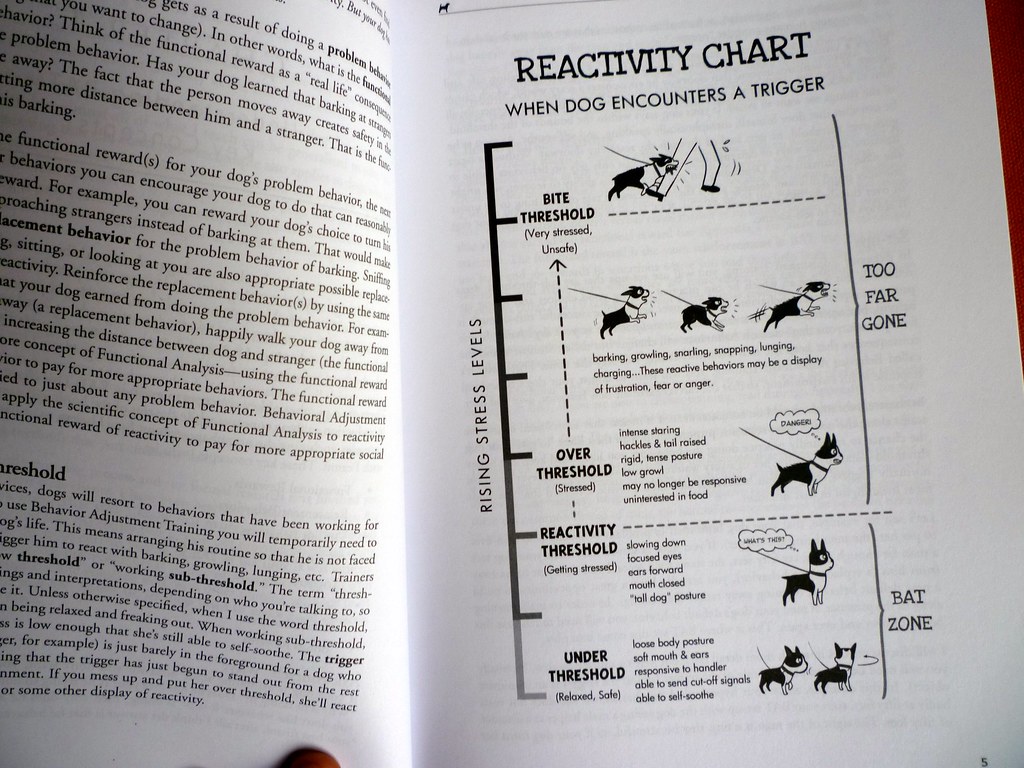
A Reactivity Chart showing “thresholds”:
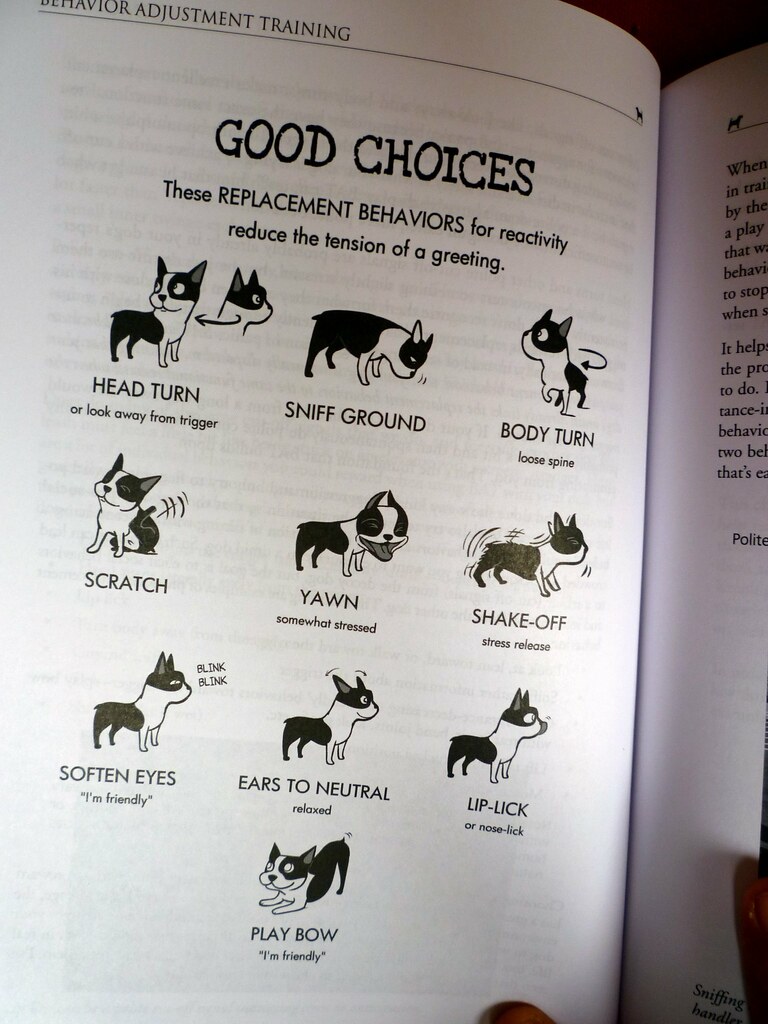
Good Choices or Replacement Behaviors (instead of barking, lunging, biting etc.)
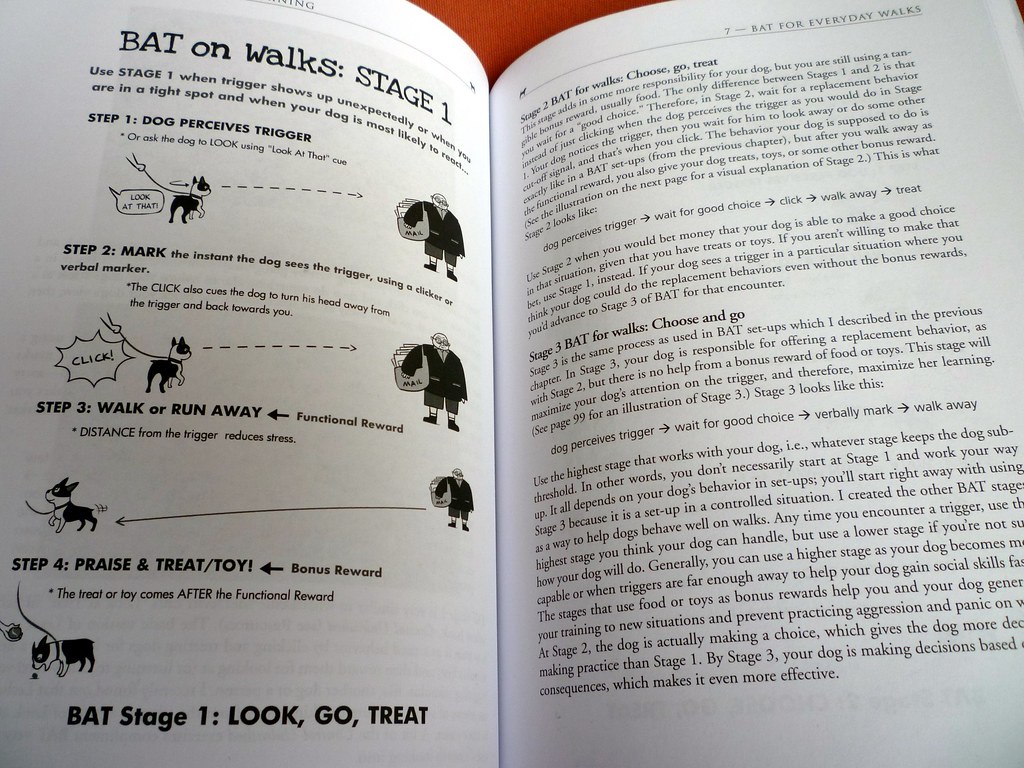
BAT On Walks, Stage 1 –
*One thing that I want to draw attention to…
Over a year ago, when I created my very first “BAT Set-Up” illustration I was still very much a BAT newbie, learning the protocol for the first time, and also learning to read Boogie. In this illustration (see below), in Step 1, even though I labeled it “Safe Distance”, the drawing of Boogie shows stress. He is clearly “over-threshold” ie, NOT at a safe distance from the trigger. In other words, my depiction of the set-up was wrong.

Note: INCORRECT illustration!
I wish I could’ve fixed this illustration before it got translated into different languages and shared around the internet, but… sigh… Thank goodness for the book! I hope that people who are still sharing the old illustration will refer to the updated version.
In the book (and also in Grisha’s latest BAT Set-Up handout) the NEW and UPDATED “BAT Set-Up” illustration shows an unstressed under-threshold dog… as he should be. The learning of Replacement Behaviors (or Good Choices) happens only when the dog is under-threshold.
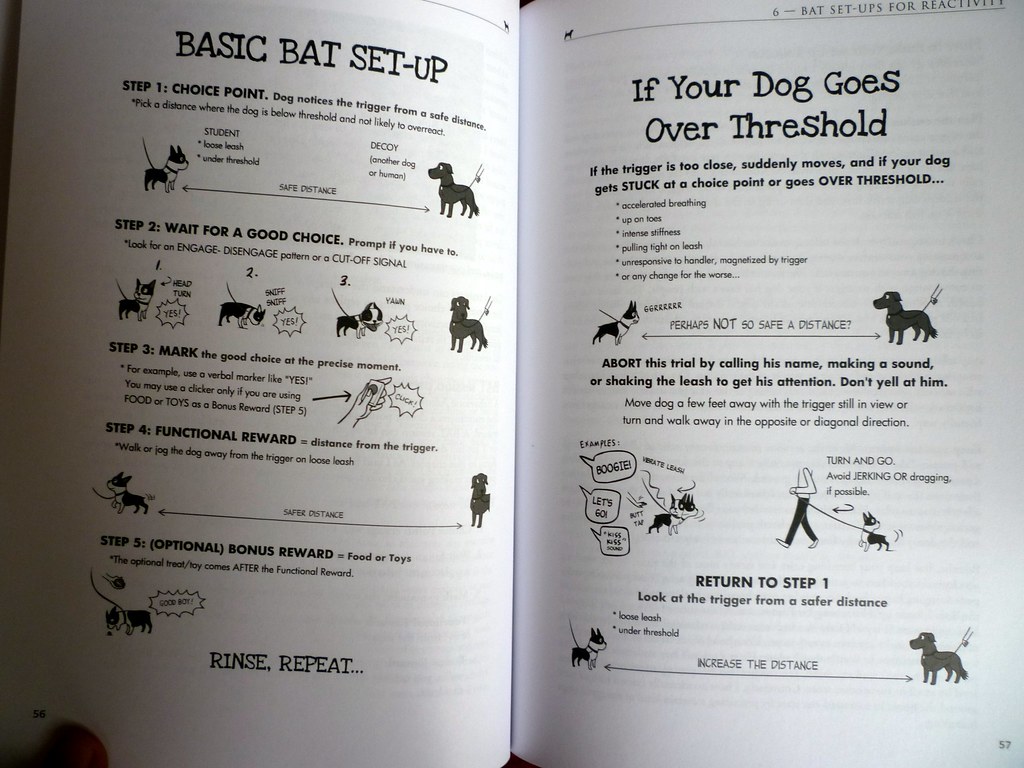
Updated CORRECT illustration - click to see larger
A clipping from the book below, which is such an important memo.
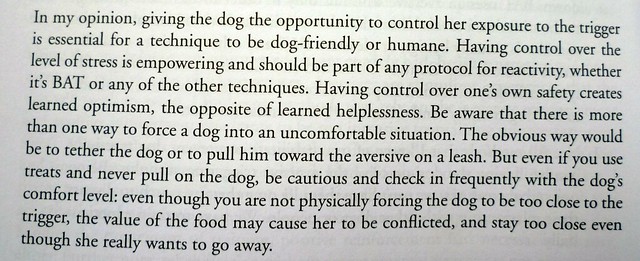
Reactive dogs need to feel this sense of control in being able to disengage from stress on their own… which is what leads to social confidence and politeness. Hey, I think this applies to humans too. 🙂
In the last chapter of the book there are testimonials from dog trainers who have used BAT. They share their experiences . I love this one in particular from Shelly Volsche …

BAT website: www.functionalrewards.com
Order the book or ebook: HERE

Freedom No-Pull Harness: Day 3

BEFORE
These past few days I am learning a few new things about loose-leash walking that I probably wouldn’t have, training with Boogie’s usual long leash and harness (as much as I like it)
This Freedom No-Pull Harness and Leash set-up is pretty cool. I LOVE IT!!! Thanks so much Sarah, for lending this to me!
The thing about using a shorter double-ended leash is that I can feel the tension as soon as Boogie pulls. This is BEFORE Boogie reaches the end of the leash, before all 26lbs of Boogie’s weight is engaged in stretching the leash completely taut… at which point he is already 200% committed to the direction that he wants to go in, and no longer responds to his name, food lures, or hand targets…
It seems that timing is important. The trick is to get Boogie’s attention BEFORE this point-of-no-return. (Bit like working under-threshold in BAT, right?) As soon as I feel tension on the short leash, I have 3 options:
- Connect with him. (“Boogie!” or Hand Target) “Yes!” and treat. What’s cool too is that because the leash is short, I have to feed treats right next to me (vs. tossing on the ground), which further reinforces for Boogie that “heeling next to Mom” is a good place to be.
- Move along with him. For example when he turns to sniff/pee on a bush, I walk with him to keep the leash between us loose, and to prevent it from tightening. This is something that I never had to do when I was holding a long leash so it’s new for me…
- Change direction and keep walking boldly forward. (“Let’s go!”) The leash attaches to front and back – which gives me a lot of extra leverage to move Boogie along. I do this when I really have to move along. “Yes!” and treat.

FREEDOM HARNESS & POLITE WALKING
The NO-FUN parts:
- The two leashes can get disorganized. Thankfully, my smart little dog has figured out how to slip his head in the space between the two leashes so that the front-clipping leash hangs on the convenient side of his body.
- Being extra careful about not pulling him. The Freedom Harness is designed to give the dog walker more control and power so it is quite easy to drag Boogie around if I wanted to and because it’s so easy, I really have to make an effort not to. The whole point of this exercise is to teach LOOSE-leash walking. I would mess everything up if I pulled him.
- Wet Grass, stinky stuff. A shorter leash means that I have to trudge through long wet grass with Boogie, and stand closer to lamp posts and doggie poo. (This includes other dogs’ poo or icky stuff on the ground that Boogie is checking out) Ew.
- The harness itself – Don’t ask me how to tighten or loosen anything and if any pieces get twisted up, I am sure I will be calling on Sarah to help me sort this out. I get confused just looking at the thing.
Some happy walks:
BIG SCARY DUDE
Last night Boogie and I were standing by the traffic lights when a big guy stood next to us on my right side, only a few feet away. With this shorter leash, I knew that even if Boogie lunged, he would not be able to reach the guy. Perhaps this gave me some confidence to do nothing instead of moving Boogie away. As it so happens this big guy was staring at Boogie (uh oh) and Boogie was seated in front of me, staring back at the guy. I called Boogie. He got up, walked away from the guy and stood on my left side. He was also pawing at my treat hand but wow – I was so impressed that we had a major trigger in close proximity and Boogie did not lunge. He moved away from the guy like it was the most natural thing in the world to do and completely ignored him. When the lights turned green, we ran across the street and I gave him a treat.
COYOTE
Later in the night, Boogie and I saw a coyote dash across our street. Boogie pulled. I stood still. The coyote dashed across the next street. Boogie turned and pulled in that direction. I still didn’t move. Then the coyote stopped in the middle of the street, turned around and stared at Boogie. I called Boogie “Let’s Go!” He disengaged from staring at the coyote, and ran home with me. First thing he did when he got inside was pick up his tennis ball and run to the window. “Coast is clear, mom. Let’s play”.
OFF-LEASH DOG
Today an off-leash sweater-wearing terrier approached us on the sidewalk outside a restaurant where the owners were having dinner. (I hadn’t seen him) I stood in front of Boogie and said to the owners: “Please call your dog! Mine isn’t friendly”. Thankfully the dog was well-trained and returned to his owners immediately when they called him, but in that split-second a huge leashed-dog approached us from behind. I pick Boogie up until the dog passed us. I put him down again when the dog had walked off several feet ahead of us. Boogie pulled towards the dog for a few seconds (more curious, than triggered). I waited, then he turned his head to look at me. “OK!” I said, and off we went, turning down a side street. No reactivity. 🙂
In addition to BAT, I wonder if the new harness plays some part in making Boogie feel safer and more connected to me?
Some time this week I think I will take Boogie to the park and train some loose-leash walking there…
By the way, everyone with a reactive dog should read the BAT book!!! And I’m not saying this just because my Boogie illustrations are in it 🙂
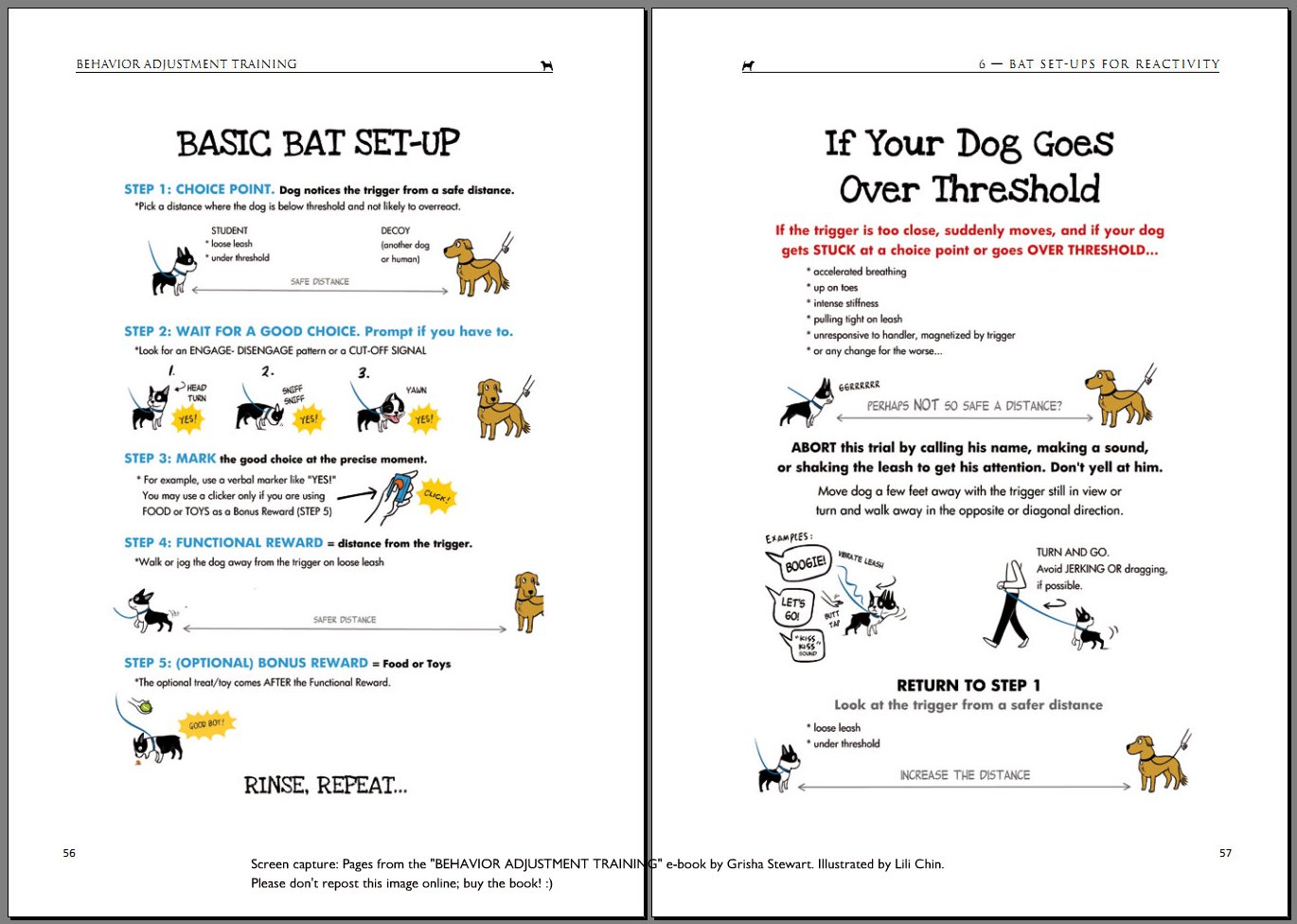
This is a screengrab from the e-book version which has color pages.
* Podcast Interview about BAT with Grisha Stewart –> http://www.animalcafe.co/dog-behavior-adjustment-training-for-fear-frustration-and-aggression/
Doggy House Calls (a new dog training TV show) and the Freedom Harness
I found this video – the premiere episode of “Doggy House Calls” – via the dogbehaviorscience forum:
*There’s a boston terrier!!!
I’m happy to announce that recently my new television show, Doggy House Calls, aired here in London, Ontario, Canada on Rogers TV.
Doggy House Calls features clicker training and purely positive reinforcement techniques! The first show featured a reactive chihuahua named Tater, the dog showed excellent results using the LAT game almost immediately.. good representation for positive training! – Melissa Millet
It must be hard to make Clicker Training look exciting on TV because in reality it’s quite visually repetitive and boring. During clicker sessions, the human trainer is fairly still and quiet… not a lot of moving around or theatrics (unlike on The Dog Whisperer Show). Cool article about the reality of dog training: The Quest For Boring
Personally I would love to watch a Clicker Training TV show that focuses more on what the dog is communicating. I think it would be cool for there to be subtitles drawing attention to body language or what the dog is doing right, explaining the tiny subtle doggie behaviors that our untrained eyes might miss while we are busy listening to the human actors.
Funny thing – today Sarah (Boogie’s trainer) came to visit, and the first time she called out Boogie’s name “Boogie!”, Boogie turned his head towards ME! He then turned back to Sarah for his treat. He did it again the second time she called his name. For a split second, he looked at me before he looked at Sarah. The power of Positive Reinforcement. Those Name Game sessions are paying off. 🙂
So this afternoon Sarah lent me her Freedom No-Pull Harnesses. These are complicated looking harnesses. So many strappy bits to lengthen or shorten, multiple buckles and things. There are two rings – one on the chest in front, and the other at the back. And the leash that comes with the harness is a double leash with two clips.


As I was saying to Sarah: Boogie walks nicely on leash until he decides that he wants to go in a different direction. I used to do Premack with him. So much so that he now turns to look at me while pulling away at the same time. I call him, I hold out treats, I hold out my hand “Touch!” (for nose target). Nope, Boogie continues to pull and refuses to come to me. It’s almost as if he is over-threshold and nothing I can do or say will make him loosen the leash.
Boogie pleads with his entire body, all four legs leaning away from me at a 45 degree angle, yawns, lip licks, head turns… the full kaboodle of “calming signals”.
“No. I don’t want to go that way. PLEEEEAAASE…I want to go THIS way”.
Boogie sometimes even pulls himself into a SIT or DOWN position and stays there until I give in. Meanwhile, passersby are laughing at us.
And yes, I keep reinforcing this behavior by eventually giving in and walking in Boogie’s chosen direction. I can see people/triggers/cars approaching and I think to myself it’s better to move than to not move at all.
I am hoping that the Freedom Harness will help me break this frustrating cycle/habit, and I can train polite loose-leash walking from scratch. For Boogie it would also be a new and different sensation.
So far, I notice that the Freedom leash is much shorter than our regular leash. I have more control and I can feel the tension on the leash as soon as it happens, such that I can call Boogie (click and treat) before the leash fully tightens <– my new challenge is to not let Boogie go too far. I need to call him much sooner before he is already pulling with all his might.
It is also SO much easier to walk two dogs together with these harnesses. Less criss-crossing and tangling of leashes and I don’t have to suffer having both my arms stretched in opposite directions. (e.g, when Boogie wants to charge ahead and when Butch wants to stop and pee on every tree)

Above is a photo of Butch and Boogie with Sarah and her bag of chicken pieces. JUST LOOK AT THOSE FACES!
You get what you train for.
I saw this post on the Clicker Solutions mailing list and it made me chuckle.
My Aussie Terrier pup has learnt to fake a wee.
I clicked/treated during her toilet training. Now she frequently just squats and doesn’t wee just expects a treat.
Any suggestions of how to stop the fake squatting?
Thank you for your help.
There were several similar replies to this question: “No wee, no treat.”
This reply was the most precise:
The problem is you get what you train for. In this case the dog was trained to squat not to pee. The solution IMHO is to train the dog for peeing. To train the dog to pee click when they finish peeing not when they squat.
Thankfully, Boogie and I don’t have this problem. 🙂
Sneak peek: Cyberdog Online (clicker training course)
* Note: There are ANIMATED GIFS in this blog entry, which may or may not show up in a RSS feed or email subscription.
Two weeks ago I was invited to participate as a student and beta-tester in a brand new online Clicker Training course – Cyberdog Online – run by three Karen Pryor Academy Certified Training Partners: Sarah Owings, Helix Fairweather and Lynn Martin.
Karen Pryor is the animal behaviorist who wrote the very inspiring book: Reaching The Animal Mind and made Clicker Training (or Operant Conditioning) famous.
Perhaps the thing that is most appealing to me about Clicker Training is that it is a pressure-free (therefore very humane) method and philosophy of teaching and learning. It’s efficiency is not dependent on the trainer’s bossiness or physical strength. The emphasis is on clear communication and positive reinforcement using the clicker as a capturing/shaping and reinforcing tool.
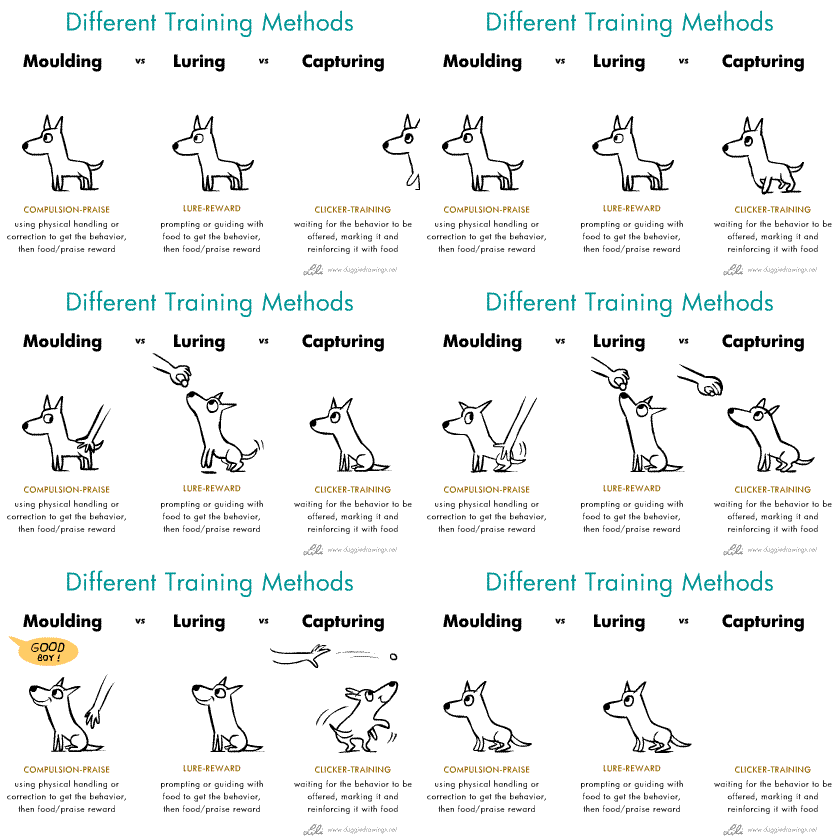
*These classifications come from Gail T. Fisher’s book: The Thinking Dog, Crossover to Clicker Training.
A long time ago, I trained Boogie to Sit, Down, Stay, Shake Hands etc. using the Moulding and Luring methods. I remember pushing Boogie’s butt down to the floor to teach him to sit, and when this didn’t work, I successfully lured him into a sitting position by moving a tennis ball over his head. (He wasn’t a very food-motivated dog when I first adopted him). As his head followed the ball – “Sit!” – his butt plopped down on the floor and he was rewarded.
Even though I have used a clicker before to capture behavior (for example, clicking Good Choices in BAT), I am not confident using a clicker to teach new behaviors and cues … or rather, anything more complicated than Hand Targeting or a Head Turn.
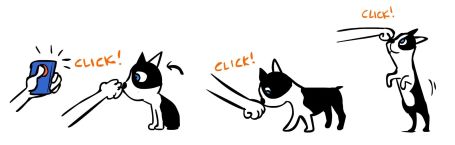
On my own, I lose focus and patience. I worry about messing up. What I need is someone to tell me exactly what to do and to break the process down into baby steps for me… Which is exactly what this Cyberdog Online course offers!
In this course, not only is Boogie learning new stuff, I the human am also being trained.
The course consists of several learning modules (StartSmart, Attention and Focus, Communication, Teamwork, Self-Control etc.), a series of lessons within each module (eg, Name Game, Settle, Wait, Sit, Targeting, Polite Walking etc.) and 4 levels within each lesson, which are further broken down into Steps 1 – 4. There is a lot of information to take in, and lots of steps, yet because everything is so well-structured, the exercises are so clear, and the feedback is always very encouraging and helpful, I don’t feel intimidated. Everything feels do-able.
I loved the beginning StartSmart module, which focuses on mechanical clicker training skills: ‘home base’ position for your hand, working on focus and timing skills (eg, click bubbles bursting on your computer screen) and even treat delivery skills (practice tossing treats into a box, practice rolling individual treats out of your palm etc.). Most of these exercises don’t yet involve the dog. Tricky, because when Boogie sees me with a clicker and treats he wants to be in on the action.
Further on, students practice with their dogs. We take video footage of our training sessions, and upload these on the internet for class review. A “virtual classroom” that is. Seeing other students’ videos is really helpful.
Some notes from Week 1:
1. Treat delivery skills & “Quiet Hands”. Until I reviewed video footage of myself delivering treats I had no idea that my hands flailed around as much as they did or that my hand would instantly drift back into the treat bag when it should be quiet and at ‘Home Base’ before the next click.
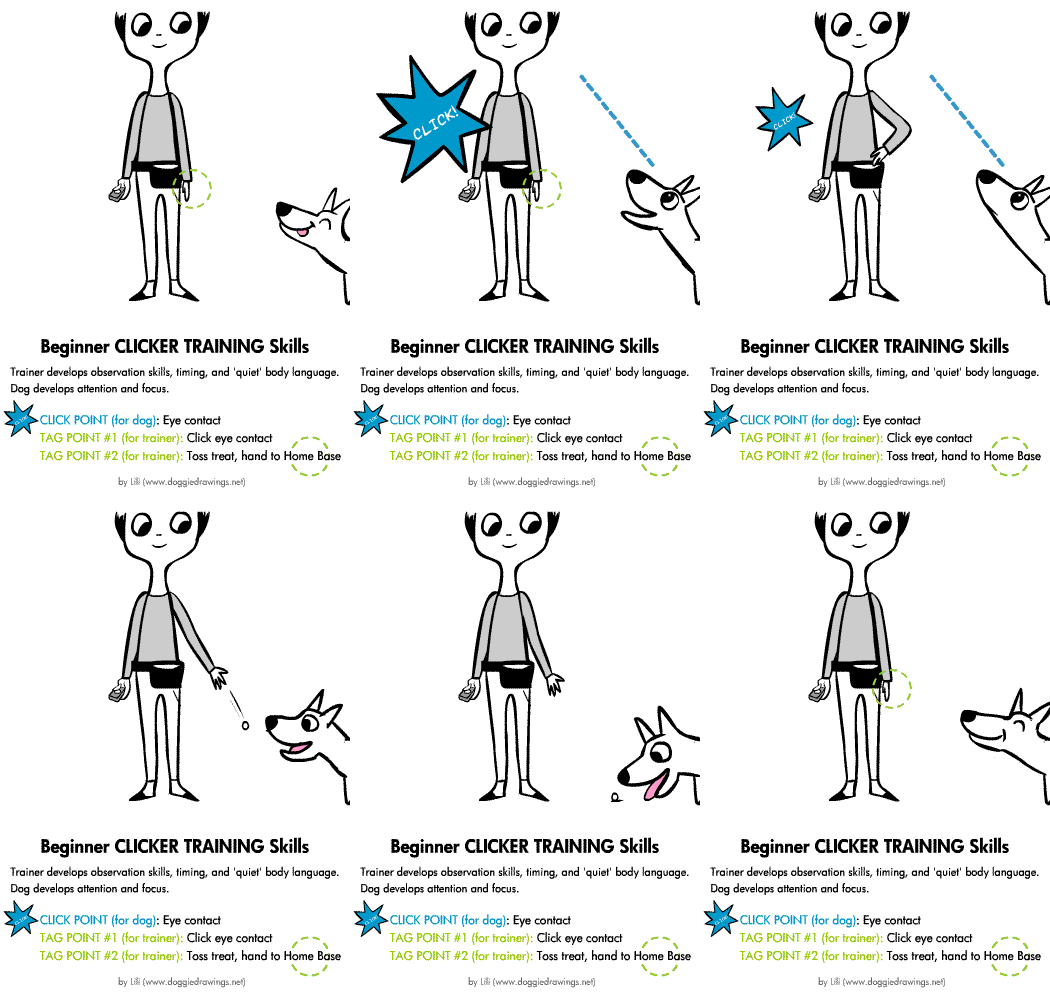
2. New concept: “Click Points” refer to the exact behaviors that I am supposed to click in each training session. The challenge is to stick to this criteria and not click for anything else. This is harder than it sounds because I get impatient! Or I get so distracted by Boogie’s cuteness (doing some other non-click-point behavior) and I lose track. The challenge for me is to WAIT for Boogie to offer the behavior by himself instead of helping…
3. New concept: “Tag Points”. Where Click Points are for the dog, Tag Points are for the student trainer. These are specific behaviors that I have to do fluently.
4. “Success Rate”. How do I know when to move onto the next Level?
According to Helix – I judge success by how quickly and frequently Boogie is getting clicked and treated. I could also calculate my rate of reinforcement…
I watch my training session video – note the start and end times from the first click to the last click. Total number of seconds / total number of clicks = Rate of Reinforcement. So for example, where there are 26 clicks in 120 seconds, that’s an average rate of 4.6 seconds per behavior/click/treat. A successful rate is 4 seconds per click, at which point I am ready to move onto the next level.
Below are examples of the clicker training lessons that I am doing with Boogie this week.
*Similar clicker lessons can already be found via dog training blogs/sites, YouTube videos and books, so I have decided to do something different and present these as animated drawings. Note: these are my own interpretations of the Cyberdog Online lessons. The animations are not part of the course.
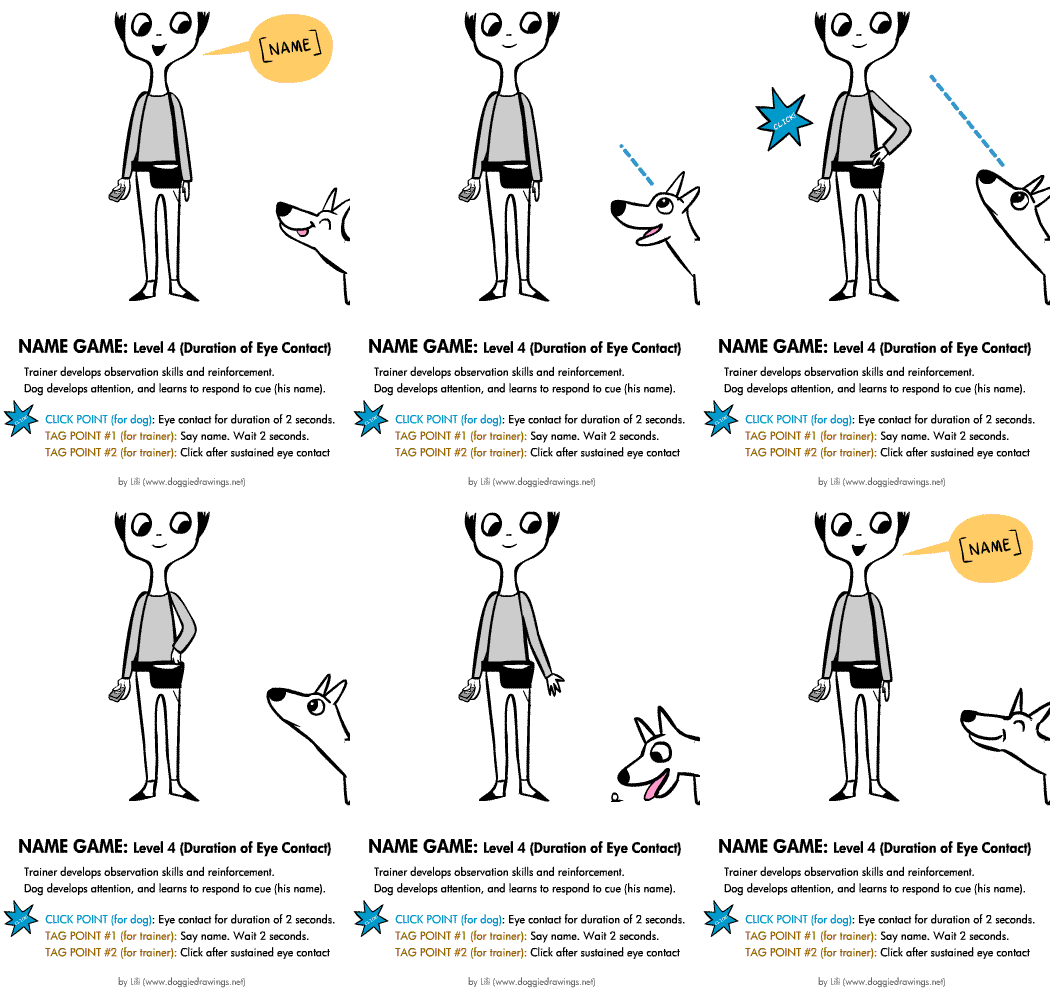
Name Game lesson (Level 4).
… and Wait At Boundary ( Level 1).
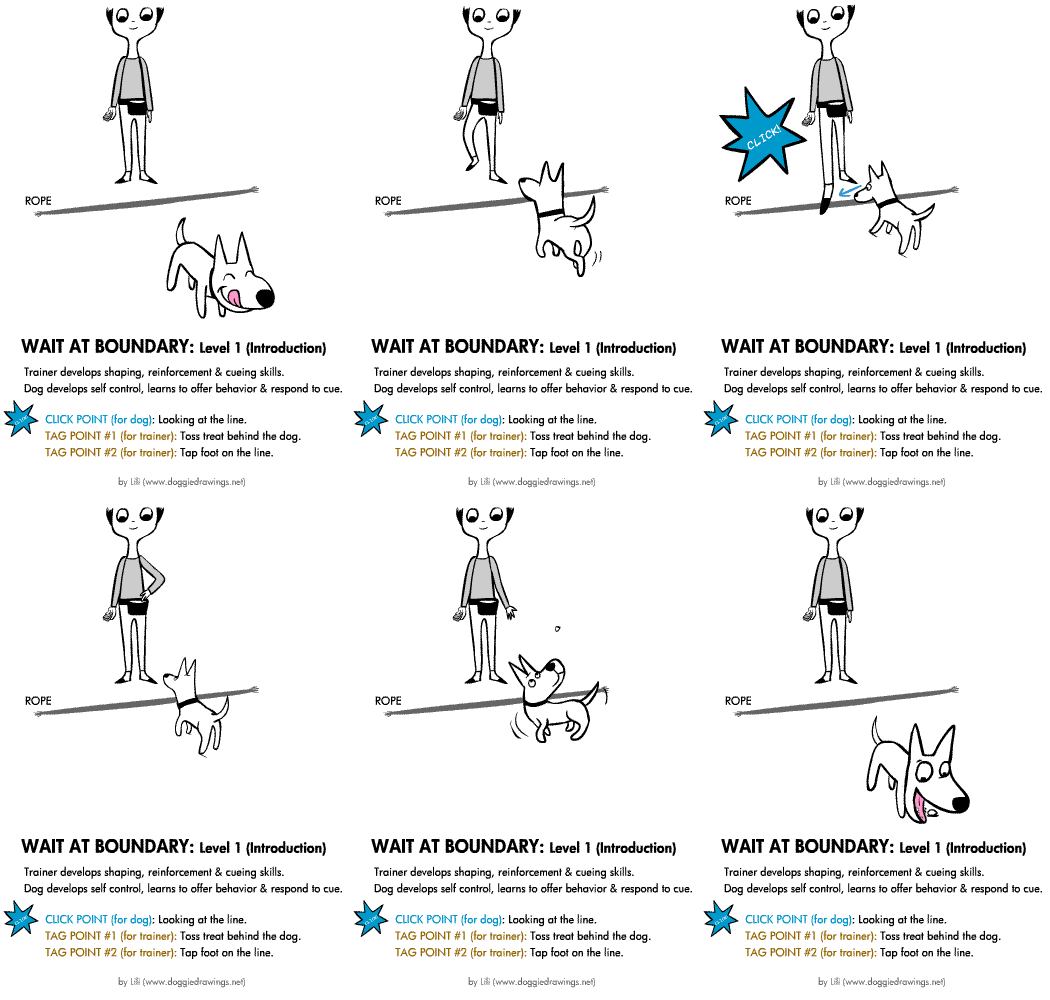
In Level 2 of the BOUNDARY lesson (my homework for this week), my new Tag Point is to stop tapping the line and click when Boogie slows down/shows hesitation before he approaches the line. Eventually a verbal cue (eg, “Wait”) will be added. I am hoping that this cue when learned, will have Boogie waiting politely when someone comes to the door….
That’s it for now! This Cyberdog Online course is still in beta-testing phase, so I can’t give too much away. 🙂
Currently reading: How Dogs Learn by John S. Bailey, which is fascinating.

*UPDATE* – The Cyberdog Online course is now up and running! http://cyberdogonline.com/
What is a “normal” walk?
This is copied and pasted from a post I read on the Functional Rewards yahoo group:
(I hope that the author doesn’t mind my reposting this)
“Reactive” dogs just can’t be compared to the mellow, ho hum, relaxed sort of dog that is comfortable, pleasant, and predictable on a leisurely walk. If that is the type of walk that the owner of a “reactive” dog hopes to have, then the owner is setting his/herself and the dog up to fail. Some reactive dogs may be able to achieve that at some point, or at least a semblance of it… but most will NOT achieve that “bomb proof” status.
I also believe that there is a type of “grief” that owners of challenging dogs go through in realizing their dog may not be able to meet the owners’ desires/needs or do the types of things that the owner hoped to do with their dog. I believe this is an important part of loving our dogs for who they are (and HOW they are).
Now, that’s not to say that we shouldn’t continue to re-train/rehab our dogs – though admittedly, sometimes I do think we do overdo this and should consider just letting our dog be who they are and CHANGE OUR THINKING and activities to SUIT THE DOG. But in using remedial training methods, mostly I just think our goals, expectations, and measures need to be comparing our dog to his/her own behavior… not against the typical dog. Does that make sense? I also think that our goals with reactive dogs are better focused on increasing management and safety, and REDUCING reactivity (the number of triggers, the intensity of the reaction, and recovery time) as opposed to shooting for a “normal” walk. One of the lessons I always remind myself: MAKE SURE MY EXPECTATIONS (of myself and my dog) ARE REASONABLE AND ACHIEVABLE.
This is an illustration that I did over a year ago.

I am still very mindful of all these ‘management rules’. However, I am pleased to say that I am better at READING Boogie, and at catching and responding to his signals, which means that we don’t always have to turn away/cross the street/avoid civilization.
These days, I rarely use the “Look At That” cue. (aka BAT – Stage One) I say “Boogie, WAIT” and we wait. Then I watch him to see what he is feeling. 80% of the time he wants to move forward, NOT move away. Using moving forward as the functional reward, I wait for Boogie to check in with me. He gets a YES! and Treat and we move forward. This way, I know that the trigger is no longer (or never was) an issue.
The other 20% of the time, Boogie freezes. He becomes tense when he sees the trigger. This is a cue for me that we need to get away. I tap his butt, call him, and we do a 180, away from the scary/offending person or dog. Boogie pees on something. Relaxes.
Yep, NORMAL dog-walking for me.
I would be happier if Boogie could be relaxed with *slow-moving hunched-over old people with grocery bags who stare at him*….


 Boogie's blog