Posts filed under ‘Articles, links’
Boogie is a DINOS (“Dogs In Need of Space”)
I read an awesome and much needed blog article today! –> “My Dog Is Friendly!” A Public Service Announcement
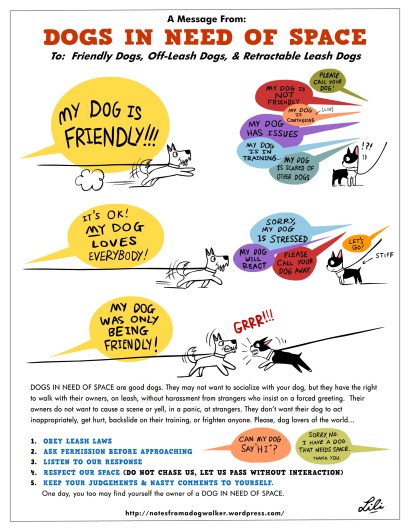
*Update: DINOS/DOGS IN NEED OF SPACE is trademarked. Please refer to the new version of the poster > “SPACE ETIQUETTE FOR DOGS” if you wish to download and share.
I cannot tell you how many times Boogie and I have been approached (or even CHASED) by dogs whose super enthusiastic owners call out: “My dog is friendly!” Or have MIDFs roll their eyes at me when they insist that their dog is friendly.
Take for example, yesterday at the vet’s office when a lady and her large-sized dog walked in. “My dog is friendly!” she said.
I had Boogie on my lap, in my arms, and I replied “My dog isn’t”. We remained on opposite sides of the waiting room and there were no incidents. Her dog was laying down turned away; Boogie was at my feet hypnotizing me to take him home.
Several minutes later when the lady wasn’t paying attention and I was busy talking to the vet tech, the dog walked on over and nosed Boogie in the butt. Boogie, who was facing the other way unaware that there was a dog approaching him, freaked out, turned around and snarled. The dog’s owner called out – “Sorry! I wasn’t looking” She pulled her dog away, then said in a very loud high-pitched voice so that the whole room could hear: “Mommy loves you very much! Even if the other dog doesn’t love you, mommy loves you!”
I tried to explain that Boogie reacted because he was startled by her dog. Another lady in the waiting room offered some moral support – “The dogs weren’t formally introduced”.
Well, it was still awkward to be the only person in the room with a growly dog. Suddenly Boogie was made to look like an asshole.
And then there are the MDIFs who – even after I tell them that my dog ISN’T friendly – continue to believe that everything will be OK because their dog is “friendly” or is “good with dogs”. Or that they themselves are god’s gift to dogs, all dogs love them, and I’m just uptight or something.
Sure, Boogie is a sweet and friendly dog, but he is sensitive, extremely discriminating and does not instantly become friends with every dog and person that he meets. Boogie needs some space and time away from the new person/dog at first. If the person/dog is large, he needs even MORE space to make up his mind.
For a long time, before I saw the Turid Rugaas DVD and learned about BAT, I had no idea that when dogs reacted it was because they needed SPACE (or distance from the trigger). Space, as a functional reward and training tool is so underrated! I don’t think a lot of people know this. And MDIFs especially, need to know this.
More links:
This DINOS Manifesto which inspired the illustration above.
P.S. People with DINOS, I recommend Grisha Stewart’s BAT book and BAT DVD (blog review coming later) with my illustrations <— If you order via these links, I get a % of sales. 🙂
P.P.S. This is another really good article – Misreading Dogs.
Zak George, Cesar Millan, Vladae the Dog Wizard.
I had never heard of Zak George before nor seen his shows even though he has been around for years… *There are Superfetch episodes on instant netflix!
Wow, I really like this guy.
I was chatting with a good friend several weeks ago about Boogie’s training. My friend has a dog that has “resource guarding issues” (barking and snapping at people) and he was sharing with me how hard he found it to give his dog collar corrections as he had been taught to do. I gave my friend a copy of the BAT book and not too eloquently explained to him the difference between the Positive Reinforcement method of changing behavior vs and the old school Corrections approach. I didn’t do as good a job as Zak George does in the video above. I really like the way he speaks very eloquently and passionately about his Positive Reinforcement approach.
According to Zak George, in conventional dog training (eg, Cesar Millan), the emphasis is on letting a dog know when he is doing the WRONG THING. In Zak George’s style of modern dog training the emphasis is on letting a dog know when he is doing the RIGHT THING. He notes that this difference in emphasis may seem like a very subtle trivial thing but is in fact a huge paradigm shift in the way we think and relate to dogs.
He also makes a distinction between TEACHING and TRAINING. He says that in “teaching tricks” he is stimulating the dog’s mind and body and cultivating a relationship with his dogs. The teacher-student relationship is a bonding experience (and yes I can totally relate to this) and the tricks thing is not simply a form of frivolous entertainment. By contrast, a lot of conventional dog training is about making the dog submit to the will of the human – which he says is arrogant and wrong.
And I think he hits the nail on the head here. It’s not so much the correctional tools that are a problem, but the head space from which these methods have developed.
I read “Cesar’s Rules” not so long ago, and interestingly, Cesar Millan refuses to call himself a “dog trainer” and prefers the term “Pack Leader” or “Rehabilitator” because I guess he wants to elevate himself above the type of trainers who teach tricks, but he is using conventional dog training methods that have been around for decades AND issuccessfully changing behavior in dogs, which really does make him a dog trainer even though he doesn’t like that job description.
This snapshot is from the Kindle version of “Cesar’s Rules”:

In this article by Susan Garrett – Punishment: Pros and Cons– she says that aversive punishment works, and while dogs may not seem troubled by it it is usually because there are lots of good things happening at the same time. The problem is that there is fallout and the anxiety may express itself in other ways.
The truth is, a very skilled trainer that has brilliant timing can produce a seemingly happy working dog while using some pretty massive doses of violent positive punishment. One key to this puzzle is that the reinforcement the dog receives from the work is also massively high. This is why large amounts of physical pain may be accepted by some dogs chasing ducks on the pond in comparison to the same dog working in the obedience ring.
I am sure Cesar must use a lot of positive reinforcement in real life (off screen) but unfortunately, in his public manifesto he still puts all the emphasis on physical punishment and making dogs “calm-submissive” as opposed to teaching dogs to make good choices on their own.
Scarily enough, there is another very conventional dog trainer guy who might soon get his own TV show – “Vladae, The Russian Dog Wizard”!!!
*See petition to Animal Planet.
There is some very disturbing crazy stuff on his blog:
Down Stay – Do a 30 minute down stay, twice a day. This will reinforce your role as the Alpha leader.
Elevating Status – Don’t allow your dog on the furniture or on your bed. If you allow your dog to be on the same level as you, you are elevating his status and lowering yours. This is clearly not the way to establish yourself as the Alpha Leader.
Yeah I have heard this one before. I don’t like this guy.
Boogie is sleeping in my bed, dammit.
The BAT Book is here!

The book looks awesome. It is big and glossy and beautiful. Once again a big thank you to Grisha for letting me contribute to this enlightening and groundbreaking book. I’ll admit that working on this book was not like any of my other dog illustration jobs. Most of these drawings were based on and originally inspired by my own PERSONAL training experiences with Boogie so it is an extra exhilirating feeling to hold this book in my hands.
Example pages:
*click on images to see them larger
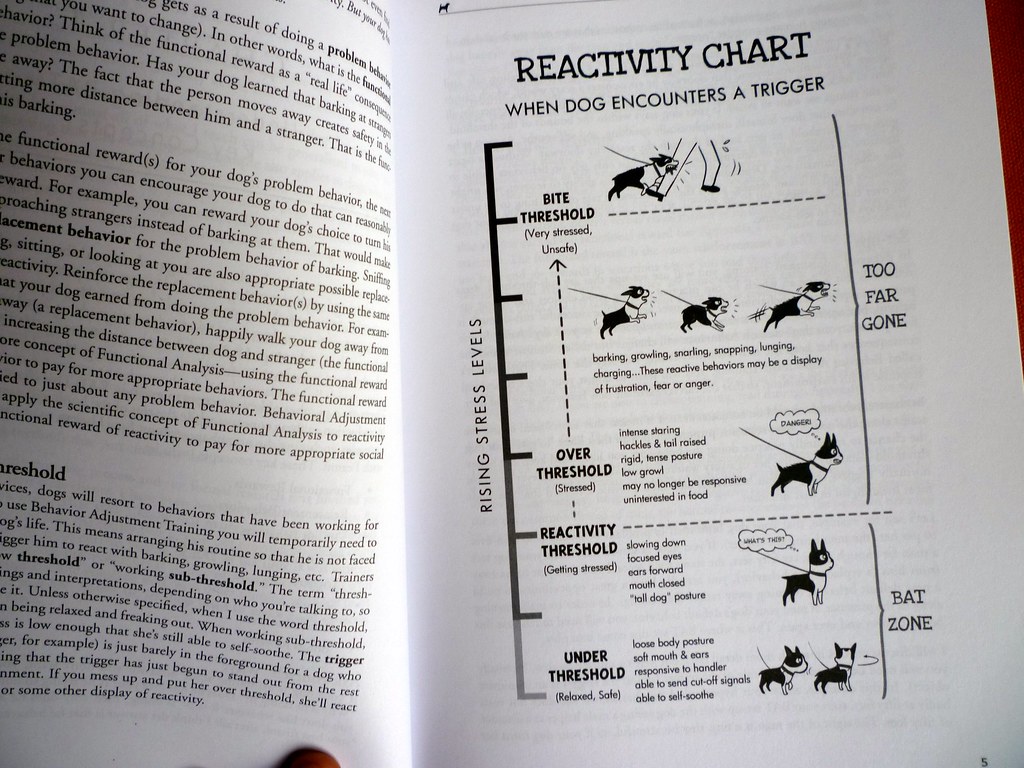
A Reactivity Chart showing “thresholds”:
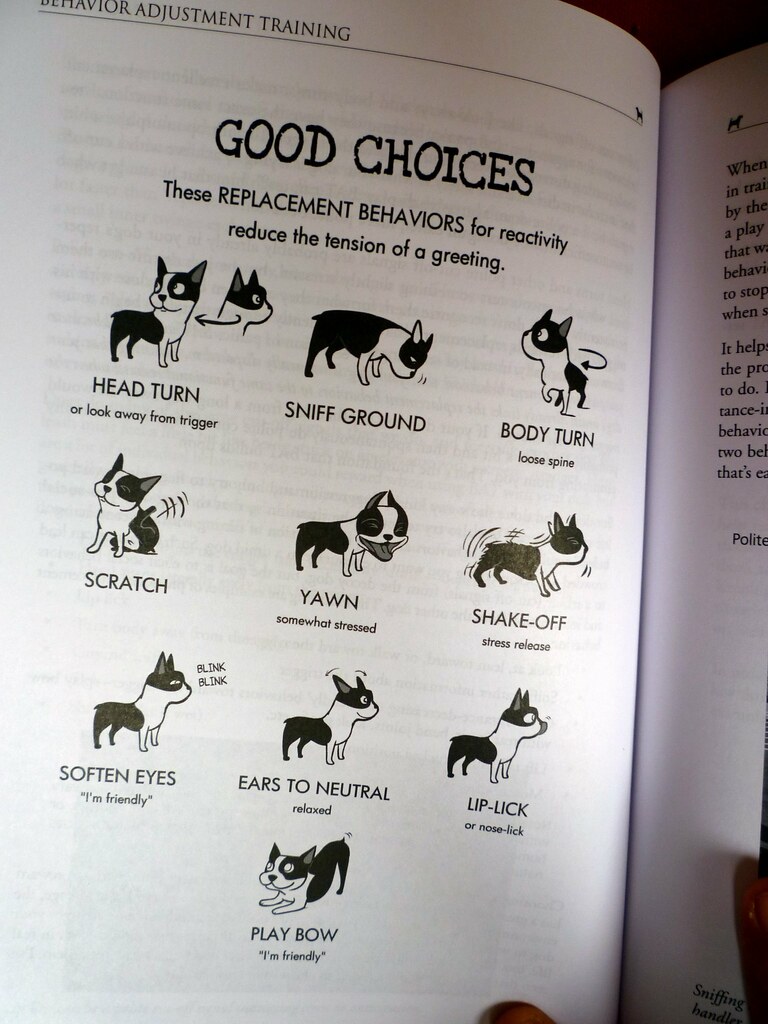
Good Choices or Replacement Behaviors (instead of barking, lunging, biting etc.)
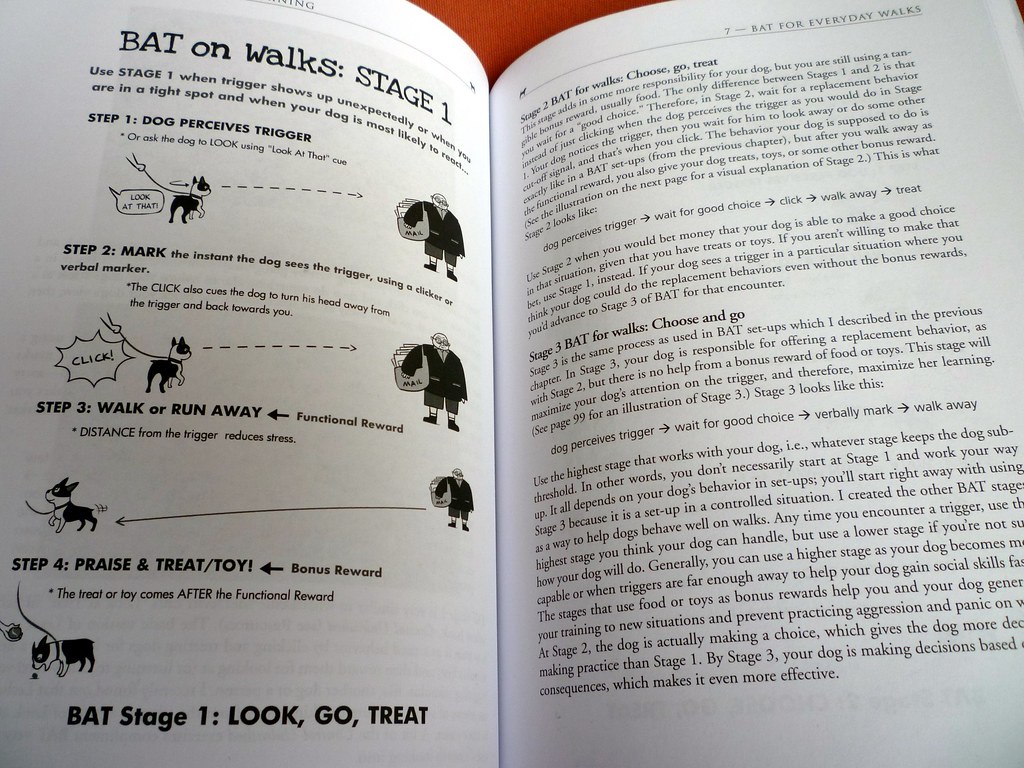
BAT On Walks, Stage 1 –
*One thing that I want to draw attention to…
Over a year ago, when I created my very first “BAT Set-Up” illustration I was still very much a BAT newbie, learning the protocol for the first time, and also learning to read Boogie. In this illustration (see below), in Step 1, even though I labeled it “Safe Distance”, the drawing of Boogie shows stress. He is clearly “over-threshold” ie, NOT at a safe distance from the trigger. In other words, my depiction of the set-up was wrong.

Note: INCORRECT illustration!
I wish I could’ve fixed this illustration before it got translated into different languages and shared around the internet, but… sigh… Thank goodness for the book! I hope that people who are still sharing the old illustration will refer to the updated version.
In the book (and also in Grisha’s latest BAT Set-Up handout) the NEW and UPDATED “BAT Set-Up” illustration shows an unstressed under-threshold dog… as he should be. The learning of Replacement Behaviors (or Good Choices) happens only when the dog is under-threshold.
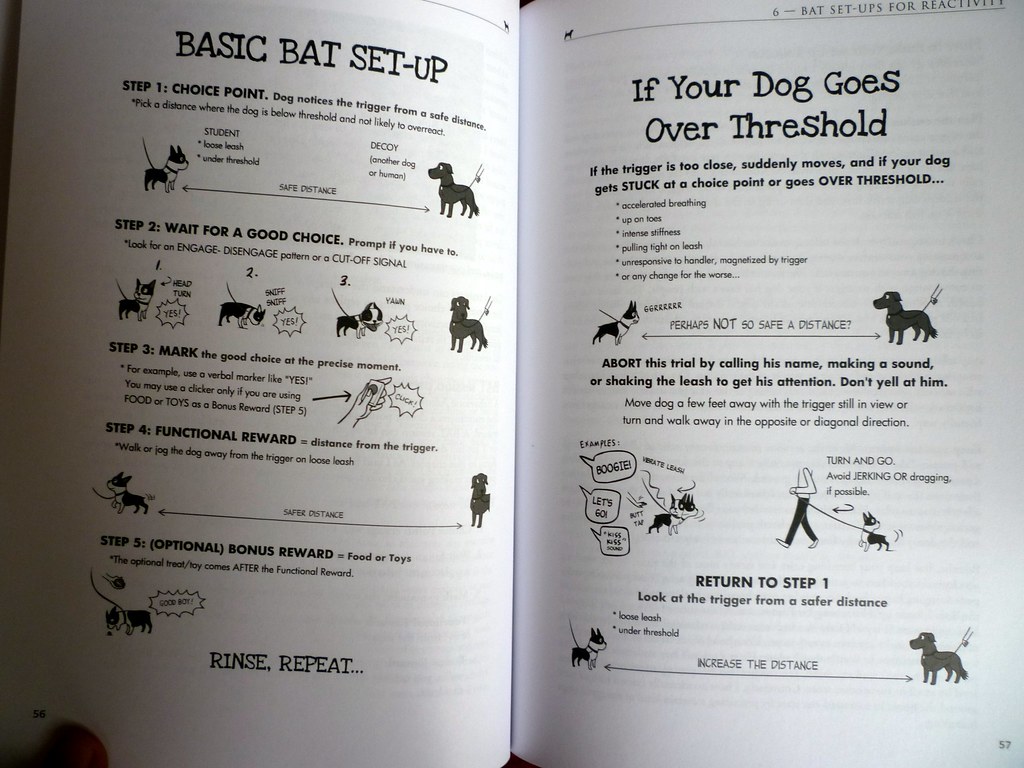
Updated CORRECT illustration - click to see larger
A clipping from the book below, which is such an important memo.
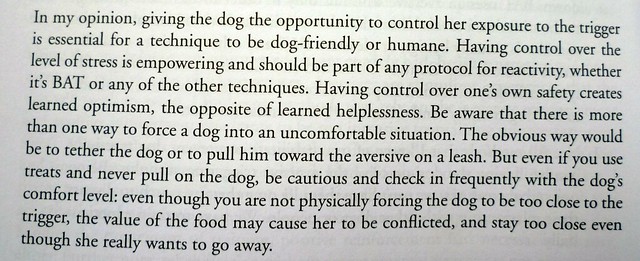
Reactive dogs need to feel this sense of control in being able to disengage from stress on their own… which is what leads to social confidence and politeness. Hey, I think this applies to humans too. 🙂
In the last chapter of the book there are testimonials from dog trainers who have used BAT. They share their experiences . I love this one in particular from Shelly Volsche …

BAT website: www.functionalrewards.com
Order the book or ebook: HERE

Doggy House Calls (a new dog training TV show) and the Freedom Harness
I found this video – the premiere episode of “Doggy House Calls” – via the dogbehaviorscience forum:
*There’s a boston terrier!!!
I’m happy to announce that recently my new television show, Doggy House Calls, aired here in London, Ontario, Canada on Rogers TV.
Doggy House Calls features clicker training and purely positive reinforcement techniques! The first show featured a reactive chihuahua named Tater, the dog showed excellent results using the LAT game almost immediately.. good representation for positive training! – Melissa Millet
It must be hard to make Clicker Training look exciting on TV because in reality it’s quite visually repetitive and boring. During clicker sessions, the human trainer is fairly still and quiet… not a lot of moving around or theatrics (unlike on The Dog Whisperer Show). Cool article about the reality of dog training: The Quest For Boring
Personally I would love to watch a Clicker Training TV show that focuses more on what the dog is communicating. I think it would be cool for there to be subtitles drawing attention to body language or what the dog is doing right, explaining the tiny subtle doggie behaviors that our untrained eyes might miss while we are busy listening to the human actors.
Funny thing – today Sarah (Boogie’s trainer) came to visit, and the first time she called out Boogie’s name “Boogie!”, Boogie turned his head towards ME! He then turned back to Sarah for his treat. He did it again the second time she called his name. For a split second, he looked at me before he looked at Sarah. The power of Positive Reinforcement. Those Name Game sessions are paying off. 🙂
So this afternoon Sarah lent me her Freedom No-Pull Harnesses. These are complicated looking harnesses. So many strappy bits to lengthen or shorten, multiple buckles and things. There are two rings – one on the chest in front, and the other at the back. And the leash that comes with the harness is a double leash with two clips.


As I was saying to Sarah: Boogie walks nicely on leash until he decides that he wants to go in a different direction. I used to do Premack with him. So much so that he now turns to look at me while pulling away at the same time. I call him, I hold out treats, I hold out my hand “Touch!” (for nose target). Nope, Boogie continues to pull and refuses to come to me. It’s almost as if he is over-threshold and nothing I can do or say will make him loosen the leash.
Boogie pleads with his entire body, all four legs leaning away from me at a 45 degree angle, yawns, lip licks, head turns… the full kaboodle of “calming signals”.
“No. I don’t want to go that way. PLEEEEAAASE…I want to go THIS way”.
Boogie sometimes even pulls himself into a SIT or DOWN position and stays there until I give in. Meanwhile, passersby are laughing at us.
And yes, I keep reinforcing this behavior by eventually giving in and walking in Boogie’s chosen direction. I can see people/triggers/cars approaching and I think to myself it’s better to move than to not move at all.
I am hoping that the Freedom Harness will help me break this frustrating cycle/habit, and I can train polite loose-leash walking from scratch. For Boogie it would also be a new and different sensation.
So far, I notice that the Freedom leash is much shorter than our regular leash. I have more control and I can feel the tension on the leash as soon as it happens, such that I can call Boogie (click and treat) before the leash fully tightens <– my new challenge is to not let Boogie go too far. I need to call him much sooner before he is already pulling with all his might.
It is also SO much easier to walk two dogs together with these harnesses. Less criss-crossing and tangling of leashes and I don’t have to suffer having both my arms stretched in opposite directions. (e.g, when Boogie wants to charge ahead and when Butch wants to stop and pee on every tree)

Above is a photo of Butch and Boogie with Sarah and her bag of chicken pieces. JUST LOOK AT THOSE FACES!
Sneak peek: Cyberdog Online (clicker training course)
* Note: There are ANIMATED GIFS in this blog entry, which may or may not show up in a RSS feed or email subscription.
Two weeks ago I was invited to participate as a student and beta-tester in a brand new online Clicker Training course – Cyberdog Online – run by three Karen Pryor Academy Certified Training Partners: Sarah Owings, Helix Fairweather and Lynn Martin.
Karen Pryor is the animal behaviorist who wrote the very inspiring book: Reaching The Animal Mind and made Clicker Training (or Operant Conditioning) famous.
Perhaps the thing that is most appealing to me about Clicker Training is that it is a pressure-free (therefore very humane) method and philosophy of teaching and learning. It’s efficiency is not dependent on the trainer’s bossiness or physical strength. The emphasis is on clear communication and positive reinforcement using the clicker as a capturing/shaping and reinforcing tool.
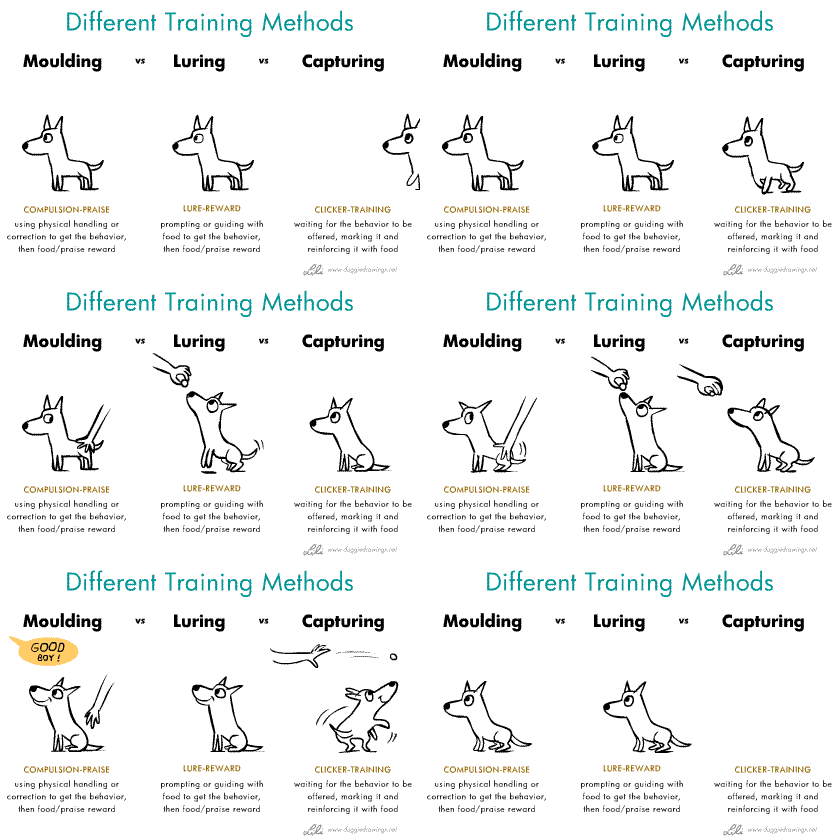
*These classifications come from Gail T. Fisher’s book: The Thinking Dog, Crossover to Clicker Training.
A long time ago, I trained Boogie to Sit, Down, Stay, Shake Hands etc. using the Moulding and Luring methods. I remember pushing Boogie’s butt down to the floor to teach him to sit, and when this didn’t work, I successfully lured him into a sitting position by moving a tennis ball over his head. (He wasn’t a very food-motivated dog when I first adopted him). As his head followed the ball – “Sit!” – his butt plopped down on the floor and he was rewarded.
Even though I have used a clicker before to capture behavior (for example, clicking Good Choices in BAT), I am not confident using a clicker to teach new behaviors and cues … or rather, anything more complicated than Hand Targeting or a Head Turn.
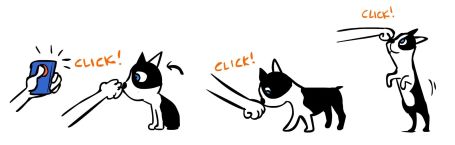
On my own, I lose focus and patience. I worry about messing up. What I need is someone to tell me exactly what to do and to break the process down into baby steps for me… Which is exactly what this Cyberdog Online course offers!
In this course, not only is Boogie learning new stuff, I the human am also being trained.
The course consists of several learning modules (StartSmart, Attention and Focus, Communication, Teamwork, Self-Control etc.), a series of lessons within each module (eg, Name Game, Settle, Wait, Sit, Targeting, Polite Walking etc.) and 4 levels within each lesson, which are further broken down into Steps 1 – 4. There is a lot of information to take in, and lots of steps, yet because everything is so well-structured, the exercises are so clear, and the feedback is always very encouraging and helpful, I don’t feel intimidated. Everything feels do-able.
I loved the beginning StartSmart module, which focuses on mechanical clicker training skills: ‘home base’ position for your hand, working on focus and timing skills (eg, click bubbles bursting on your computer screen) and even treat delivery skills (practice tossing treats into a box, practice rolling individual treats out of your palm etc.). Most of these exercises don’t yet involve the dog. Tricky, because when Boogie sees me with a clicker and treats he wants to be in on the action.
Further on, students practice with their dogs. We take video footage of our training sessions, and upload these on the internet for class review. A “virtual classroom” that is. Seeing other students’ videos is really helpful.
Some notes from Week 1:
1. Treat delivery skills & “Quiet Hands”. Until I reviewed video footage of myself delivering treats I had no idea that my hands flailed around as much as they did or that my hand would instantly drift back into the treat bag when it should be quiet and at ‘Home Base’ before the next click.
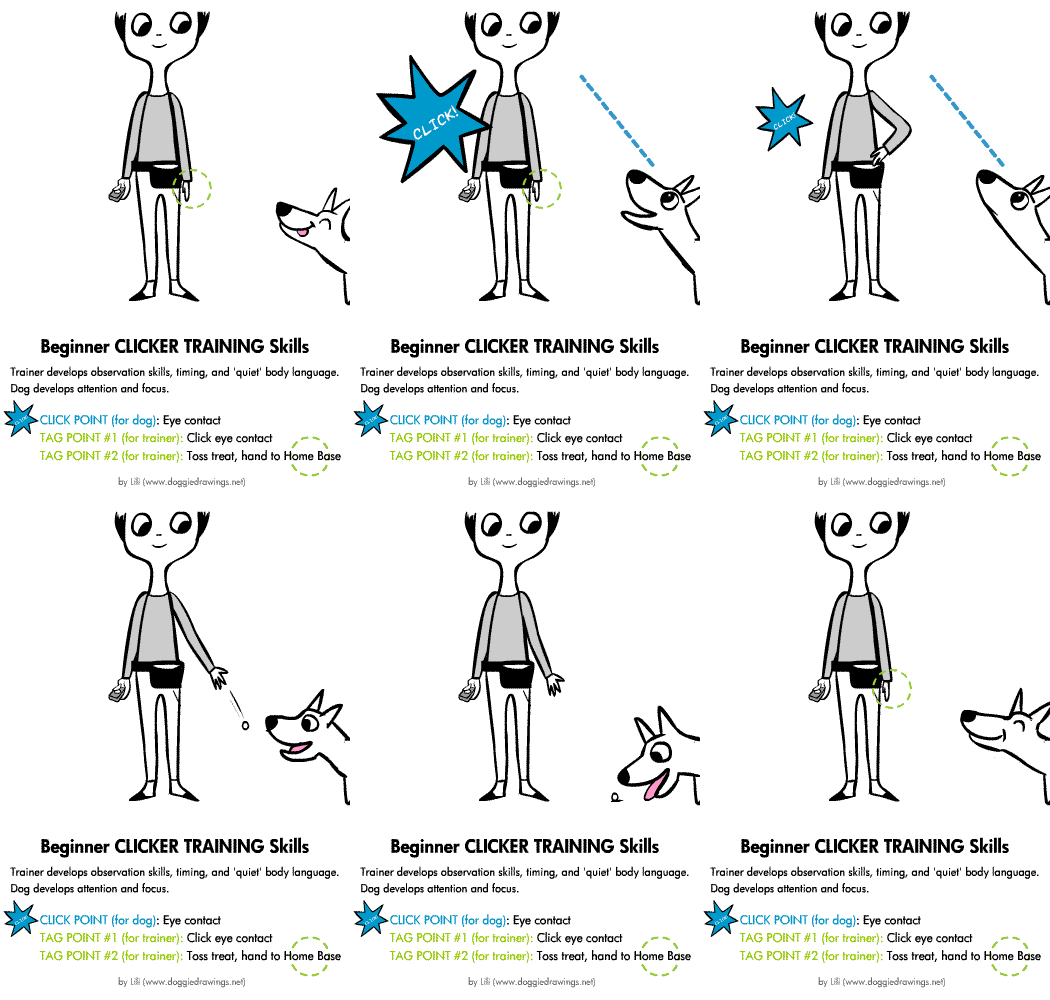
2. New concept: “Click Points” refer to the exact behaviors that I am supposed to click in each training session. The challenge is to stick to this criteria and not click for anything else. This is harder than it sounds because I get impatient! Or I get so distracted by Boogie’s cuteness (doing some other non-click-point behavior) and I lose track. The challenge for me is to WAIT for Boogie to offer the behavior by himself instead of helping…
3. New concept: “Tag Points”. Where Click Points are for the dog, Tag Points are for the student trainer. These are specific behaviors that I have to do fluently.
4. “Success Rate”. How do I know when to move onto the next Level?
According to Helix – I judge success by how quickly and frequently Boogie is getting clicked and treated. I could also calculate my rate of reinforcement…
I watch my training session video – note the start and end times from the first click to the last click. Total number of seconds / total number of clicks = Rate of Reinforcement. So for example, where there are 26 clicks in 120 seconds, that’s an average rate of 4.6 seconds per behavior/click/treat. A successful rate is 4 seconds per click, at which point I am ready to move onto the next level.
Below are examples of the clicker training lessons that I am doing with Boogie this week.
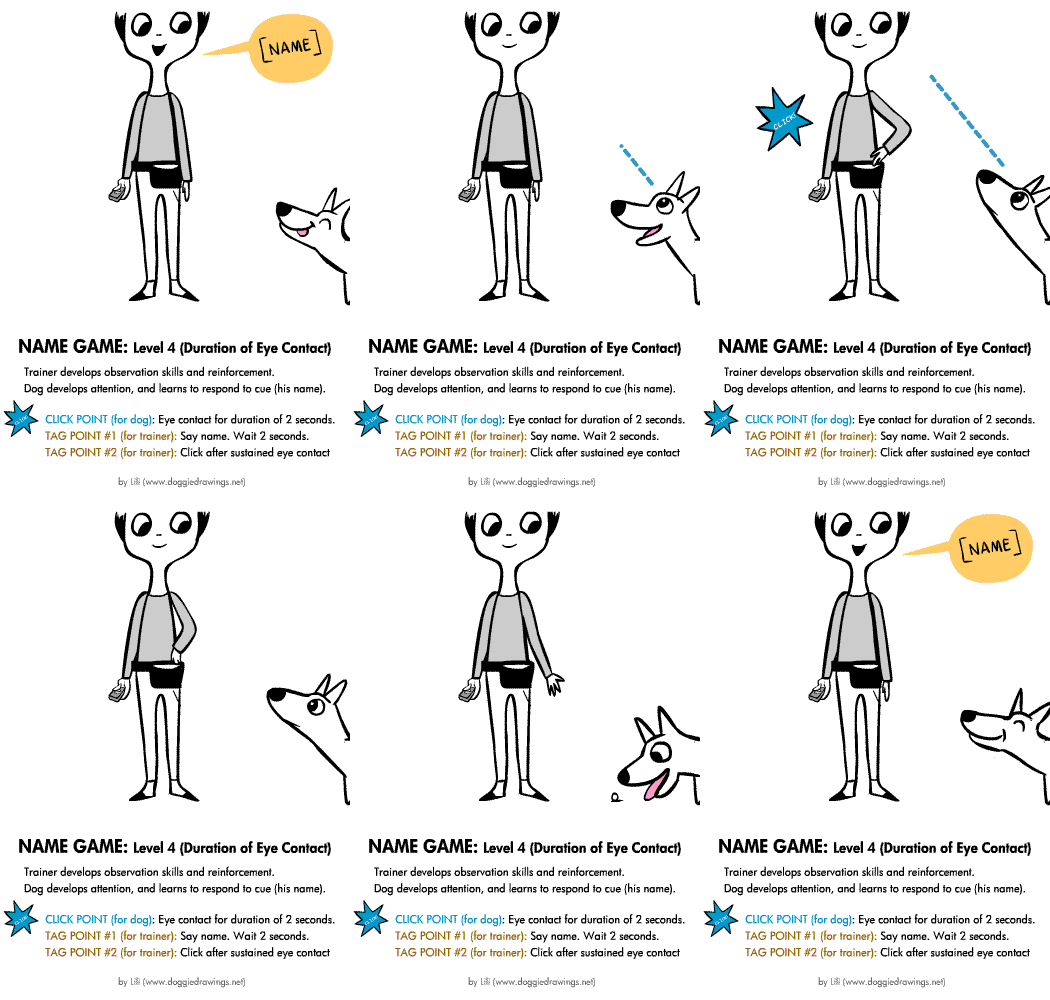
*Similar clicker lessons can already be found via dog training blogs/sites, YouTube videos and books, so I have decided to do something different and present these as animated drawings. Note: these are my own interpretations of the Cyberdog Online lessons. The animations are not part of the course.
Name Game lesson (Level 4).
… and Wait At Boundary ( Level 1).
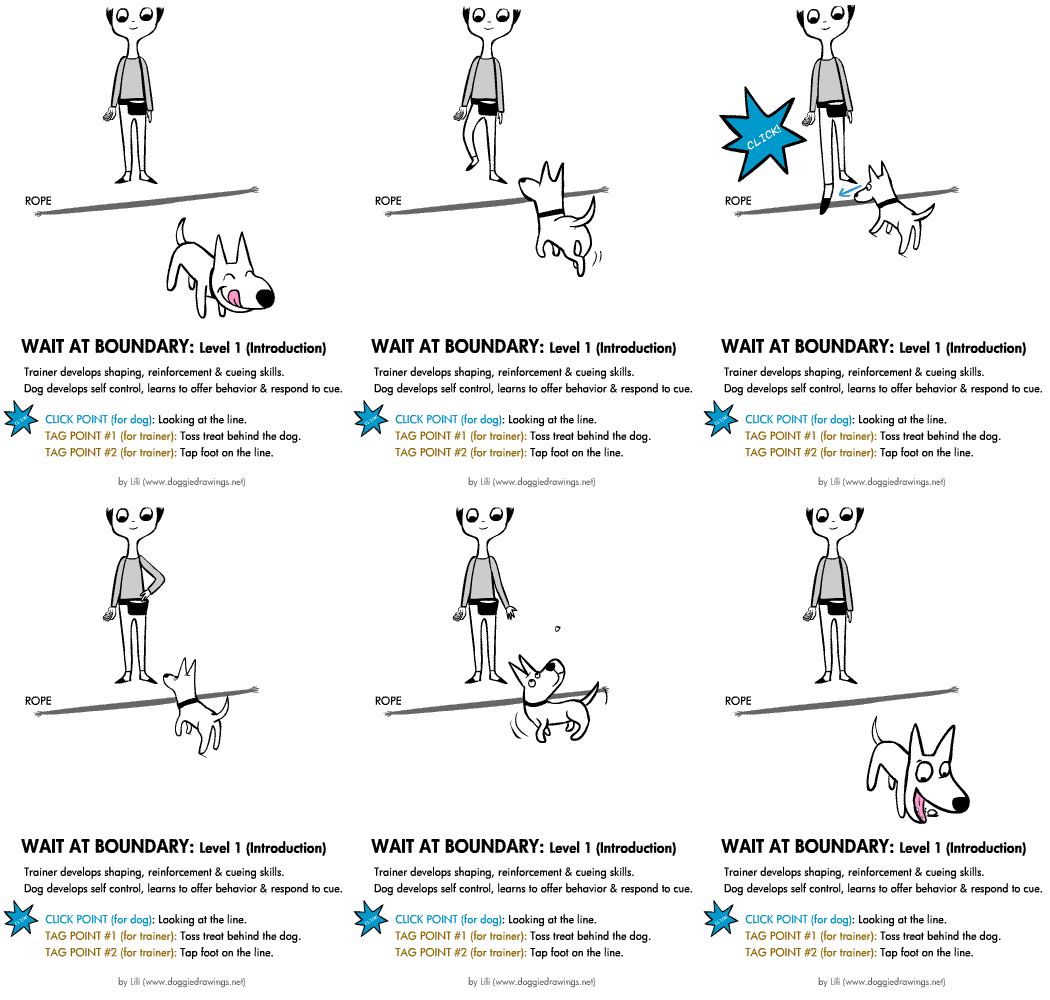
In Level 2 of the BOUNDARY lesson (my homework for this week), my new Tag Point is to stop tapping the line and click when Boogie slows down/shows hesitation before he approaches the line. Eventually a verbal cue (eg, “Wait”) will be added. I am hoping that this cue when learned, will have Boogie waiting politely when someone comes to the door….
That’s it for now! This Cyberdog Online course is still in beta-testing phase, so I can’t give too much away. 🙂
Currently reading: How Dogs Learn by John S. Bailey, which is fascinating.

*UPDATE* – The Cyberdog Online course is now up and running! http://cyberdogonline.com/
Boogie, the celeb!
Check this out, Boogie and I are on Dog Milk! This is a very cool design-related website that always makes me want to spend money. 🙂
Here is the link to the article/interview: http://dog-milk.com/the-scoop-lili-and-boogie

Furthermore, we (and Boogie’s blog) have also been mentioned in Australian magazine A Dog’s Life.
Here is one of the scanned pages.
In other news, I haven’t made doggie ice cream yet and am reconsidering the BACON idea. I gave Boogie bacon as treats for a few days – he loved these of course but the tummy troubles and soft poo were not so good. 😦
Trainer vs Trainer – pilot episode
Wow.
In the first 2 minutes, I already guessed who the winner would be … and I was right! 🙂
One thing that isn’t clear is how much time the trainers have off-screen to work with each dog. I would totally watch a series like this … though, I would want to see more of the training process and relationship between the trainers and dogs, and not only the results at the time of judging.
How funny that dog training has become a sort of competitive sport. In some ways I think it’s a great idea to broadcast different trainers and different techniques to break the monopoly that The Dog Whisperer show has on what people believe about dog behavior.
P.S. I don’t have access to Animal Planet unfortunately, but I’m a Shorty Rossi fan!
National Dog Bite Prevention Week
May 15th – 22nd is my birthday week! It also happens to be National Dog Bite Prevention Week!

Just look at this soft sweet face of my pumpkin-headed boston terrier. Hard to believe that he is hypersensitive to so many things and “aggressive”.
I think about Dog Bite Prevention every single day. It’s a drag, but that’s how it is. Boogie had a bite history even before I adopted him which is why his previous humans put him in a shelter. I didn’t let this knowledge stop me from adopting him because at the time I had no idea what it meant to have a dog that bites. I naively thought at the time that “dog training” would be as easy as it looked on The Dog Whisperer Show, and I had no idea I had SO MUCH to learn about dogs…. and about all the stuff that people (unconsciously) do to upset dogs.
Sharing here some new drawings and links.
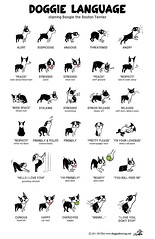
1. a new illustration of dog body language showing stressed/distancing signals as well as happy/friendly ones. My references: Turid Rugaas, Brenda Aloff and Boogie. Links to download or purchase are HERE.

click on image to see larger sizes
2. Sneak peek at Grisha Stewart’s book on BAT (Behavior Adjustment Training) which will be out this summer and available from www.doggiezen.com/bat I am dying to share some of these illustrations but we’ll all have to wait for the book! 🙂

3. Madeline Gabriel’s blog: Dogs and Babies is awesome.

Read this blog entry: Ask The Dog (Part 1)
There is also a post on how little children become magnetized by dogs… and how to nip this behavior in the bud for everyone’s safety, and more importantly so that kids learn respect for others’ personal space. Here is the first in a series of articles .
Here are Part 2, Part 3, Part 4.
For example, when your child crawls in the general direction of your dog, stop and point out the dog. “Look, our dog is resting. When our dog is lying down, we move around. Let’s move around the dog.” Show your child by example what you mean by “around.” Aim for at least a three foot buffer to allow room if the child were to fall or the dog stretch out a leg or roll over.
Tell your child, “You did it! You walked around our dog. She feels safe when you walk around. You are a good friend to dogs!”
4. Liam J. Perk Foundation: Why Dogs Bite and How They Warn Us
“This is a classic example of inter-species miscommunciation. The reporter was showing affection for the dog by leaning in and putting both hands on the dog’s neck. The dog did not interpret this as a friendly gesture, but rather saw it as a threat and acted accordingly.” (via )
Also:
Never punish your dog for growling. This may seem counter-intuitive and may even go against the advice of your dog trainer or dog trainers you have seen on TV. If your dog growls at your child he is sending a clear warning that he is very uncomfortable with the actions or proximity of the child. Be grateful that your dog chose to warn with a growl rather than going straight to a bite. If you punish the growling, you may inhibit the warning growl the next time and the dog may bite without growling first. Punishment or scolding will not make the dog feel better about the child, in fact he may even feel more anxious and be even more likely to bite in the future, especially if you are not there to control the situation. If your child cannot follow directions and/or has got into the habit of being rough with the dog, then the dog and child should be separated until the child has learned to treat the dog with kindness and respect.
5. Dr. Sophia Yin has an excellent article on Dog Bite Prevention
Dave Dickenson, interim director of the Sacramento County Animal Care and Regulation: ” One problem is that we’ve been told many times that you should greet a dog by letting him sniff you hand, but in reality, the best way to greet is to stay outside of the dog’s personal bubble and let the dog approach you at his own rate.”

I did the illustrations for this poster which can be downloaded here.
I also animated this video –
* Please share! 🙂
6. I like this tweet via @Fearfuldogs:
If a dog doesn’t hurt a person or other dog when it bites, chances are this was a choice not luck.
Podcast with Irith Bloom on “Stressed Dogs”
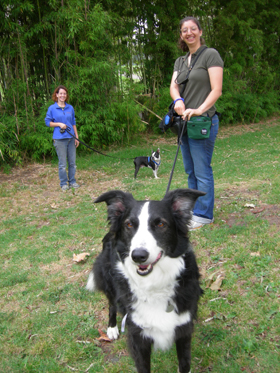
Sarah and Irith
This photo was taken from last year when we did a session with Irith Bloom (The Sophisticated Dog) and her English Shepherd, Franklin. I think Franklin is the ONLY big dog that Boogie gets along with and doesn’t react to. Boogie and Franklin had a nice parallel walking session together a few months ago.
Podcast HERE on Dog Lovers Digest
Chat transcript here. (also with Sarah, Boogie’s trainer)
Video by Irith:
Becoming the Cookie, Becoming the Moose, and Boogie’s prey drive…
I just did something quite impulsive.I signed myself up for Susan Garrett’s “5 minute recall formula” online training course and it ain’t cheap. (hmm… what can I sell on ebay? Who wants a doggie drawing?)

I have been seeing link recommendations to this web course on many dog trainers’ blogs and facebook pages and after watching a few intro webinar videos, something hit a nerve. I think it was the term “prey instinct” or “prey drive”. I keep coming across this term on the web, on dog behavior forums, websites, blogs etc. and the more I read about working with “drives” and “building arousal”, the more I realize that:
- Boogie has a super intense prey drive (eg, tennis balls, squirrels, birds, cats etc. in motion)
- I haven’t a clue what to do when Boogie is distracted or in prey drive mode. I no longer exist for him. The only way I can get his attention is by picking him up off the ground.
- Premack works for when he is still under threshold, but not so much for when he is already over threshold /aroused/magnetized by his target object.
- Boogie doesn’t chase. He stalks very very slowly. Then suddenly pounces or sits and waits. At which point the squirrel is already way up that tree. This is why I believe that he will never catch the squirrel and may live out the rest of his days in frustration….
- Boogie NEVER chases me when we are playing with his toys. He makes me chase HIM. And I stupidly follow every time, so this behavior of “making Mom follow me” is super reinforced.
- Food rewards and tug games help – he runs after me, but then he immediately runs off after eating or winning the toy.
- If training with a dog’s “prey drive” requires that I encourage and reward my dog to CHASE ME and fixate on me, then yep, I have a lot to learn….
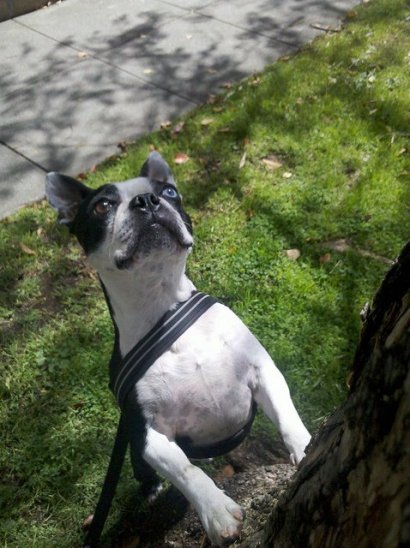
Metaphors in dog training are kinda amusing. Susan Garrett’s course is about identifying your dog’s “cookies” (= rewards that are food, toys and activities), and “Becoming The Cookie”. ie, becoming the master of all reinforcements for your dog so that when you call him, wherever he is, whatever he is doing or interested in, he will turn away and he will RUN TO YOU. LIKE THE WIND.
Elsewhere on the web I came across another model of dog training that I hadn’t heard of before. It’s called Natural Dog Training and of all the web articles and authors that I have read on the subject, Neil Sattin’s website is the easiest to follow. Based on what I have read so far, the Natural Dog Training philosophy doesn’t involve any physical punishment but is somewhat dismissive of Operant Conditioning. In Susan Garrett’s webinar, she also mentioned the limits of using only Operant Conditioning because “drive states are not considered or manipulated”.
(Here’s one article that says NDT is more Freud than Skinner)
According to Neil Sattin, we should “Become the Moose”. Yep, Moose! Not Squirrel, not Cookie, but a big ol’ Moose which is NDT’s chosen metaphor for a dog’s highest-value prey object.
It may sound like a masochistic death-wish (yeah I want my dog to hunt and kill me?) but it isn’t. The Moose is supposedly big, calm, powerful and always attractive to the dog. The Moose as uber-prey is the thing that activates a dog’s hunting drive and creates social bonding between a bunch of dogs who otherwise would not be interested in bonding. In NDT, they see resolution of a dog’s innate hunting drive/prey instinct or the release of energy/stress as being more relevant to learning than food rewards.
The stress release focus reminds me of BAT because in BAT, eliminating stress IS the reward. (-R) We want to do everything in our power to keep our dog under-threshold and un-stressed in the first place. The focus is on teaching and reinforcing good choices and self-calming signals in our dog so that ultimately our dog learns how not to stress out when some scary person or dog appears.
In NDT, the goal is the same (a calm unstressed dog) but I see no mention of calming signals… The focus is on encouraging the dog to act out their “natural prey drive” through healthier outlets so that it doesn’t turn into stress/aggression/reactivity towards other dogs and people etc.
They highly recommend letting your dog’s energy express itself in games of tug and ALWAYS letting your dog win (!?!) Or playing chase where you ALWAYS have your dog chase you instead of vice versa because the human is supposed to be the prey aka Moose. (Ah! In the intro webinars, Susan Garrett says the same thing about having your dog chase you and rewarding him with play play play)
I think the logic in all this is that if I teach my dog to assert himself with/through ME when he is all revved up, then I can still hold his attention and focus even when he is all revved up… I totally fail at this with Boogie.
There is a NDT exercise called “Pushing” which involves pushing and feeding your dog at the same time to get him simultaneously “aroused” and “relaxed”. The dog is encouraged to “push back” for his reward. More here – Dogwise forum: Has Anyone Heard of The Pushing Exercise? (it’s a very long discussion between Neil Sattin & +R trainers, I haven’t read it all yet)
The first exercise in the Recall Course involves collar-grabbing & feeding at the same time and Susan Garrett explains this as a Classical Conditioning exercise. Action games of tug and chase are also encouraged to break up the exercise and to keep the dog’s arousal level high. *This is hard… Boogie backs away when I touch his collar.
Two schools of training with different behavior theories but similar exercises …
Now if I can only get Boogie to chase me. When I run off with his toy and call him, he stops and stares at me as if to say “I’ll wait here until you throw it or bring it back”.


 Boogie's blog