Posts filed under ‘Books & DVDs’
DVD: The Language of Dogs
I got around to watching this 2-disc DVD today and it was very interesting.
Sarah Kalnajs is a behaviorist who does temperament testing on shelter dogs to figure out what the dog’s “behavior problem” is (assuming that this is why the dog was surrendered) so that the shelter can decide on whether the dog is adoptable, and by whom.
To be honest, it was quite stressful to watch because there is a lot of footage of dogs displaying anxious behavior.
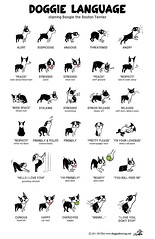
The first part of this documentary is about dog communication and body language and there are many examples displayed by a variety of breeds. The signals are divided into the following categories:
- Signals of Stress
- Calming Signals or Appeasement/Non-Aggressive Signals
- Distance Increasing Signals (which could lead to aggression)
- Distance Decreasing Signals (inviting interaction, friendly)
- Displacement Behaviors – some behaviors that dogs do when they are unsure what they should be doing
- Ritualized patterns of behavior that are odd… eg, if the dog has been trained this way, or socially inept, or abused, or has OCD…
Sarah K makes it clear that we have to look at these signals in context rather than in isolation… We should look at the whole body and what else is happening.
Stress signals aren’t necessarily a bad thing or a cause for alarm. But it is important that we notice them because they are usually triggered by something that we (or the environment) are doing to the dog that may be invasive.
Some notes:
– Slow movement or lack of behavior IS a behavior. A dog may not move much; he may not appear scary or stiff, but if he doesn’t offer any behaviors, and shows little or no movement or interest in food or whatever we are doing, this can be interpreted as a stress signal.
– A wagging tail, contrary to what we have been taught as kids, DOES NOT mean that the dog is friendly and wants to be petted. If the tail is high up and wagging fast, this signals “arousal” and could in fact lead to aggression.The only time that it is safe to pet a dog is if his tail swishes around in slow big circles like a “windmill”. Not that this applies to Boogie, who doesn’t even have a tail.
– Distance Increasing signals (eg, hard eyes, ears forward, heightened posture, tail up, excessive barking etc.) = “Back off”.
– Distance Decreasing signals (eg, playbow, easy windmill tail, tongue flicking, relaxed posture, submissive grin, soft eyes, rollover etc.) – we should NEVER punish these signals or the dog might stop offering them. Sarah Kalnajs also says that we should also never punish a “growl” because the dog will then skip the growl and go straight for the bite. (We think that in a previous life, Boogie used to be punished for growling/barking, which is why he is a “silent biter”)
– When a dog lies down and shows his belly, this does not always mean = “Pet me” (or friendliness)
She distinguishes between the “Rollover” and the “Tap Out”. The former is when a dog’s whole body is relaxed and/or wiggly and he wants a belly rub. But if a dog lies down and shows other signs of stress, and then gets back up again after you retreat, this is a submissive “tap out”. He does not want to be touched.
The later part of the DVD shows behavior sequences when shelter dogs are being assessed. In most cases, Sarah K performs certain actions to elicit the problem behaviors (eg, touching the dog’s body or food with a fake arm-on-a-stick)… and offers explanations of what is going on. Some dogs appear totally friendly, then turn suddenly and bite!!! (HELLO, Boogie!) Sometimes the warning signals are really subtle; sometimes they only come out when food is present or when a person does something to freak the dog out, eg, touch his tail.
It is sad to know that some of these dogs will be euthanized if they don’t pass the temperament test… like one puppy that showed subtle signs of aggressive behavior that she believed would get worse in adulthood. I don’t understand why this puppy was considered untrainable.
There are also heartwarming examples of dogs who improve after spending time in a foster home with TLC (away from the stress of the shelter) and become place-able in forever homes, which reaffirms for me why rescue and fostering is so important.
Turid Rugaas DVD
 I have just watched this DVD by Turid Rugaas the dog expert & author of the book by the same title, and I am totally baffled that this information is not more publicly available.
I am also amazed that a show like The Dog Whisperer which carries on and on about “calm submission” does not have anything to say about Calming Signals and how dogs use these to communicate their need for calmness and conflict resolution.
I learned so much from this DVD and it’s only 48 minutes long. In fact it answered several questions about Boogie’s behaviors that have been festering in my brain.
Here are some things I learned:
– Dogs are born with these calming signals. They are part of a dog’s natural makeup and heritage. Puppies know this stuff and as they mature they get better at it, if they are allowed to socialize frequently with other puppies and people.
– Dogs live in packs so *conflict resolution* is a highly important part of their natural behavior repertoire. Conflict resolution is more important that obedience. An example: If your dog is at the dog park surrounded by dogs and you call him to you and he doesn’t come straight away, acknowledge that he has to *peace-out* with the other dogs before he comes to you. This is polite social behavior.
– When a dog is wagging his tail, this doesn’t necessarily mean he is happy. A wagging tail = arousal and excitement.
– There are two types of Playbow. There is the playbow when the dog wants to play and he will jump from side to side in this position. Then there is the playbow when a dog jumps backwards and wanders off like he is not really interested in playing. In this case, he is doing the Playbow as a calming signal to the other dogs to let them know that he is friendly. Boogie does this all the time!!! Check out my earlier blog post and video.
– When dogs mark, there are several reasons –
1. He could be marking his territory
2. He could be stressed about something
3. He could be using this as a calming signal to another dog/person.
4. If two or more dogs are marking something together, this is “being social” together.
Did you all know this stuff about marking? I certainly didn’t. I always wondered why sometimes when Boogie sees another (friendly) dog the first thing he does is go mark a tree. He seems to mark more often when there are more dogs around. I always wondered if he was being “dominant” and showing the other dog who’s boss, but now it’s good to know that this could be a response to stress or a conflict-resolution behavior.
Turid also says that if we are walking our dog and if a stranger approaches and our dog goes off to one side to sniff or mark, we should let him do it. (According to BAT, this is a “functional reward”. I let Boogie do this anyway, and I also praise him because it is a friendly alternative to lunging)
– Because dogs don’t like conflict, sometimes when two dogs play too rough or get too close, a third dog will run in and split them apart. According to Turid, the dog who is splitting up the action is not “jealous” or trying to be party-pooper. He is doing his part to prevent potential conflict. He will barge in from either the side or the back, not front on. The splitting-up behavior is a calming signal to the other dogs.
– Another calming signal is to walk in a curve around another dog/person. This is a social skill that we can help our dogs develop by leading them (on-leash) in a wide curve around the other dog/person. The more stressed or agitated our dog, the wider the arc and the further the distance, and as he shows signs of being more comfortable we can make the distance smaller, but still in a curve, because in the dog world this is polite behavior and we want to reinforce it.
– Turid points out that most people greet dogs the wrong way and this is so true. Most people lean over a dog and pet him on the head or stick their hand in front of his face. To dogs, this is stressful stuff and the dog may then turn his back on you, lick his lips, turn his head away or walk away past you (as calming signals). Or in the case of Boogie, he will cower or bite you. The correct way to greet a dog is to give him your BACK or your SIDE and pet him on the side of his face or body. This communicates to the dog that you are no threat.
– As we learn to read a dog’s signals we can change our behavior. If we see that a dog is stressed, we can make the choice to change our position, turn our heads or turn our bodies around to make the dog more comfortable.
This information is so valuable! Thank you to Sarah for lending me this DVD.
P.S. The DVD is much better than the book because you get to see dogs moving and interacting. Just try to ignore the cheezy muzak soundtrack 🙂
Related link: Turid Rugaas website
“Behavior Adjustment Training” DVD
I will write more about this later but want to mention a very interesting, awesome DVD that I ordered recently.
It’s a seminar on BAT – “Behavior Adjustment Training” given by Grisha Stewart, the dog trainer who answered my question on this Dogster Good Dog Blog last year.

In a nutshell, this is a training system that focuses on reducing fear and aggression and reinforcing friendly behaviors so that dogs learn to control their needs using socially-acceptable behaviors (no barking/biting) and gain self-confidence in the process.
Doesn’t this sound PERFECT for Boogie?
The process takes a lot of time, patience, and “set-ups” and we would need professional help to try this, but anyhow, I still learned a lot about dog behavior and psychology from this DVD, which helps ME not to stress-out.
What sounds great about this training is that the main reward is not food, but giving the dog what he really wants, which is DISTANCE or INFORMATION to feel safe.
There are lots of details to take into account – timing, proximity, body language – most importantly, keeping the dog “under threshold” (stress-free) in order for the learning to be effective. When a dog is “over-threshold” ie, has emotionally-crossed over into that reactive uncontrollable-growly-lungey-zone when his owners no longer exist – oh yes, we know this one well – it is too late.
Unfortunately in life, shit happens when sometimes dogs and strange people appear out of nowhere …
Regardless, I love having more knowledge about what’s going on. When I feel more attuned to Boogie’s body signals and CAN communicate with him, this makes me so happy and gives me hope.
–> Many examples on Boogie’s Walk Log!
Here is the info on BAT and below is a YouTube clip with an excerpt from the DVD:
*Update: Here is a simpler explanation of BAT
There is also a BAT/Functional Rewards Yahoo Group where dog trainers and dog owners do Q&As and discuss their experiences.
Just read:
Sophia Yin: How to Behave So Your Dog Behaves <- loved it!
Next on my reading list:
Leslie McDevitt: Control Unleashed <- highly recommended by lots of dog trainers!
Reading CLICK TO CALM: Healing the Aggressive Dog
 I finished Ali Brown’s “Scaredy Dog”. I was going to continue with my book summary on this blog but to be honest, I found the information in the later chapters too complex to take notes for . There are lots of detailed exercises that require the repetitive and patient participation of other people and their balanced dogs – which would be a LOT of work to set up. Also, these are scenarios that Boogie and I are way NOT ready for.
Just this morning, Boogie was calmly sniffing the grass outside. The minute that he looked up and saw an old man pass by in front of us, he LUNGED up at the man. It was so fast and so extreme. It was a good thing that I had him on a short leash as I always do and he couldn’t reach the man (who didn’t even notice).
I corrected Boogie. It was instinctual. Made him sit. Stay. When he was calm and looking at me, I said “Good Boy” and gave him a treat. This was probably not what I should have done according to the book, but the thing is… everything happened so fast. I did not have time to think nor had I predicted that he would lunge at THIS man… or I would’ve led him away before the man came close.
There is no predicting WHO Boogie will lunge at, and this is pretty stressful when we walk in areas where there are lots of people.
Old people who walk slowly, hunched over (same gait as most homeless people) are a common target. The lunges are more extreme when they happen from a standing or sitting position. Which is why I do my best to keep Boogie walking, in HEEL position, focused on me.
According to most dog training literature including Cesar Millan, dogs pick up on our tension. So if we are tense or uncertain, dogs pick up on this energy and act accordingly. If I tighten the leash, I am transferring MY stress to my dog. Check out this awesome slo-mo video with leash-tightening –
Cesar Millan and dog trainers say that we should remain CALM at all times. Or act HAPPY, as this book advises. Cesar Millan also said that if we pretend to be calm or happy on the surface, our dog would know that we are pretending… and that we are not really calm on the inside.
All this makes sense in theory but in reality, we can’t all be calm all the time. And certainly NOT when our dog is behaving like a sociopath. I don’t meditate everyday, I don’t “zen out” in the instant that a strange person or dog appears. On the contrary, I go into “Alert and Control” mode.
I have started reading Emma Parson’s “Click To Calm: Healing the Aggressive Dog”.
I am only just into chapter one and already I feel that this is going to be a goodie because I like the way she writes. Very down-to-earth. Already I sense more realistic and practical information in this book than in all the others that I have read so far on Dog Behavior and Training. Like Karen Pryor and Ali Brown, Emma Parsons belongs to the “Positive/Clicker-training” camp…
Clicker Training puts the focus on what the animal is doing right instead of what the animal is doing wrong…
You can mark or capture behavior that will be gone in an instant. Only the clicker gives you the ability to pinpoint a millisecond of calm behavior in a stream of aggressive behavior….
The clicker’s clarity soon comes to signify confidence to a dog, regardless of whether the handler feels confident or not. Clicker-Training your dog tells him that you are in total control of the situation, even when you don’t feel in control at all.
Like other Positive/Clicker Trainers, she is anti-punishment.
The most serious danger with punishment, however, is that it very often feels good to the punisher. Punishment is reinforcing to the punisher. It mistakenly leads us to believe that we have “fixed” the behavior. The next time we will be tempted to punish harder and faster.
I don’t like the Sprenger collar, but until I can learn new methods of working with Boogie to prevent leash-pulling and aggressive behavior, this is our “quick fix”.
Will continue reading this book and report back with further thoughts!
Tips for working with a reactive dog. (Part 1)
 Following on from my previous blog post, I am now up to the part in Ali Brown’s book “Scaredy Dog!” where there is some immensely interesting and possibly helpful information! I am going to take notes here on this blog so that Boogie’s dad and extended family (and Boogie’s blog readers) can have access to this info. Here are some tips:
1. STUFF-A-DOG
The purpose of this exercise – which is to be carried out repeatedly many many times in different locations at different times of the day for many many days – is to associate GOOD THINGS with your dog’s name. The idea is to teach Boogie that when we call his name “Boogie” this is always a positive thing.
What we do is hand-feed treats to our dog and when he is chewing on the treat we say his name. Yeah, we stuff his face with treats and while he is relishing the yumminess of the food in his mouth, we say his name over and over. We should vary the intonation of our voice… sometimes use a happy tone of voice, a sad tone, an angry tone, loud, quiet, silly… we vary the tones as much as we can so that regardless of what tone of voice we say his name with, it will always have a positive vibe.
Here is the tricky part. In order for Stuff-A-Dog to work to “build the power of our dog’s name”, we have to refrain from using his name in casual conversation when we are talking about him in his presence. We should only use his name when we are talking TO him. In fact, to make things easier for us humans, Ali Brown suggests that we either pick a “nickname” to use when feeding him treats and always use this same nickname… OR… when we are talking about him while he is present, we refer to him with a code word or say “the dog” instead. If we mistakenly say “Boogie” while not addressing him, and if Boogie turns to look at us, we should immediately smile and praise him.
Man, this one is going to be a challenge because we talk about Boogie ALL THE FRIGGIN’ TIME while he is in the same room hearing “Blah blah blah blah Boogie…. blah blah … Boogie… Blah blah blah…” This explains why Boogie rarely comes to us when we call him!!!!
“The goal of Stuff-A-Dog” is not just for you to get your dog’s attention but to classically condition your dog to come to you when he hears his name. You really want this response to be a knee-jerk response..”
We are to do this repeatedly in the house, on walks, in the car, EVERYWHERE. When we have reached 5000 Stuff-A-Dogs over a 6-8 week period (!!!) we can do fewer repetitions.
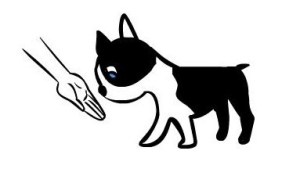 2. HAND-TARGETING
I am pleasantly surprised that she brings up this training activity because Boogie and I are already doing this! 🙂 See my blog post on Clicker Training Boogie.
Ali Brown suggests doing hand-targeting as often as possible in different locations and we should aim for an 80% success rate. Any more than 80% means our dog will get bored. You want to keep it mildly challenging and stimulating. If he doesn’t respond to the “Touch” (or “here”) cue, give him up to 30 seconds to figure it out. Wait. If he still doesn’t respond, take him back to the last location where he responded. The goal is to do this in increasingly distracting environments (eg, add TV, add music, add people etc) so that eventually when he is out on the street with “scary stuff” around him he will still respond.
“The more distracting the environment, the more exciting the praise and reward must be.” This could be a tennis ball not necessarily treats.
3. PAYING ATTENTION. USING THE CAR AS A TRAINING TOOL
To reinforce our dog’s focus on US, we want our dog to pay attention to us the moment he steps out of a car (or house), instead of pulling forward and away from us. We need to teach our dog to “Wait” at the door. Actually, Boogie is pretty good at this one; when we tell him to Sit and Stay, he does. Or most of the time I say “Heel” and he steps backwards from the door and lets me go out first. Ali Brown suggests adding a treat for reinforcement. When we say “OK” (or “let’s go”) then this is the cue to jump out of the car or walk out of the house.
The moment that he is out of the car (or house), we say his name in a loud and happy tone. The moment he LOOKS AT US – click and treat! Then reinforce a few hand-targets and other cues.
Here’s something interesting. The next step is to put our dog BACK IN THE CAR (or house) and do some reinforcement cues again with lots of treats.
Then repeat the process. Lead our dog out of the car/house and call his name. Click and treat when he looks at us. Do some hand-targets. However… If he doesn’t look at us within 10 seconds (this is the goal), he goes back into the car/house and we WALK AWAY from the car/house. If the dog cries or barks (which I am pretty sure that Boogie will do), wait for calm and quiet for a minimum of five seconds before going back to the car/house.
Repeat the exercise a few times and aim for a 80% success rate. This training could take weeks or months to get down pat.
“The critical aspect to this exercise is that your dog learns that the expected behavior when coming out of the car is to look at you. In this manner, there is limited opportunity for your dog to look around and find things that are scary. It seems as if some of our reactive dogs are anxious enough to look around and find things to which to react.”
The goal is to teach our dog to stay calm and check back with us, to look at us and do what we ask.
“Even if he finds something that is nerve-wracking, he is much more likely to be able to disengage from looking at it and return his gaze to you”.
4. WHAT TO DO WHEN WE SEE A DOG ON THE STREET…
What Ali Brown refers to as the “oh shit” moment!!! OH YES, we know this one very well.
This is the moment that we can make a change. As soon as we see the person and dog, if we tense up, our dog will pick up on this. (Yes, Cesar Millan makes this point very clear. Dogs pick up on our energy).
What we need to do is ACT HAPPY THAT WE SEE THE OTHER PERSON AND DOG. We walk our dog 90 degree angle off path and keep walking and talking and praising our dog for coming with us and treating him all the way. After some distance we ask him to sit…. praise and treat him or play with him, as the other dog passes by. A few minutes after the dog passes we continue along our way. *I have sort of been doing this with Boogie… except that I probably don’t act HAPPY very convincingly 🙂
The idea here is to desensitize our dog to the presence of other dogs and to show him that nothing bad is happening to him. When a scary dog approaches, we are communicating to our dog that we are not going to allow that other bad dog to scare him or to get too close to him. We want our dog to internalize that it is a GOOD THING when another dog appears (treats, happy voice, praise, human is in charge etc) Of course, it could take a long time for him to learn to feel safe… after many many repeated experiences. After weeks and months.
If our dog reacts poorly (growls, lunges etc) as we walk away from the other dog, Ali Brown says to keep walking and continue to act HAPPY… keep going until our dog stops looking at the other dog. Then call his name and get his attention and click and treat profusely. Eventually our dog will TRUST us to protect him and to make decisions for him. He will learn that nothing bad is going to happen when there’s another dog around. Over time, the “safe/non-reactive” distance between our dog and the other dog will become smaller and smaller.

Bootcampers. Me & The Boogs at a "safe distance" away on the left.
(I noticed this change with Boogie at Bootcamp classes with other people and their dogs. Boogie became more tolerant of smaller distances between him and other dogs…. that is, so long as they don’t bark or look at him.)
When we eventually get to the point when Boogie is calm and shows signs of wanting to go and check out the other dog’s butt (this could be weeks or months later… we need to learn to read his body signals), and if we know that the other dog is calm and friendly, then we can allow him to “go sniff” BUT… we should count to three and then we should call Boogie away and back to us. Small steps at a time.
Or if we see tense body language in Boogie (hackles up, hard stare) then we should call him away immediately. No butt-sniffing allowed. It is important for our dog to feel safe near the other dog before he is allowed to move onto the next step. And over time we will be able to read Boogie and know how he feels about the other dog to know what is the best move to make.
This is as far as I’ve got in the book. TO BE CONTINUED….
Here is a blog post that I wrote a year ago when Boogie first started lunging. In this post I wrote about some doggie interactions that started badly but turned out positively. At the time I had no understanding of what was really going on but now things are so much clearer, thanks to this book.


 Boogie's blog